
Geopolitical Risk Mitigation in European Equities: The DAX as a Barometer for Ukraine Peace Hopes
The DAX index, Germany's benchmark equity gauge, has emerged as a critical barometer for investor sentiment regarding geopolitical risks, particularly those tied to the protracted Russia-Ukraine conflict. In 2025, the index has oscillated between optimism and caution, reflecting the dual forces of peace prospects and persistent global instability. Recent data underscores this duality: the DAX closed near record highs at 24,359.30 in late August 2025, driven by hopes for a trilateral peace deal between U.S. President Donald Trump, Ukrainian President Volodymyr Zelenskyy, and Russian President Vladimir Putin, according to an FxLeaders forecast. However, a four-day losing streak in early October 2025-marked by a 0.29% decline-highlighted lingering vulnerabilities, including U.S. tariff fears and renewed cyberattacks on European infrastructure, as noted in an ESMA press release.
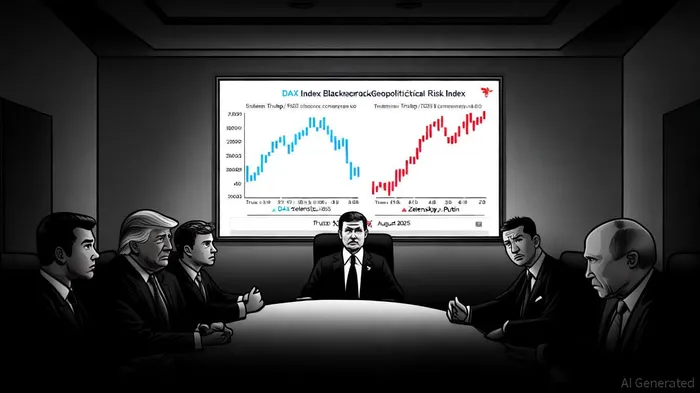
The DAX and Geopolitical Risk: A Symbiotic Relationship
The DAX's performance is inextricably linked to geopolitical risk indicators. According to the BlackRockBLK-- Geopolitical Risk Dashboard, national security concerns and hybrid threats (e.g., cyberattacks on energy systems) have become central to market dynamics, as ESMA has observed. The Russia-Ukraine war, ranked as the top global risk in the 2025 World Economic Forum report, has reshaped Europe's economic and security landscape. For instance, the DAX's rebound in August 2025 coincided with a 20% drop in the BGRI, reflecting reduced risk premiums after Trump's meeting with Putin, per the FxLeaders analysis. Conversely, the October 2025 selloff mirrored a 15% spike in the GPR Index by Caldara and Iacoviello, which tracks geopolitical tensions through media analysis.
This interplay underscores the DAX's role as a real-time indicator of geopolitical optimism or pessimism. As stated by the European Securities and Markets Authority (ESMA), equity markets in 2025 have experienced pronounced volatility due to "global uncertainties," with the DAX serving as a proxy for European investor confidence.
Mitigating Geopolitical Risks: Strategic Frameworks for European Equities
Investors navigating this volatile landscape must adopt a multi-pronged approach to mitigate risks while capitalizing on opportunities. Key strategies include:
Diversification and Hedging Instruments
Bonds and real assets are critical for resilience. According to JPMorgan, government bonds offer protection during growth shocks, while infrastructure and timber assets hedge against inflationary pressures from supply disruptions (as discussed in the Caldara and Iacoviello study). For example, the DAX's auto sector, which fell under pressure in October 2025 due to U.S. tariff fears (per the FxLeaders analysis), could benefit from reallocating capital to inflation-linked bonds or energy-efficient infrastructure projects.Sectoral Exposure to Resilient Industries
Historical data reveals that sectors like information technology and financials have outperformed during high geopolitical risk periods, as shown in the Caldara and Iacoviello analysis. The DAX's recent gains were partly driven by strong earnings in the tech sector, which remains less exposed to direct geopolitical shocks compared to energy or manufacturing.Options and Derivatives for Risk Mitigation
The use of put options has surged in 2025 as investors seek downside protection. As noted by Capital Group and highlighted in EBA guidance, the relative price of puts on the DAX has increased by 30% year-to-date, reflecting heightened demand for hedging strategies. This approach is particularly relevant for European equities, where liquidity strains and sharp corrections remain risks, a point ESMA has emphasized.Active Monitoring of Geopolitical Developments
Investors must prioritize real-time analysis of political shifts, such as the potential for renewed escalation in Ukraine or U.S.-China trade tensions, and incorporate scenario planning. The European Stability Mechanism (ESM) and European Banking Authority (EBA) have emphasized the need for stress-testing portfolios against cyberattack risks and commodity price shocks, as discussed in EBA materials.
Ukraine's Reconstruction: A Dual Opportunity and Risk
While the Russia-Ukraine war remains a destabilizing force, it also presents unique investment opportunities. The $524 billion Ukrainian reconstruction plan, supported by the EU's Ukraine Investment Framework, offers access to tax incentives and co-financing in sectors like renewable energy and SMEs, according to a PwC report. However, investors must balance these opportunities with caution, as the ESM warns that geopolitical risks could disrupt project timelines and liquidity (as noted in EBA materials).
Conclusion: Balancing Optimism and Prudence
The DAX's performance in 2025 illustrates the delicate balance between geopolitical optimism and economic fragility. While peace hopes have driven short-term gains, the persistence of hybrid threats and global fragmentation necessitates robust risk mitigation strategies. By leveraging diversification, hedging tools, and active monitoring, investors can navigate the uncertainties of 2025 while positioning for long-term resilience.





Comentarios
Aún no hay comentarios