
Geopolitical Risk Mitigation in Energy Markets: Crude Oil Pricing and Investment Opportunities Post-Russia-Ukraine War Resolution
The War's Current Impact on Oil Markets
The U.S. Treasury's recent sanctions on Russian oil giants Rosneft and Lukoil have already begun to disrupt Moscow's revenue streams, a critical lifeline for its war efforts. These measures, described as "significant" by the Trump administration, aim to curtail Russia's ability to profit from oil exports, thereby pressuring the regime to seek a peace deal. While the immediate effect has been a recalibration of market expectations-evidenced by a 1.5% drop in oil futures to $57.95 a barrel-longer-term outcomes remain uncertain.
Historically, geopolitical conflicts have introduced volatility into oil markets, but their lasting impact often depends on how quickly supply chains adapt. For example, the Gulf War (1990–1991) initially spiked prices but saw stabilization once hostilities ceased and supply routes were restored according to the IEA report. Similarly, the Russia-Ukraine war has triggered a "geopolitical risk premium" in oil pricing, yet markets have gradually adjusted to alternative supply routes and shifting demand patterns, limiting its long-term influence as research shows.
Projected Crude Oil Price Scenarios Post-Conflict
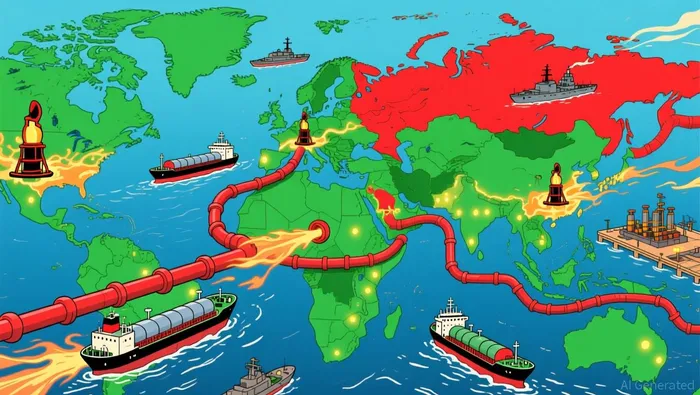 The U.S. Energy Information Administration (EIA) forecasts a decline in benchmark Brent crude prices from $81 per barrel in 2024 to $74 in 2025 and $66 in 2026. This downward trajectory is attributed to robust global production growth-particularly in North and South America-and slower demand growth, which counterbalance geopolitical risks. Notably, U.S. sanctions on Russia's oil sector, implemented after the EIA's forecast was finalized, could further reduce Russian exports and accelerate this trend.
However, the resolution of the war itself may not lead to a dramatic price drop. The market has already priced in much of the uncertainty, and OPEC+ production restraints, coupled with non-OPEC+ output growth, will likely keep prices within a narrow range. A swift end to hostilities could stabilize prices but may not trigger a sharp rebound, as the global energy transition continues to diversify supply and demand.
Investment Opportunities in a Post-Conflict Energy Landscape
The energy sector's response to geopolitical de-escalation will hinge on two key factors: the speed of market normalization and the acceleration of clean energy transitions. Here are three strategic investment areas to consider:
Renewables and Energy Efficiency
Global energy investment in 2025 is projected to reach $3.3 trillion, with $2.2 trillion allocated to renewables, nuclear, grids, and efficiency measures according to the IEA report. The EU's push for energy independence post-Ukraine war has already spurred significant investments in solar and wind energy, while the UK's North Sea Transition Deal seeks to balance fossil fuel extraction with net-zero goals as analysis indicates. Solar investment alone is expected to hit $450 billion in 2025, driven by Chinese exports to developing economies as data shows.Nuclear Energy and Grid Modernization
Nuclear energy is experiencing a resurgence, with global spending on new plants and refurbishments exceeding $70 billion in 2025. The UK's Sizewell C project, backed by £14.2 billion in public funding, exemplifies this trend. However, grid investments lag behind, with annual spending at $400 billion-far below the $1 trillion needed to support renewable integration and meet rising electricity demand as the IEA reports. Investors should prioritize grid modernization and energy storage solutions to address this critical gap.LNG and Diversified Supply Chains
The U.S. is poised to nearly double its LNG export capacity by 2028, positioning itself as a key player in a post-Russia-Ukraine energy order. However, supply chain constraints and price volatility remain risks. Meanwhile, China and India are expanding coal-fired power plants to meet domestic demand, with China approving nearly 100 GW of new capacity in 2024 according to the IEA. Investors should focus on LNG infrastructure and technologies that enhance supply chain resilience.
Conclusion
The end of the Russia-Ukraine war could bring stability to energy markets, but its impact on crude oil prices will depend on broader trends such as OPEC+ policies, renewable adoption, and geopolitical realignments. For investors, the post-conflict era presents opportunities in renewables, nuclear energy, and LNG infrastructure-sectors poised to benefit from both market normalization and the global energy transition. As always, vigilance in monitoring geopolitical developments and policy shifts will be critical to navigating this evolving landscape.







Comentarios
Aún no hay comentarios