
Geopolitical Risk and Market Resilience: The Enduring Shadow of 9/11
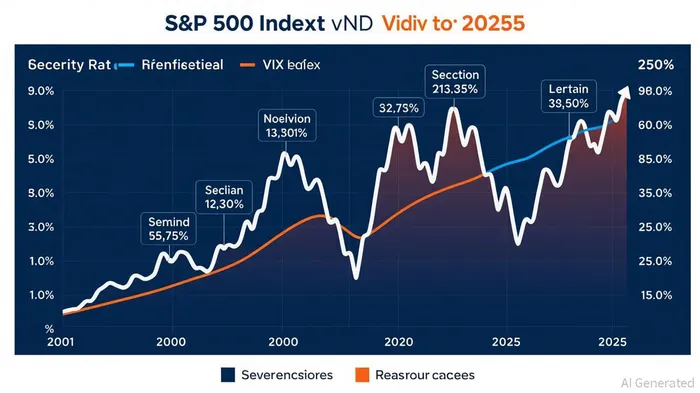
The 9/11 attacks in 2001 remain a defining moment in modern financial history, not only for their immediate economic shock but for the enduring psychological and structural shifts they triggered. As markets approach another 9/11 anniversary, investors must grapple with how memorial events and geopolitical risks continue to shape risk perception, volatility, and long-term resilience.
The Immediate Market Fallout: A Case Study in Shock
On September 11, 2001, the S&P 500 plummeted by 6.03% as trading floors closed for four days, while the VIX volatility index surged by 11.07 points, peaking at 44.94—a level not seen since the 1987 crash [2]. This acute disruption reflected not just the physical destruction but a sudden recalibration of risk. According to a report by the Cboe, the VIX's spike underscored investor flight to safety and uncertainty over global supply chains, insurance liabilities, and geopolitical stability [2].
The ripple effects extended beyond equity markets. Merger and acquisition activity, as measured by Hart-Scott-Rodino (HSR) filings, collapsed from a peak of 4,926 transactions in 2000 to just over 1,000 by 2003 [3]. This contraction highlighted how geopolitical shocks can paralyze corporate strategy, as firms prioritized liquidity preservation over growth.
Long-Term Adaptations: Risk Perception and Institutional Resilience
Over the following decades, markets and institutions adapted to the new reality of heightened geopolitical risk. The insurance sector, for instance, restructured to address terrorism-related liabilities, with firms developing specialized catastrophe bonds and reinsurance mechanisms [1]. Similarly, governments expanded subsidies for financial sectors post-9/11, a trend that intensified during the 2008 financial crisis and persists today [1].
Investor psychology also evolved. Studies show that 9/11-related discrimination and economic insecurity during the Great Recession exacerbated mental health challenges among marginalized groups, further complicating market dynamics [1]. Yet, markets demonstrated resilience: the S&P 500 recovered its 2001 losses by 2004 and entered a multi-decade bull run. This resilience, however, was not automatic. It required policy interventions, such as the Federal Reserve's rate cuts and the passage of the Patriot Act, which reshaped regulatory frameworks [1].
Memorial Events and Recurring Volatility
Anniversaries of 9/11 have continued to act as volatility triggers. In 2025, for example, escalating trade tensions coincided with the 24th anniversary, sending the S&P 500 down 7% and the VIX surging by 23.8 points to 45.3 [2]. Such events illustrate how historical trauma can resurface in market behavior, even when the original catalysts have faded.
Academic research underscores this phenomenon. A retrospective assessment of 9/11's economic effects notes that memorial events amplify investor sensitivity to geopolitical risks, particularly in sectors like defense, energy, and insurance [1]. This “memory effect” suggests that markets do not merely react to current events but layer new risks atop historical scars.
Lessons for Modern Investors
For today's investors, the 9/11 experience offers three key takeaways:
1. Volatility is Inevitable, but Predictable: Historical data shows that markets often overreact to geopolitical shocks, creating opportunities for contrarian strategies.
2. Resilience Requires Adaptation: Institutions that survived 9/11's aftermath—such as insurers and banks—did so by innovating risk-transfer tools and leveraging government support [1].
3. Psychological Factors Matter: Investor behavior is shaped by collective memory, meaning that even low-probability events can drive high-impact market moves.
Conclusion
The 9/11 attacks and their aftermath reveal a paradox: while geopolitical risks are inherently unpredictable, their market impacts follow discernible patterns. By studying how memorial events and institutional responses shape risk perception, investors can better navigate today's volatile landscape. As the Cboe's historical data shows, markets are not just resilient—they are adaptive, provided they are guided by foresight and preparedness [2].







Comentarios
Aún no hay comentarios