
Geopolitical Risk and Market Reallocation: Decoding Trump's UN Address and Its Investment Implications
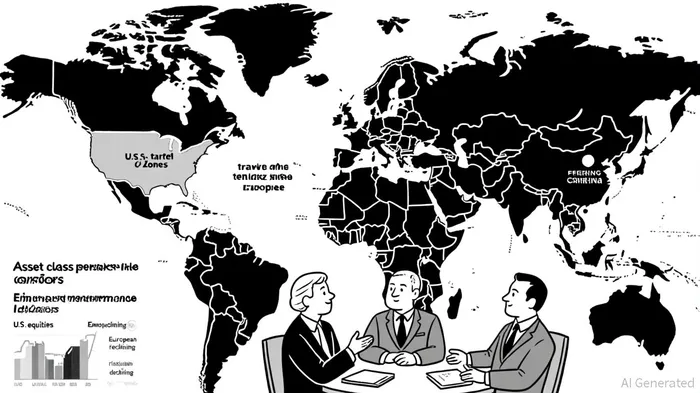
Donald Trump's 2025 United Nations General Assembly speech has crystallized a pivotal shift in U.S. foreign policy, emphasizing unilateralism, bilateral diplomacy, and a sustained critique of multilateral institutions. This recalibration, framed as a return to “America First” principles, carries profound implications for global markets. By dissecting Trump's policy signals and their historical economic precedents, investors can identify asset classes and regions poised to benefit—or suffer—from this new geopolitical paradigm.
Policy Signals and Geopolitical Reordering
Trump's address underscored a transactional approach to international relations, with a focus on renegotiating trade terms, withdrawing from global governance structures, and leveraging tariffs as a diplomatic tool. He highlighted bilateral successes, such as mediating peace between Armenia and Azerbaijan, while criticizing the U.N. and WHO as “decayed” institutions[2]. This aligns with his administration's broader strategy of reducing U.S. financial contributions to multilateral bodies, a move that weakens global cooperation on climate change, health, and security[1].
The speech also signaled a hardening stance toward China and Russia, with Trump advocating for 60% tariffs on Chinese imports and increased military pressure on adversarial states[3]. These actions, coupled with the America First Investment Policy memorandum restricting foreign direct investment from “hostile” nations, suggest a deliberate effort to insulate the U.S. economy while reshaping global supply chains[5].
Market Responses to Trump's Transactional Diplomacy
Historical data reveals a mixed legacy for Trump-era trade policies. While Section 232 and 301 tariffs aimed to protect domestic industries, they instead exacerbated supply chain disruptions and failed to reduce the U.S. trade deficit, which hit $1.2 trillion in 2024[4]. However, recent market trends indicate a renewed appetite for U.S.-centric assets. For instance, the S&P 500 has surged nearly 10% since Trump's re-election, buoyed by corporate tax cuts and deregulation[3]. Financials, in particular, have rallied as investors anticipate relaxed anti-trust policies and lower compliance costs[1].
Conversely, trade-dependent regions like Europe and Mexico face heightened volatility. The EU STOXX 600 and Mexican autos sectors have seen sharp declines following tariff announcements, with Stellantis projecting up to 12% earnings cuts under worst-case scenarios[2]. China's e-commerce platforms, such as Temu, also face exposure due to the elimination of the “de minimis” trade exemption[2].
Asset Class Positioning and Regional Opportunities
The current market environment favors assets that hedge against geopolitical uncertainty and benefit from U.S. policy tailwinds:
- U.S. Equities and Industrials: Pro-business policies, including tax incentives for semiconductors and EVs, have driven inflows into industrials and financials. The Russell 2000 and Magnificent 7 indices, despite recent volatility, remain attractive for their exposure to domestic manufacturing[3].
- Emerging Markets with Strategic Alliances: Mexico and India, while initially vulnerable to U.S. tariffs, could benefit from long-term trade realignments. Mexico's push to diversify exports beyond the U.S. and India's growing role in semiconductor manufacturing present asymmetric opportunities[2].
- Tangible Assets and Cash Reserves: With inflationary pressures from tariffs and geopolitical tensions, 82% of UK wealth managers now prioritize real estate, fine art, and classic cars as hedges[1]. Similarly, 80% of investors are holding cash to navigate market swings[1].
- Defensive Sectors: Bonds and non-U.S. developed markets are gaining traction as stabilizers, with 72% of investors each expressing interest in these asset classes[1].
Strategic Reallocations for 2025
Investors must balance the short-term volatility of Trump's policies with long-term structural shifts. Key strategies include:
- Overweight U.S. Financials and Industrials: These sectors benefit from deregulation and tax incentives, despite near-term tariff-related inflation[3].
- Underweight Trade-Exposed Regions: European and Chinese equities face elevated risk premiums due to retaliatory measures and supply chain reallocations[2].
- Diversify into Tangible Assets: Real estate, commodities, and alternative investments offer inflation protection amid geopolitical fragmentation[1].
- Maintain Liquidity: Cash reserves provide flexibility to capitalize on market dislocations, particularly in a stagflationary environment[5].
Conclusion
Trump's UN address is not merely a rhetorical exercise but a blueprint for a reordered global economy. By prioritizing bilateralism and economic nationalism, his administration risks deepening trade fragmentation but also creates openings for U.S.-centric assets and agile investors. As geopolitical risks evolve, the ability to anticipate and adapt to Trump's transactional diplomacy will define portfolio resilience in 2025 and beyond.







Comentarios
Aún no hay comentarios