
Geopolitical Risk Management in Banking: A Strategic Shift and Its Implications for Investors
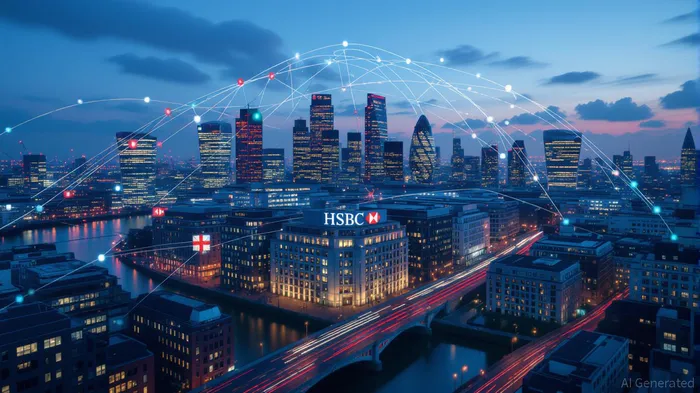
In an era defined by escalating geopolitical tensions—ranging from U.S.-China trade disputes to the unpredictable policies of a re-elected Donald Trump—banks are recalibrating their strategies to navigate a fractured world. HSBC Holdings Plc's recent decision to disband its geopolitical risk team stands out as a bold, if controversial, move. While peers like JPMorgan ChaseJPM-- and Goldman SachsGS-- are expanding their geopolitical advisory services, HSBC has opted to integrate these functions into existing departments as part of CEO Georges Elhedery's cost-cutting overhaul. This divergence raises critical questions for investors: Is HSBC's approach a prudent cost-saving measure, or a risky underinvestment in a world where political instability increasingly shapes financial outcomes?
The HSBC Dilemma: Streamlining vs. Strategic Blind Spots
HSBC's geopolitical risk team, which operated for decades, was tasked with identifying threats in volatile markets and advising both executives and clients. The team's dissolution in 2024, affecting fewer than 10 roles, is part of a broader £1.8 billion restructuring plan. Elhedery's strategy emphasizes operational efficiency, with the bank shifting focus to high-margin regions like Asia and the Middle East while scaling back in Europe. The rationale is clear: reduce overhead and redirect capital to growth areas.
Yet the timing is perplexing. Geopolitical risks are at their zenith. The U.S. and China remain locked in a trade standoff, European markets face fragmentation, and energy shocks loom. Meanwhile, JPMorganJPM-- Chase recently launched its Center for Geopolitics, and Goldman Sachs has expanded its political risk advisory services to include AI-driven analytics. These moves reflect a growing recognition that geopolitical intelligence is no longer a niche function but a core competency for global banks.
The Cost of Pruning: Short-Term Gains, Long-Term Risks
HSBC's restructuring has delivered immediate benefits. The bank's cost-income ratio has improved, and its focus on Asia—a region expected to drive 60% of global economic growth by 2030—positions it to capitalize on emerging opportunities. However, the disbandment of the geopolitical risk team introduces a potential blind spot. By absorbing these functions into existing departments, HSBC may dilute the specialized expertise required to forecast and mitigate risks in markets like China, where foreign banks face increasing scrutiny.
Consider Wells Fargo's recent suspension of travel to China after a senior executive was barred from leaving the country—a scenario that underscores the unpredictable challenges foreign banks face. HSBC's reliance on generalist teams, rather than dedicated geopolitical experts, could slow its response to such incidents, eroding client trust and competitive edge.
Competitor Strategies: A Tale of Two Approaches
JPMorgan's Center for Geopolitics, launched in May 2024, offers a stark contrast. By hiring former government officials and integrating real-time data analytics, JPMorgan has positioned itself as a go-to advisor for clients navigating the Trump administration's erratic trade policies. Similarly, Goldman Sachs' geopolitical advisory services now include scenario modeling for clients in energy and technology sectors—industries particularly vulnerable to political shifts.
These investments reflect a broader trend: banks are treating geopolitical risk as a revenue generator, not just a cost center. For clients, the value proposition is clear: access to insights that can preempt market disruptions. For banks, it's a way to differentiate in a crowded industry. HSBC's decision to downsize this function risks ceding ground to competitors who are doubling down on the very expertise it is shedding.
Investment Implications: Balancing Prudence and Resilience
For investors, HSBC's strategy presents a nuanced trade-off. On one hand, the bank's cost discipline and focus on Asia are positives. Its return on equity (ROE) has improved by 200 basis points since 2023, and its exposure to volatile European markets is shrinking. On the other hand, the geopolitical risk disbandment could prove costly in a crisis. A 2024 McKinsey study found that banks with robust geopolitical risk frameworks outperform peers by 8% in earnings during periods of global instability.
Investors should monitor HSBC's performance in high-risk regions. If the bank's Asia-focused strategy pays off, shares could outperform. However, a geopolitical shock—such as a trade war or sanctions escalation—could expose HSBC's vulnerabilities. Diversified investors might consider hedging with exposure to banks like JPMorgan, which are building resilience into their models.
Conclusion: A High-Stakes Bet
HSBC's decision to disband its geopolitical risk team is a calculated bet. In a world where political uncertainty is the new normal, the bank is choosing efficiency over preparedness. While this may boost short-term profitability, it risks leaving HSBC exposed in a crisis. For investors, the lesson is clear: in volatile times, adaptability is as valuable as cost discipline. As HSBC's peers invest in the tools to navigate geopolitical chaos, the bank's long-term competitiveness will depend on whether its streamlined model can withstand the next shock.





Comentarios
Aún no hay comentarios