
Geopolitical Risk and Legal Uncertainty in Emerging Markets: Lessons from Venezuela's Energy Sector Under Maduro
Emerging markets have long been a double-edged sword for investors, offering high-growth potential amid volatile geopolitical and legal landscapes. Nowhere is this duality more evident than in Venezuela's energy sector, where the interplay of U.S. military intervention, sanctions, and political upheaval under Nicolás Maduro has created a case study in systemic risk and strategic opportunity. As the world's largest oil reserves sit idle amid a production collapse, the Maduro saga underscores how geopolitical and legal uncertainties can reshape energy markets-and the fortunes of investors who navigate them.
Geopolitical Risks: A Catalyst for Market Volatility
The U.S. military operation that captured Maduro in January 2026 has introduced unprecedented instability into Venezuela's energy sector. While the country holds 300 billion barrels of proven oil reserves, its current output of less than 1 million barrels per day-down from a peak of 3.45 million in 1998- reflects decades of underinvestment and sanctions. The immediate aftermath of the regime change has triggered a "geopolitical risk premium" in oil markets, with traders recalibrating expectations for global supply dynamics.
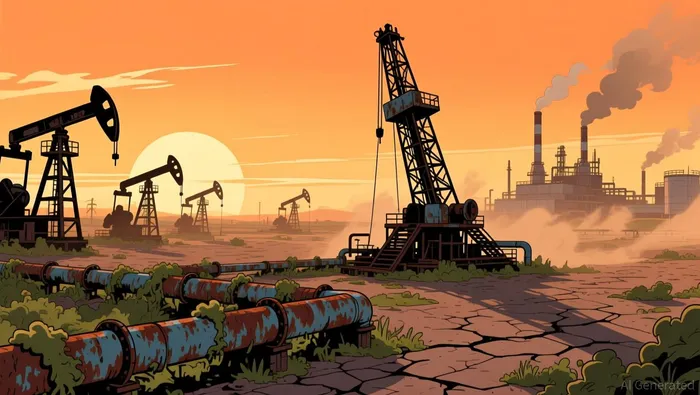
This volatility is compounded by the U.S. government's dual approach to sanctions relief. While policymakers aim to incentivize U.S. oil companies to reenter the market by selectively rolling back restrictions on crude exports, the long-term political stability of Venezuela remains uncertain. Analysts warn that even with U.S. support, rebuilding Venezuela's oil infrastructure will require up to $200 billion in investment and a decade of sustained effort. The mismatch between speculative market expectations and the physical realities of production recovery has created what some describe as a "supply destruction" paradox, where current global oil projects are being curtailed in anticipation of future Venezuelan output.
Legal Uncertainties: A Barrier to Investment
Legal frameworks in Venezuela's oil sector remain a minefield for foreign investors. Since 2007, a history of expropriations and arbitrary contract enforcement has deterred major international oil companies from committing capital. Even ChevronCVX--, the sole U.S. oil major currently operating in the country, has proceeded cautiously. The reimposition of U.S. sanctions in 2023–2025 further complicated matters, creating a regulatory environment where asset seizures and regime shifts could erase years of investment overnight.
The legal uncertainty is not confined to Venezuela. China, which had secured 85% of the country's remaining oil exports before the U.S. intervention, now faces disrupted supply chains and a strategic rebalancing in Latin America. For U.S. companies, the path forward hinges on assurances of political stability and clear contractual protections-a scenario that remains aspirational given Venezuela's institutional fragility.
Strategic Opportunities: Navigating the Chaos
Despite the risks, the Maduro case reveals strategic opportunities for investors willing to navigate the chaos. U.S. refiners and Gulf Coast operators, equipped to handle Venezuela's heavy crude, stand to benefit from shorter shipping distances and lower costs compared to Canadian producers. Additionally, the potential displacement of Chinese influence in Latin America's energy markets could open new corridors for U.S. and European firms to secure long-term supply agreements.
For legal and energy firms, the post-Maduro landscape offers a unique opportunity to shape the rebuilding of Venezuela's regulatory framework. As the U.S. Department of Energy explores sanctions relief tied to infrastructure development, there is a growing demand for legal expertise in contract drafting, compliance, and dispute resolution. Companies that establish early partnerships with U.S. policymakers or Venezuelan stakeholders may position themselves as key players in the sector's revival.
Conclusion: Balancing Risk and Reward
Venezuela's energy sector under Maduro exemplifies the volatile interplay of geopolitical risk and legal uncertainty in emerging markets. While the path to recovery is fraught with challenges-including internal regime tensions, logistical hurdles, and global oversupply-strategic investors who prioritize long-term resilience over short-term gains may find opportunities in this fractured landscape. As one analyst notes, "The cost of uncertainty is high, but for those who can weather the storm, the rewards could be transformative."
For now, the market remains in a wait-and-see mode, with oil prices stabilizing despite the upheaval. Yet the lessons from Venezuela are clear: in emerging markets, volatility is inevitable, but preparedness-and a willingness to adapt-is what separates prudent investment from speculative folly.







Comentarios
Aún no hay comentarios