
Geopolitical Risk and Its Impact on Immigrant-Driven Economies
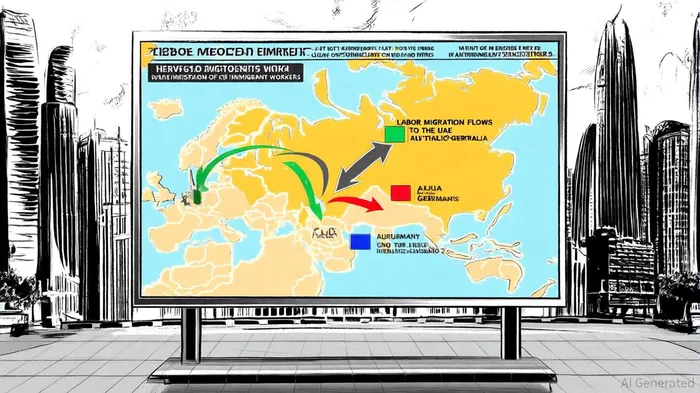
In an era of escalating geopolitical tensions, economies reliant on immigrant labor face unprecedented vulnerabilities. The United Arab Emirates, Australia, and Germany—three nations deeply dependent on foreign workers—illustrate how political instability, trade shifts, and policy changes can disrupt critical sectors. As global supply chains fragment and migration patterns evolve, investors must assess the financial risks to industries such as construction, healthcare, and hospitality, which underpin these economies.
The UAE: Construction and Hospitality in a Shifting Geopolitical Landscape
The UAE's economy is a mosaic of immigrant labor, with construction and hospitality sectors accounting for over 60% of its workforce[1]. South Asian workers, particularly from India, Bangladesh, and Pakistan, form the backbone of these industries. However, 2025 has brought heightened risks. The Sudanese civil war, for instance, has destabilized one of the UAE's key labor-sending regions, reducing the availability of skilled workers and driving up recruitment costs[3].
Compounding this, the Russian invasion of Ukraine has disrupted global supply chains, increasing material costs for construction projects. According to a report by the Geopolitical Monitor, UAE construction firms faced a 15% rise in operational expenses in Q1 2025 due to delayed shipments and higher wages for remaining workers[3]. Meanwhile, the hospitality sector, already strained by post-pandemic recovery, has seen a 10% decline in labor availability from Southeast Asia, where political instability in the Philippines and Indonesia has curtailed outbound migration[5].
Australia: Agriculture and Healthcare Under Pressure
Australia's agricultural sector, which relies heavily on seasonal migrant labor, has been hit by dual challenges. The 2025 Sudanese and South Asian crises have reduced the availability of temporary workers, forcing farmers to pay up to 30% higher wages for local labor or automation[4]. This has eroded profit margins, with the Australian Bureau of Agricultural Economics reporting a 12% drop in rural farm productivity in early 2025[4].
In healthcare, the aging population and labor shortages have made immigrant professionals indispensable. However, the return of U.S. President Donald Trump in 2025 and his imposition of global tariffs have disrupted trans-Pacific migration flows. Data from the World Economic Forum indicates that Australia's healthcare sector now faces a 20% vacancy rate in nursing roles, with recruitment costs rising by 25% year-on-year[2]. These trends threaten the sustainability of rural healthcare services, where immigrant workers previously filled critical gaps[4].
Germany: Manufacturing and Healthcare in a Geoeconomic Storm
Germany's manufacturing sector, a pillar of its economy, has long depended on immigrant labor to offset demographic decline. Yet, 2025's geopolitical landscape has intensified labor shortages. The Future of Jobs Report 2025 notes that 40% of German manufacturing firms now report delays in production due to a 15% reduction in immigrant workers from Eastern Europe, where conflicts and economic instability have curtailed migration[2].
The healthcare sector, similarly, is under strain. With 30% of German nurses being foreign-born, the sector has seen a 10% increase in turnover rates since 2024, driven by stricter immigration policies in key labor-sending countries like Poland and Romania[5]. As the population ages, this shortage is projected to cost the German healthcare system €12 billion annually by 2026[2].
Strategic Implications for Investors
For investors, the lessons are clear: diversifying supply chains, investing in automation, and hedging against labor shortages are critical. Sectors with high immigrant labor dependency—such as construction and healthcare—require scenario planning to mitigate risks from geopolitical shocks. Conversely, opportunities exist in countries that adapt swiftly, such as Germany's push for AI-driven manufacturing or Australia's incentives for domestic agricultural training[4].
As the 2025 geopolitical crises demonstrate, the financial health of immigrant-driven economies is inextricably linked to global stability. Investors who recognize these interdependencies will be better positioned to navigate the volatility ahead.







Comentarios
Aún no hay comentarios