
Geopolitical Risk and the Fragility of Sovereign Asset Management: Lessons from EU-Russia Disputes
The ongoing conflict between the European Union and Russia over frozen sovereign assets has exposed profound vulnerabilities in the global financial system. What began as a strategic tool to isolate Russia economically has evolved into a legal and political quagmire, with Cold War-era investment treaties now weaponized to challenge the very foundations of sanctions regimes. As the EU grapples with the dual imperatives of supporting Ukraine and safeguarding its own fiscal stability, the implications extend far beyond Europe, reshaping the rules of international finance and investor confidence.
Legal Challenges: The Weaponization of Investment Treaties
The EU's immobilization of approximately €300 billion in Russian Central Bank reserves-primarily held in Belgium's Euroclear-has triggered a surge in investor–state dispute settlement (ISDS) claims. Russian oligarchs and entities, leveraging bilateral investment treaties (BITs) signed during the Cold War, have filed over 24 publicly known cases against EU member states, demanding up to $62 billion in compensation. These claims, rooted in treaties like the 1989 Belgium-Luxembourg–USSR BIT, exploit legal loopholes to challenge sanctions and asset freezes as violations of fair and equitable treatment.
Belgium, which hosts Euroclear, has become a focal point of this legal battle. The country's government has resisted EU proposals to use frozen assets as collateral for a reparations-backed loan to Ukraine, citing fears of Russian lawsuits over its role in holding these reserves. This hesitation underscores a broader dilemma: how to balance legal obligations under outdated treaties with the urgent need to address contemporary security threats.
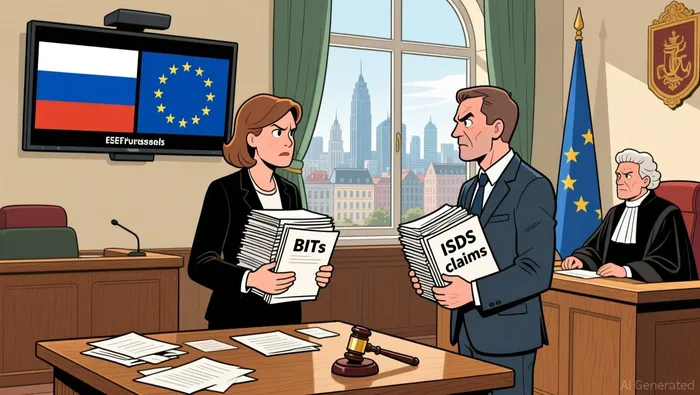 The financial risks posed by these disputes are staggering. If Russian entities succeed in their ISDS claims, EU member states could face liabilities rivaling the $70 billion in military aid already provided to Ukraine. Belgium's reluctance to endorse the EU's proposed reparations-backed loan-valued at €140 billion-further complicates efforts to stabilize Kyiv's economy. The European Commission's push to freeze assets indefinitely under Article 122 of the EU treaty aims to mitigate this risk, but political resistance persists, particularly in countries wary of legal retaliation.
The ripple effects extend to global financial stability. The immobilization of Russian reserves has set a precedent for using financial infrastructure as a geopolitical tool, raising concerns about the role of central securities depositories like Euroclear. Meanwhile, the ECB's geopolitical risk indicator highlights how conflicts like the Russia-Ukraine war have fragmented markets, stifled investment, and exacerbated inflationary pressures, particularly in Central and Eastern Europe.
Geopolitical and Global Systemic Risks
The EU-Russia disputes have also exposed the fragility of international investment law. By weaponizing BITs, Russian actors have created a "regulatory chill," deterring governments from enacting bold policies during crises. The EU's 2025 sanctions package, which prohibits sanctioned investors from enforcing arbitral awards, reflects an acknowledgment of this threat but raises questions about the legitimacy of overriding treaty obligations.
Beyond Europe, the precedent is troubling. Russian courts have begun disregarding arbitration agreements in disputes involving European counterparties, forcing companies to adopt parallel legal strategies to mitigate risks. This erosion of legal predictability undermines investor confidence and signals a broader breakdown in the rules-based international order.
The Path Forward: Reform or Collapse?
The EU-Russia asset disputes highlight an urgent need to modernize investment treaties. Designed for a pre-21st-century geopolitical landscape, these agreements lack mechanisms to address conflicts or national security imperatives. Civil society and policy experts have called for terminating outdated treaties, removing ISDS provisions, and enhancing transparency to align with contemporary realities.
For global financial stability, the stakes are high. If left unaddressed, the weaponization of investment law could normalize the use of legal tools to undermine sanctions, destabilize markets, and erode trust in international institutions. The EU's struggle to reconcile legal obligations with strategic imperatives serves as a cautionary tale for other regions facing similar conflicts.
In an era of escalating geopolitical tensions, sovereign asset management is no longer a technical exercise-it is a battlefield where legal, political, and financial systems collide. The EU's response to the Russia crisis will shape the future of global finance, for better or worse.







Comentarios
Aún no hay comentarios