
Geopolitical Risk and Emerging Market Stability: Venezuela's Alliances and Crime Dynamics in 2025
Venezuela's 2025 economic and political landscape is a volatile cocktail of deepening geopolitical alliances, surging crime rates, and fragile investor confidence. For emerging market investors, the country's trajectory offers a cautionary tale of how political realignments and security crises can amplify systemic risks, even in the face of modest economic growth.
Political Alliances: A Double-Edged Sword
Venezuela's strategic pivot to Russia and China has become a cornerstone of its survival strategy amid U.S. sanctions and regional isolation. According to a report by El País, the July 2024 presidential election victory of Nicolás Maduro has accelerated these partnerships, with Russia securing a 64% increase in bilateral trade in 2024 and China committing to joint crude oil sales with state-owned enterprises like CNPC [2]. These alliances, however, are not without limitations. While they provide short-term liquidity and access to alternative financial systems, they also expose Venezuela to the structural weaknesses of its partners, including China's own debt challenges and Russia's economic stagnation.
The U.S. response has been equally aggressive. The Trump administration's revocation of Chevron's oil license in March 2025 and its military strikes on drug-trafficking vessels in the Caribbean have escalated tensions, pushing Venezuela to deepen its reliance on non-Western allies [1]. This geopolitical chess game has created a paradox: while Russia and China offer economic lifelines, they also entrench Venezuela's dependence on opaque and often transactional partnerships, further eroding institutional credibility.
Crime Dynamics: A Looming Shadow
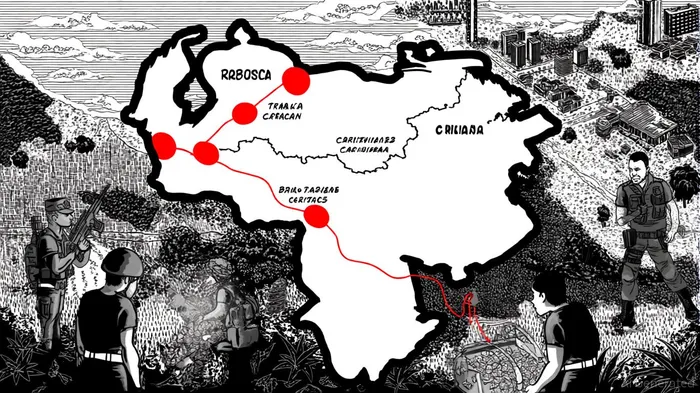
The human cost of Venezuela's crisis is stark. Caracas, already a hotspot for violent crime, saw a 20% rise in homicide rates in 2025, according to Human Rights Watch, with organized groups like Tren de Aragua exploiting porous borders to expand their illicit networks [3]. These dynamics are not just a domestic issue; they spill into neighboring countries, destabilizing the Caribbean and complicating regional trade. The U.S. military buildup in the region—featuring F-35 deployments and naval patrols—has only heightened the risk of militarization, with analysts warning of a Cold War-style standoff [5].
For investors, the implications are clear. A report by Reuters highlights that Venezuela's oil sector, once a beacon of potential, is now plagued by criminal encroachment and U.S. sanctions, deterring foreign capital [4]. Even as the government touts a 7.71% GDP growth in 2025, driven by its “13 Productive Motors” strategy, inflation is projected to hit 71.7%, and poverty remains entrenched at 51.9% [3]. The disconnect between official metrics and on-the-ground realities underscores the fragility of Venezuela's economic recovery.
Investor Sentiment: A Calculated Deterrence
Despite the allure of a “trillion-dollar” market, investor confidence remains muted. Opposition leader María Corina Machado's calls for democratic reforms have failed to translate into tangible opportunities, as infrastructure decay and arbitrary governance persist. A Bloomberg analysis notes that wealthy Venezuelans now rely on private solutions for basic services, a trend that signals a lack of trust in public institutions [3]. Meanwhile, the ruling United Socialist Party of Venezuela (PSUV) continues to consolidate power through constitutional reforms and electoral manipulation, further complicating the political calculus for foreign investors.
The U.S.-Venezuela standoff adds another layer of uncertainty. While Trump's administration has engaged in pragmatic diplomacy—such as repatriating U.S. citizens detained in Venezuela—its hardline stance on sanctions and military posturing has created a volatile environment. As The Financial Analyst reports, global markets have already reacted to this instability, with energy prices fluctuating in response to Venezuela's oil output and U.S. military actions [5].
Regional Implications and the Path Forward
Venezuela's crisis is no longer confined to its borders. The Caribbean's transformation into a battleground for geopolitical and criminal interests threatens regional stability, with neighboring states caught between diplomatic mediation and self-preservation. Colombia and Brazil, for instance, have adopted a cautious balancing act, engaging with both the Maduro regime and opposition factions while prioritizing economic pragmatism [4].
For investors, the lesson is clear: emerging markets are increasingly shaped by the interplay of political alliances and security dynamics. Venezuela's experience in 2025 demonstrates that even modest economic gains can be undermined by systemic risks, from hyperinflation to military escalation. The path to stability will require not just new partnerships but a fundamental reimagining of governance and transparency—challenges that remain far from resolution.





Comentarios
Aún no hay comentarios