
Geopolitical Risk Diversification in Eastern Europe: Defense and Energy Markets in the Shadow of Drones
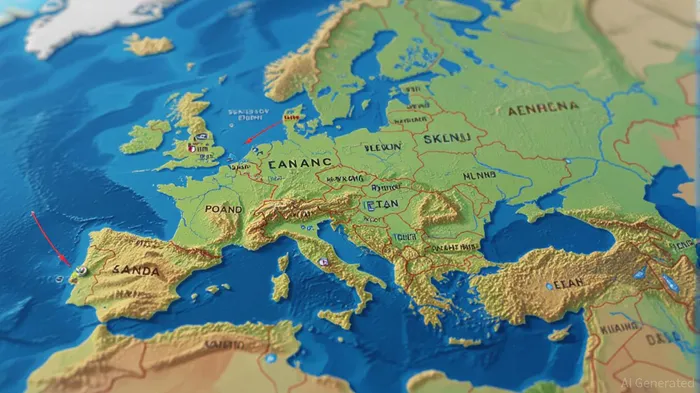
In an era where geopolitical volatility defines global markets, Eastern Europe has emerged as a critical battleground for defense and energy investments. Poland, in particular, stands at the forefront of this transformation, driven by escalating tensions with Russia and the persistent threat of drone incursions. As a NATO member and a linchpin of European security, its strategic investments in defense modernization and energy resilience offer a compelling case study for investors seeking to hedge against geopolitical risks.
Poland's Defense Surge: A Blueprint for Security Expenditures
Poland's 2025 defense budget of $31.3 billion—equivalent to 4.7% of GDP—marks a historic shift in national priorities[1]. This surge is not merely a reaction to Russia's aggression but a calculated effort to position Poland as a regional security leader. The government has allocated $14.021 billion specifically for military procurement under the Armed Forces Development Programme, with a focus on rapid modernization[2]. Key partnerships, such as the $16 billion defense contract with South Korea for K2 Black Panther tanks, FA-50 jets, and K239 Chunmoo rocket systems, underscore a strategic pivot toward diversified supply chains[3].
The urgency of these investments has been amplified by drone threats. In 2024, Russian drones violated Polish airspace, prompting Prime Minister Donald Tusk to declare it the country's “closest brush with open conflict since World War II.” This incident catalyzed a surge in civilian military training, with over 20,000 participants in 2025—a figure expected to double by year-end[4]. For investors, this signals a sustained demand for defense technology, particularly in drone detection and counter-drone systems, which are now integral to NATO's eastern flank strategy.
Energy Resilience: Diversification as a Strategic Imperative
Parallel to its defense push, Poland is overhauling its energy infrastructure to reduce reliance on Russian gas. A $1.2 billion investment in its first nuclear power plant, coupled with renewable energy incentives, reflects a dual strategy of energy security and environmental sustainability[5]. The Central Communication Port (CPK) megaproject—a $8 billion airport and high-speed rail network—further cements Poland's role as a logistics hub, enhancing its economic resilience[6].
These initiatives align with broader EU and NATO goals to decouple energy markets from Russian influence. Poland's energy diversification is not just about infrastructure; it's about geopolitical leverage. By integrating with European energy grids and leveraging LNG terminals like Świnoujście, Poland is positioning itself as a critical node in the region's energy security architecture[7].
South Korea's Geopolitical Constraints: A Contrasting Case
While Poland expands its strategic autonomy, South Korea faces a more constrained geopolitical landscape. Sandwiched between U.S. security guarantees and China's economic weight, Seoul must navigate a delicate balancing act. Its defense cooperation with Poland—despite recent political turbulence, including President Yoon Suk Yeol's brief martial law declaration—remains a priority, with payments for military equipment denominated in U.S. dollars to mitigate currency risks[8].
However, South Korea's ability to pivot is limited by its proximity to North Korea and its dependence on Chinese trade. Unlike Poland, which leverages its NATO membership to diversify partnerships, South Korea's defense strategy remains heavily reliant on U.S. alliances. This asymmetry highlights the importance of regional context in geopolitical risk diversification: Poland's geographic and institutional position allows for bold investments, while South Korea's constraints necessitate cautious, incremental strategies.
Investment Opportunities: Defense Tech and Energy Security Stocks
For investors, the interplay of drone threats and energy insecurity in Eastern Europe opens avenues in two key sectors:
1. Defense Technology: Companies specializing in drone detection, electronic warfare, and rapid-deployment systems are poised to benefit. Polish firms like PGZ (a state-owned defense contractor) and South Korean partners such as Hanwha Aerospace are already capitalizing on this demand[9].
2. Energy Infrastructure: Renewable energy developers and nuclear technology firms with exposure to Eastern Europe—such as PKN Orlen (Poland's largest oil refiner) and Westinghouse (nuclear reactor supplier)—are well-positioned to capitalize on Poland's energy transition[10].
Conclusion: A Long-Term Hedging Strategy
Poland's proactive approach to defense and energy markets illustrates the potential for geopolitical risk to drive innovation and investment. By contrast, South Korea's constrained flexibility underscores the importance of institutional and geographic positioning in shaping strategic outcomes. For investors, the lesson is clear: diversifying exposure to regions with robust security and energy resilience—like Eastern Europe—can mitigate the volatility of global conflicts while capitalizing on long-term growth opportunities.







Comentarios
Aún no hay comentarios