
Geopolitical Risk and Defense Sector Opportunities: Navigating Putin's Volatility for Strategic Gains
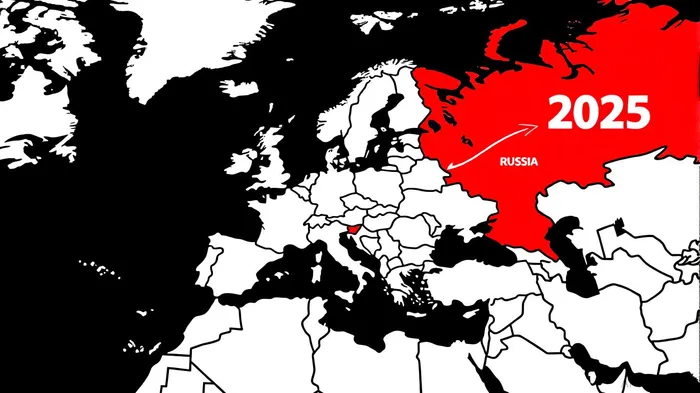
The global defense sector is undergoing a seismic shift driven by escalating geopolitical tensions, with Russian President Vladimir Putin's strategic posturing and military buildup serving as a catalyst for volatility and opportunity. As of 2025, Putin's policies have entrenched Russia's defense industry into its economic core, while simultaneously triggering a rearmament surge across NATO and European allies. This dual dynamic creates a fertile ground for investors seeking to capitalize on both equities and commodities tied to the defense industrial base.
Putin's Geopolitical Leverage and the Defense Spending Surge
Putin's 2025 defense budget allocates 15.5 trillion roubles ($170 billion) to military needs, with spending projected to rise by a quarter year-over-year, according to Reuters. This reflects a strategic commitment to maintaining Russia's military dominance in Ukraine and countering Western influence. A Bloomberg analysis finds Russia's defense industry has reoriented itself to produce 10 times more armored vehicles and 10-fold more drones than pre-war plans, embedding militarization into long-term economic strategy.
This aggressive posture has spurred a global arms race. European defense spending is projected to grow at a 6.8% annual rate from 2024 to 2035, outpacing U.S. and Chinese trends, according to a MarketMinute analysis. Germany's $110 billion 2025 defense budget exemplifies this shift, as nations prioritize modernization of land systems, naval platforms, and air defense technologies, as shown in a Morningstar analysis. The same MarketMinute analysis also notes that U.S. defense contractors like Lockheed MartinLMT-- and Raytheon have secured record contracts amid heightened demand.
Commodities in the Crosshairs: Supply Chain Bottlenecks and Strategic Reserves
The defense sector's reliance on critical minerals is under acute strain. Rare earth elements, uranium, and semiconductors-essential for advanced weaponry and energy systems-are facing supply chain disruptions. For instance, Morningstar reports that germanium prices surged 115% since 2022 due to its use in infrared sensors for missile systems. The MarketMinute analysis identifies 12 defense-critical materials at "high risk" of supply constraints, with China dominating processing for 95% of U.S. rare earth imports.
Russia's own ambitions in this space are noteworthy. Reuters also reported the Kremlin has signaled potential export restrictions on rare earth metals, aiming to secure a 12% global market share by 2030. Meanwhile, the U.S. has invoked the Defense Production Act to boost domestic mineral production, allocating $439 million since 2020 to reduce reliance on foreign adversaries, per the MarketMinute analysis. These developments highlight a growing arms race for resource control, with commodities like uranium and gallium becoming geopolitical flashpoints, as Bloomberg further details.
Defense Equity Performance: A Sector in Ascendancy
The defense equity market has mirrored these trends. The MarketMinute analysis shows European firms like Rheinmetall and BAE Systems have seen share prices rise by over 130% and 133%, respectively, in two years. In the U.S., Lockheed Martin and Northrop GrummanNOC-- have benefited from a $156.2 billion funding boost under the "One Big Beautiful Bill Act," driving investments in drones, cybersecurity, and next-gen shipbuilding, according to a Quartz outlook.
However, volatility persists. For example, lithium prices-critical for both electric vehicles and defense batteries-have plummeted 80% since 2023 due to oversupply, despite long-term demand projections, as shown in an IEA analysis. This underscores the need for investors to balance near-term commodity fluctuations with strategic bets on defense infrastructure.
Strategic Buying Opportunities: Where to Position
- Defense Contractors with Diversified Supply Chains: Firms like General DynamicsGD-- and RTX CorporationRTX--, which are securing contracts amid supply chain bottlenecks, offer resilience-an approach highlighted by Morningstar.
- Critical Mineral Producers: Companies with exposure to rare earths (e.g., MP Materials) or uranium (e.g., Cameco) could benefit from U.S. and EU efforts to reduce dependency on China, as noted in the MarketMinute analysis.
- European Defense Stocks: With European budgets expanding faster than U.S. counterparts, firms like Thales and Leonardo S.p.A. are well-positioned for sustained growth, per Reuters reporting.
Conclusion: A Volatile Yet Rewarding Landscape
Putin's geopolitical gambits have transformed the defense sector into a high-stakes arena of volatility and opportunity. While supply chain risks and commodity price swings introduce uncertainty, the long-term trajectory of defense spending-driven by rearmament and resource competition-presents compelling investment avenues. Investors who align with companies and commodities at the forefront of this shift may find themselves well-positioned to capitalize on the next phase of global realignment.





Comentarios
Aún no hay comentarios