
Geopolitical Risk and Defense Sector Opportunities: How NATO's 2025 Modernization Drive is Reshaping Investment Landscapes
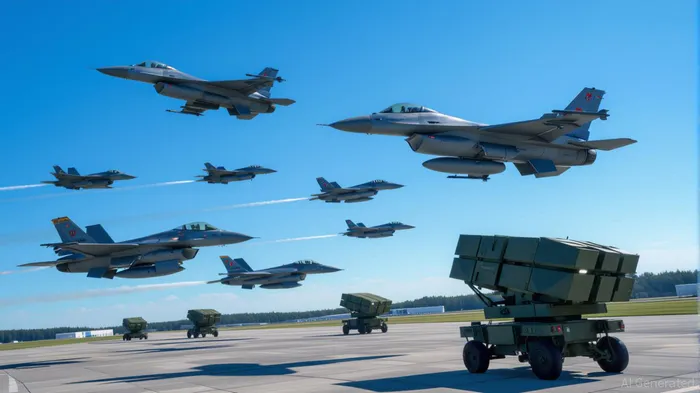
The summer of 2025 marked a pivotal shift in NATO's strategic calculus. A Russian drone incursion into Polish airspace—labeled a “large-scale provocation” by Prime Minister Donald Tusk—triggered a unified alliance response, scrambling fighter jets and deploying advanced air defense systems[1]. This incident, the first direct military engagement involving NATO and Russian assets since the Ukraine conflict began, exposed critical vulnerabilities in the alliance's ability to counter asymmetric threats. In its aftermath, NATO accelerated a long-anticipated pivot toward hard power, raising defense spending targets and prioritizing modernization. For investors, this represents a rare confluence of geopolitical urgency and industrial transformation, creating fertile ground for defense contractors and aerospace firms.
A Strategic Reckoning: From Diplomacy to Deterrence
The Poland drone incident crystallized NATO's growing anxiety. European leaders, including German Chancellor Olaf Scholz and Italian Prime Minister Giorgia Meloni, swiftly condemned the breach as a deliberate test of the alliance's resolve[2]. NATO Secretary General Mark Rutte underscored the need to “translate political signals into military capabilities,” a call echoed at the 2025 NATO Summit in The Hague[3]. The summit produced a landmark agreement: a 5% GDP defense spending target by 2035, with 3.5% allocated to core defense requirements and 1.5% to infrastructure, innovation, and industrial capacity[4]. This represents a doubling of the previous 2% guideline and signals a strategic shift from diplomacy to deterrence, particularly in countering Russian aggression and Chinese supply chain dominance[5].
The financial implications are staggering. If all members meet the target, NATO defense spending could reach $4.2 trillion by 2035[6]. However, fiscal constraints loom large. The U.S. and France face credit downgrades, while Italy and Germany grapple with debt burdens. To bridge this gap, the alliance is prioritizing multinational procurement contracts and industrial cooperation, as outlined in the updated Defence Production Action Plan (DPAP). This plan emphasizes long-term contracts for uncrewed aerial systems, main battle tanks, and air defense systems, while addressing supply chain vulnerabilities[7].
Defense Contractors in the Spotlight
The DPAP's focus on modernization has already begun to reshape the defense industrial landscape. Key beneficiaries include:
- Ammunition and Platforms: Rheinmetall and BAE Systems are expanding production lines for artillery and armored vehicles, driven by NATO's emphasis on “kinetic readiness.” Poland's announced procurement of F-35 fighter jets further bolsters demand for advanced platforms[8].
- Missile Defense and Counter-Drone Tech: Lockheed MartinLMT-- and RTX Corp (Raytheon Technologies) are poised to capitalize on contracts for air and missile defense systems. The Poland incident has intensified interest in cost-effective counter-drone solutions, such as jamming and directed energy systems, where companies like Leonardo (Italy) and Rafael (Israel) are emerging as key players[9].
- Cybersecurity and Innovation: Heightened concerns over critical infrastructure protection are fueling demand for cybersecurity firms. General DynamicsGD-- and Palo Alto NetworksPANW-- are already seeing increased inquiries from NATO members seeking to fortify their digital defenses[10].
The DPAP also highlights the importance of industrial cooperation. For instance, the Rapid Adoption Action Plan (RAAP) aims to streamline procurement cycles, enabling faster deployment of cutting-edge technologies. This favors firms with agile supply chains and multinational partnerships, such as BoeingBA-- and Airbus, which are integrating AI and autonomous systems into their offerings[11].
Challenges and the Path Forward
While the investment case is compelling, risks remain. Fiscal constraints in Europe could delay spending commitments, particularly in countries like Spain, which has resisted the 5% target[12]. Additionally, industrial bottlenecks—such as semiconductor shortages and labor gaps—could slow modernization efforts. However, NATO's emphasis on joint procurement and innovation hubs (e.g., the EU's Industrial Strategy for Defence) aims to mitigate these challenges[13].
Conclusion: A New Era for Defense Investing
The Poland drone incident was not an isolated event but a catalyst for a broader strategic realignment. NATO's 5% spending target and procurement priorities reflect a recognition that deterrence in the 21st century requires not just political unity but industrial might. For investors, this means opportunities in sectors ranging from missile defense to cybersecurity, with a premium on firms capable of scaling production and navigating geopolitical complexity. As the alliance moves from rhetoric to action, defense contractors with robust innovation pipelines and multinational partnerships are likely to outperform. In an era of heightened risk, the defense sector offers both resilience and growth—a compelling case for long-term investment.





Comentarios
Aún no hay comentarios