
Geopolitical Risk and Cybersecurity Investment Opportunities in Southeast Asia: How Crackdowns Catalyze Digital Security Demand
The Southeast Asian cybersecurity market is undergoing a seismic shift, driven by a paradox: as governments intensify crackdowns on transnational cybercrime hubs, criminal networks adapt by expanding their reach, while regional economies accelerate investments in digital infrastructure to mitigate risks. This dynamic creates a unique investment thesis where geopolitical volatility and technological innovation converge to fuel demand for cybersecurity solutions.
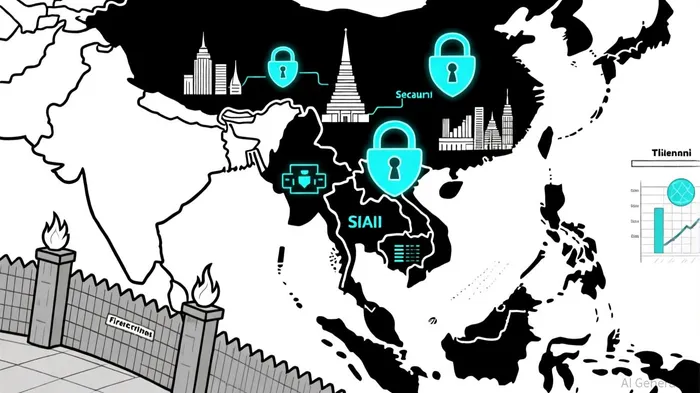
Cybercrime Crackdowns: A Double-Edged Sword
Recent operations in Laos, Cambodia, and Myanmar exemplify the region's struggle to contain cybercrime. In August 2024, Lao authorities dismantled a major scam center in the Golden Triangle Special Economic Zone, detaining 771 individuals and seizing 2,000 devices, according to a USIP report. Similarly, Thailand, under pressure from China, cut off utilities to border areas hosting scam operations in early 2025, as noted in a World Economic Forum article. However, these efforts have proven insufficient to curb the problem. Cybercriminals, leveraging satellite internet services like Starlink and shifting operations to remote regions or even South America and Africa, have demonstrated remarkable resilience in a PYMNTS report. The United Nations Office on Drugs and Crime (UNODC) estimates that Southeast Asia's cybercrime industry generated $37 billion in 2023 alone, with losses expected to rise as AI-powered scams and deepfake technologies become more pervasive, according to the UNODC report.
The Investment Catalyst: Policy and Market Responses
The urgency of this crisis has spurred a wave of policy reforms and infrastructure investments. ASEAN's Cybersecurity Cooperation Strategy (2021–2025) is a cornerstone of this response, with initiatives like the ASEAN Regional Computer Emergency Response Team (CERT) in Singapore aiming to enhance cross-border collaboration, as outlined in a CSIS blog post. Singapore, a regional leader, has allocated significant resources to its Cybersecurity Strategy 2025, prioritizing AI-infused threat detection and quantum-safe encryption, per an ACSMI report. Meanwhile, Japan and India are reshaping the Asia-Pacific cybersecurity landscape: Japan is investing $3.8 billion in industrial control system (ICS) hardening, while India's Digital India 2.0 program focuses on SOC modernization and cloud security, according to a Cybercenter plan.
The market is responding with rapid growth. Southeast Asia's cybersecurity market is projected to reach $4.53 billion in 2025, expanding at a 6.76% CAGR to $6.28 billion by 2030, based on a Statista forecast. Security services, particularly managed detection and response (MDR) and cloud security posture management (CSPM), are leading this growth. For instance, Singaporean cybersecurity startups raised $120 million in H1 2025 alone, with 70% of funding directed toward SaaS security and third-party risk solutions, according to a Speeda report.
Sector-Specific Opportunities
- Cloud Security: With Southeast Asia's cloud market projected to hit $513 billion by 2033, demand for Zero Trust frameworks and CSPM tools is surging. Vendors like Cisco and FortinetFTNT-- are expanding regional partnerships to address misconfigurations and shared responsibility gaps, as noted in a PT Security analysis.
- AI-Driven Threat Detection: Criminals' use of AI for deepfakes and synthetic identities has pushed governments to adopt AI-powered defenses. Singapore's AI-infused threat detection programs and Malaysia's StarSentry platform for SMEs are prime examples, according to an AIBP report.
- Regulatory Compliance Tools: Fragmented legal frameworks across ASEAN member states create demand for compliance solutions. The Philippines' Anti-Financial Account Scamming Act (AFASA) and Singapore's Shared Responsibility Framework are driving investments in financial sector cybersecurity, as detailed in a Cybercrime Busters article.
Risks and Mitigations
While the outlook is bullish, challenges persist. Cultural reluctance to report cyber incidents, inconsistent enforcement of regulations, and the vulnerability of SMEs (which face 43% of regional cyberattacks) remain hurdles, according to PT Security's threatscape https://global.ptsecurity.com/en/research/analytics/cybersecurity-threatscape-in-southeast-asia. However, capacity-building programs like the ASEAN Cyber Capacity Programme (ACCP) and public-private partnerships are addressing these gaps. Investors should prioritize firms with cross-border operational capabilities and AI-native security solutions.
Conclusion
Southeast Asia's cybersecurity landscape is a microcosm of global trends: geopolitical instability and technological disruption are converging to create a $6.28 billion market by 2030. For investors, the key lies in aligning with initiatives that address both immediate threats (e.g., ransomware, AI scams) and systemic weaknesses (e.g., SME readiness, cloud security). As cybercrime syndicates evolve, so too must the region's defenses-and with them, the opportunities for those who recognize the urgency of this digital arms race.





Comentarios
Aún no hay comentarios