
Geopolitical Risk and the Cryptocurrency Volatility Cycle: Timing Anomalies in 2025
In 2025, the cryptocurrency market became a barometer for global geopolitical instability. As traditional financial systems grappled with trade wars, regional conflicts, and regulatory shifts, digital assets exhibited extreme volatility-often reacting to events in real time. For large-scale investors, this created a paradox: while crypto's decentralized nature promised resilience, its price swings exposed a fragile dependency on timing. This article unpacks how geopolitical risk and regulatory uncertainty in 2025 created timing anomalies in large-scale crypto positioning, reshaping strategies for institutional players and retail investors alike.
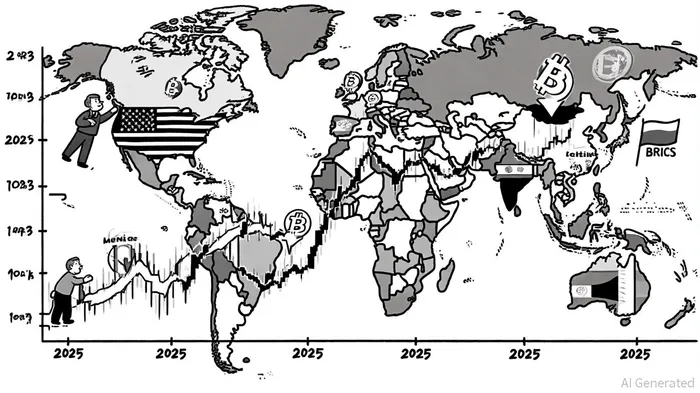
The 2025 Geopolitical Landscape: A Volatile Backdrop
The year began with optimism. Donald Trump's pro-crypto executive order in January 2025, which banned CBDCs and prioritized innovation, sent BitcoinBTC-- surging 30% in weeks . However, this optimism was short-lived. By April, U.S.-China trade tensions escalated, with the U.S. imposing fresh tariffs on Chinese goods. Bitcoin plummeted below $78,000-a 16% drop in a week-as investors fled risk assets . The market's rebound during a temporary tariff pause in May 2025 underscored a critical insight: large-scale positioning in crypto was increasingly tied to the timing of geopolitical developments, not just their existence.
The Middle East further amplified this pattern. In June, Israeli airstrikes on Iranian nuclear sites triggered a $35 billion market capitalization loss for Bitcoin within hours, with over $656 million in liquidations . Yet, as with the U.S.-China trade war, Bitcoin rebounded when tensions eased-highlighting how institutional investors and hedge funds adjusted their exposure based on real-time geopolitical cues.
Regulatory Shifts and the Timing of Institutional Entry
While geopolitics drove short-term volatility, regulatory developments shaped long-term positioning. The U.S. SEC's pivot from enforcement to innovation-friendly frameworks-exemplified by Project Crypto-encouraged institutional adoption. By October 2025, U.S. spot Bitcoin and EthereumETH-- ETFs had attracted $28 billion in net inflows, with over 170 public companies holding significant crypto reserves . However, this growth was not linear. Q1 2025 saw a 12% drop in XRPXRP-- activity and a contraction in Bitcoin ATMATM-- networks, driven by regulatory uncertainty and cyberattacks .
The EU's MiCA regulation, which took effect in December 2024, further complicated timing. While it provided clarity for crypto service providers, its implementation created a "wait-and-see" period for large investors. This hesitation was evident in the lag between MiCA's enforcement and the surge in institutional Ethereum holdings-a timing anomaly that left some investors exposed to mid-2025 volatility .
BRICS and the De-Dollarization Narrative
The BRICS bloc's expansion into alternative payment systems introduced another layer of complexity. By October 2025, XRP had risen 12% year-to-date, driven by speculation about its role in cross-border transactions as the group pushed for de-dollarization . This trend forced large-scale investors to balance between U.S.-centric assets (like Bitcoin) and emerging alternatives (like XRP), creating a fragmented positioning strategy. The 2025 BRICS summit in Brazil, which promised announcements on new payment systems, became a focal point for timing decisions-a stark contrast to the dollar-centric logic of traditional markets.
The Dual Role of Crypto: Speculation vs. Resilience
Cryptocurrencies' dual identity as speculative assets and tools for financial resilience further muddied the waters. During the Russia-Ukraine War, Bitcoin's use in humanitarian aid and cross-border transactions demonstrated its value as a "digital gold" . Yet, its performance during the 2025 U.S. interest rate hikes-where Bitcoin declined despite geopolitical stability-showed that macroeconomic factors could override its safe-haven appeal . For large investors, this duality created a timing dilemma: when to bet on Bitcoin's speculative potential versus its utility in crisis scenarios.
Strategic Implications for 2025 and Beyond
The timing anomalies of 2025 highlight a critical lesson: geopolitical risk and regulatory shifts are not just background noise-they are active drivers of crypto positioning. Large-scale investors who thrived in this environment adopted three strategies:
1. Dynamic Hedging: Using stablecoins like TetherUSDT-- during geopolitical spikes while maintaining exposure to Bitcoin and Ethereum.
2. Regulatory Arbitrage: Exploiting timing gaps between U.S., EU, and BRICS regulatory frameworks to optimize entry points.
3. Scenario Planning: Preparing for both best-case (tariff pauses, BRICS adoption) and worst-case (conflict escalation, cyberattacks) outcomes.
As 2025 drew to a close, the crypto market's volatility underscored a broader truth: in a world where geopolitical events can move markets in hours, timing is no longer a secondary consideration-it is the primary determinant of success.






Comentarios
Aún no hay comentarios