
Geopolitical Risk and Crypto Markets: Harnessing Volatility as a Strategic Entry Point
Geopolitical risk has become a defining force in global markets, and cryptocurrencies-despite their volatility-are increasingly positioned as both victims and beneficiaries of these dynamics. From the Russia-Ukraine war to the U.S.-China trade war, digital assets have exhibited complex, often asymmetric responses to global crises. For investors, this volatility is not merely a risk but a potential opportunity. By understanding the interplay between geopolitical events and crypto market behavior, strategic entries can be made to capitalize on short-term swings while mitigating long-term exposure.
The Dual Nature of Geopolitical Impact
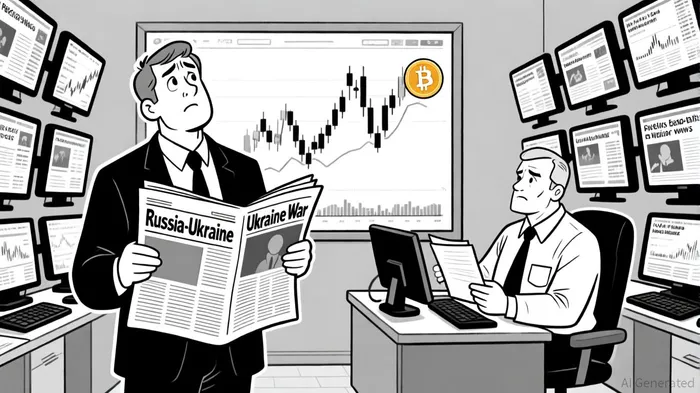
Research underscores that cryptocurrencies do not uniformly act as safe-haven assets. During economic crises-such as trade wars or sanctions-Bitcoin and EthereumETH-- have shown resilience, with a Wiley study noting positive returns amid U.S.-China tensions in 2022 and 2025. Conversely, political crises, like the initial stages of the Russia-Ukraine war, triggered sharp declines in crypto prices as uncertainty spiked, as shown by a ScienceDirect analysis. This duality highlights the importance of event-type differentiation: investors must distinguish between economic-driven and political-driven volatility to avoid misaligned strategies.
For instance, during the 2022 invasion of Ukraine, BitcoinBTC-- initially dropped by over 20% but rebounded as individuals and institutions in both countries adopted crypto to circumvent banking disruptions and sanctions, according to a MarketClutch article. By May 2025, Bitcoin surged to an all-time high amid renewed U.S.-China trade tensions, illustrating its potential as a digital safe haven during economic policy uncertainty, as reported in an Analytics Insight article.
Strategic Instruments for Volatility Management
To leverage this volatility, investors have turned to advanced tools like crypto futures. These instruments allow for hedging, shorting, and leveraged exposure without holding the underlying asset, enabling rapid responses to geopolitical shocks. During the Russia-Ukraine war, Bitcoin futures trading volumes surged as investors hedged against fiat devaluation and market instability, according to a Scholastica paper. Similarly, Ethereum futures saw increased activity during U.S.-China trade escalations, reflecting their role in diversifying portfolios against traditional safe-haven assets like gold, as indicated by an NCBI study.
Another critical strategy involves asymmetric positioning. Given that cryptocurrencies respond differently to economic versus political crises, investors can allocate capital to assets that align with the type of risk on the horizon. For example, during trade wars, Bitcoin's perceived scarcity and decentralization make it a compelling hedge against inflation and currency devaluation, as argued in a Modern Diplomacy article. In contrast, during political crises, allocating to stablecoins or gold-backed tokens may offer more immediate liquidity and stability, according to an NCBI comparison.
Case Studies: Lessons from the Field
The Ukraine conflict provides a textbook example of strategic crypto adoption. By 2023, the Ukrainian government had raised $225 million in cryptocurrencies, primarily Bitcoin and Ethereum, to fund military and humanitarian efforts, as detailed in a CEPA article. This not only demonstrated crypto's utility in crisis scenarios but also highlighted its role in capital preservation. Meanwhile, Iran's use of Bitcoin to bypass U.S. sanctions in 2021-$1 billion in transactions-showed how digital assets can serve as a lifeline in sanctioned economies, reported by a CryptoRobotics report.
On the investment front, the 2025 U.S.-China trade tensions saw institutional investors flock to Bitcoin futures as a hedge against geopolitical risk. One notable case involved a hedge fund that shorted Bitcoin during the initial invasion of Ukraine but reversed its position within weeks as the market stabilized, netting a 30% return in under two months, according to a Medium article.
Risk Mitigation and the Road Ahead
While the opportunities are clear, risks remain. Regulatory actions, such as the U.S. Treasury's 2022 sanctions on Russian-linked crypto wallets, caused an 8% temporary drop in Bitcoin prices, documented in a CoinMetro overview. This underscores the need for dynamic risk management, including stop-loss orders and diversified portfolios that balance crypto exposure with traditional assets.
Looking ahead, the rise of central bank digital currencies (CBDCs) and evolving regulatory frameworks will further shape crypto's role in geopolitical scenarios. Investors must stay attuned to these shifts, leveraging real-time data and geopolitical intelligence to refine their strategies.






Comentarios
Aún no hay comentarios