
Geopolitical Risk and Commodity Volatility: U.S.-Venezuela Tensions and the Surge in Oil and Gold Prices
The escalating U.S.-Venezuela standoff in 2025 has become a focal point for global commodity markets, with oil and gold prices surging amid heightened geopolitical risk. As the Trump administration intensifies its blockade of sanctioned oil tankers and deploys military assets to restrict Venezuela's oil trade, the ripple effects on energy markets and safe-haven assets are reshaping investment strategies. This analysis examines how U.S. actions, coupled with the potential for regime shifts in Venezuela, are driving volatility in oil and gold prices-and what this means for investors navigating a fractured global landscape.
Oil Markets: A Delicate Balance Between Sanctions and Supply
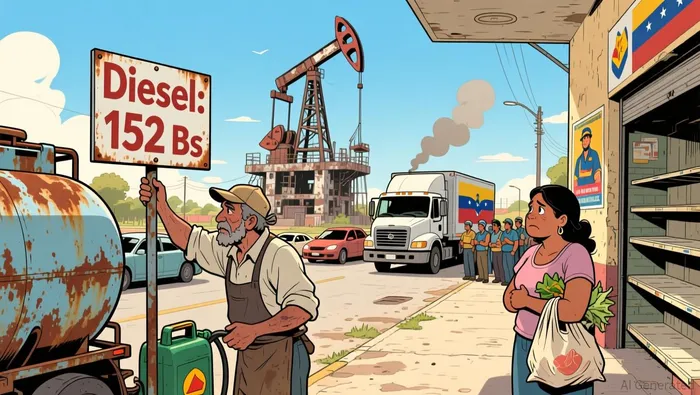
Venezuela's oil production, a critical pillar of its economy, has plummeted by 25% due to U.S. maritime restrictions and prior sanctions. The Trump administration's blockade, which targets tankers linked to the Maduro regime, has disrupted exports that once averaged 750,000 barrels per day (bpd), with U.S. imports alone dropping to 152,000 bpd. While global oil markets remain oversupplied, the unique properties of Venezuela's heavy crude-difficult and costly to replace-pose risks for refined product pricing, particularly for diesel and fuel oil.
The potential for further escalation looms large. A U.S. military intervention could reduce Venezuelan production by 10–60%, depending on the scale of conflict. Such a scenario would tighten global diesel markets, exacerbating inflationary pressures.
. Conversely, a stable political transition in Venezuela-marked by the easing of sanctions and foreign investment-could see production rebound to 2–3 million bpd within two years. However, this optimistic outlook hinges on geopolitical stability, which remains uncertain as Venezuela mobilizes its military along borders and conducts nationwide exercises(https://www.kpler.com/blog/venezuelan-supply-and-export-scenarios-under-a-us-military-intervention).
Gold: The Safe-Haven Surge Amid Latin American Uncertainty
As tensions escalate, gold has emerged as a critical hedge against geopolitical and economic instability. By late 2025, gold prices surged past $4,490 per troy ounce, while silver neared $70 per ounce, driven by U.S. military actions, expectations of Federal Reserve rate cuts, and a weakening U.S. dollar. Analysts from J.P. Morgan Global Research project gold prices could reach $5,000 per ounce by late 2026, with long-term potential exceeding $6,000.
The appeal of gold is further amplified by Latin America's broader instability. Central banks, particularly in emerging markets, have accelerated gold purchases to diversify reserves away from U.S. dollars. For investors, this trend underscores gold's role as a safeguard against currency devaluation and geopolitical shocks. The World Bank notes that Venezuela-related tensions, coupled with U.S. dollar weakness, have created a "perfect storm" for gold's continued ascent.
Investor Implications: Hedging Against Uncertainty
For investors, the interplay between U.S.-Venezuela tensions and commodity markets demands a dual strategy: hedging against short-term volatility while positioning for long-term opportunities.
Long-Term Recovery: A post-Maduro Venezuela could see a surge in foreign investment, but this requires political stability. Energy firms with expertise in heavy crude refining may benefit from Venezuela's potential return to 2–3 million bpd production.
Safe-Haven Assets:
Conclusion: Navigating a Fractured Geopolitical Landscape
The U.S.-Venezuela standoff exemplifies how geopolitical risks can rapidly reshape commodity markets. While oil prices face near-term headwinds from oversupply, the unique properties of Venezuela's crude and the risk of military escalation create asymmetric upside potential. Meanwhile, gold's meteoric rise reflects a global shift toward safe-haven assets, driven by Latin American instability and U.S. dollar uncertainty.
Investors must remain agile, leveraging real-time geopolitical intelligence and macroeconomic signals to adjust exposure. As the 2025–2026 period unfolds, the ability to balance short-term volatility with long-term resilience will define successful strategies in an increasingly fragmented world.







Comentarios
Aún no hay comentarios