
Geopolitical Rhetoric and Oil Price Volatility: Strategic Investment Insights for 2025
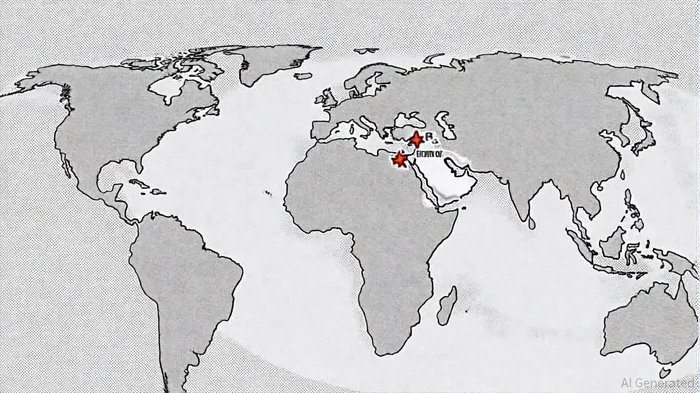
In the volatile landscape of 2025, the interplay between political rhetoric and oil markets has become a defining feature of global economic stability. Recent events, such as the June 2025 Israeli airstrikes on Iranian nuclear infrastructure, have demonstrated how geopolitical tensions can trigger immediate and sharp price swings. Brent crude prices surged 7–11% within hours of the incident, with analysts estimating a $10/barrel risk premium tied to fears of supply disruptions through the Strait of Hormuz [1]. This underscores a critical truth: political posturing, even without physical conflict, can act as a catalyst for oil price volatility.
The Mechanism of Political Rhetoric in Energy Markets
Political rhetoric shapes market perceptions by amplifying fears of supply disruptions. For instance, the Russia-Ukraine war, which began in 2022, remains a foundational case study. The invasion initially pushed crude prices above $120 per barrel, driven by Western sanctions on Russian exports and fears of cascading supply shocks [1]. While the immediate crisis has stabilized, the war's ripple effects persist. European nations have diversified imports, with India and China absorbing discounted Russian crude, while Gulf states and Nigeria have capitalized on higher prices [1].
The influence of rhetoric extends beyond direct conflicts. Tensions between the U.S. and China over Taiwan, coupled with the shifting balance of power in a multipolar world, have created a climate of uncertainty. As noted in a 2025 analysis, even the potential for conflict—rather than actual disruptions—can drive oil prices upward, as investors price in risk premiums [2]. This dynamic is further compounded by the role of OPEC+ spare capacity, which acts as a buffer but cannot fully offset shocks from politically unstable regions [1].
Investment Strategies for Navigating Geopolitical Risks
In response to this volatility, institutional investors have adopted a range of strategies to hedge against geopolitical-driven oil price swings. Goldman SachsGS-- Research projects Brent crude prices will fluctuate between $70–$85 per barrel in 2025, contingent on non-OPEC production and geopolitical developments [1]. To mitigate risks, investors are increasingly diversifying into alternative assets and employing hedging mechanisms.
Commodity Diversification: Gold has emerged as a strategic asset, with global demand rising 16% in Q1 2025. Its low correlation with traditional equities makes it a reliable hedge during geopolitical crises [3]. Similarly, natural gas and BitcoinBTC-- are gaining traction. Bitcoin's 10-year correlation of 0.15 with the S&P 500 positions it as a digital safe haven, though its volatility remains a concern [3].
Hedging Instruments: Call and put options are being used to lock in price ranges for crude oil. Call options protect against rising prices by capping costs, while put options shield producers from downside risks [3]. Hedge funds, particularly global macro funds, have also demonstrated agility in timing geopolitical events, adjusting exposure based on real-time risk assessments [2].
Regional Reallocation: Investors are reducing exposure to politically unstable regions while increasing allocations to emerging markets with stable growth trajectories. For example, U.S. shale production is expected to add 0.4–0.5 million barrels per day in 2025, offering a buffer against supply shocks [3].






Comentarios
Aún no hay comentarios