
The New Geopolitical Playbook: How AI Is Redrawing the Map of Global Manufacturing and Trade Costs
The global supply chain has long been a labyrinth of variables—tariffs, geopolitical tensions, logistics bottlenecks, and shifting labor costs. But in 2025, artificial intelligence has emerged as the cartographer of this new economic frontier, enabling companies to navigate these complexities with unprecedented precision. From Apple’s reshoring to Tesla’s battery sourcing, AI is not just optimizing supply chains; it’s rewriting the rules of global trade.
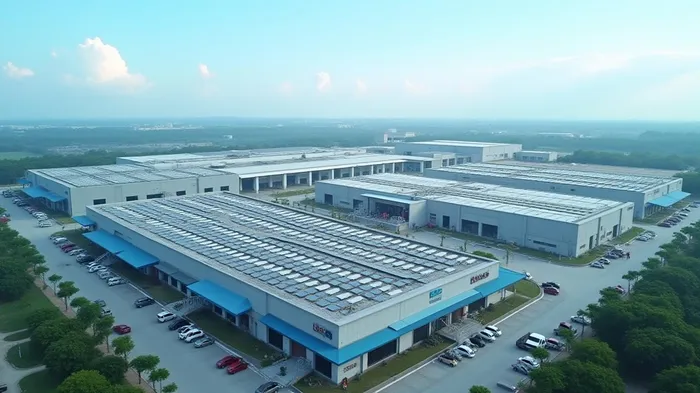
Apple’s Playbook: AI as a Geopolitical Hedge
Apple’s decision to shift 30% of iPhone production from China to Vietnam and India isn’t just a cost-cutting move—it’s a data-driven strategy to sidestep U.S. tariffs. The company’s AI systems analyze geopolitical risks, supplier reliability, and tariff trends in real time, identifying regions where labor costs are competitive and trade policies are stable. The result? A supply chain that’s both agile and insulated from sudden policy shifts.
This proactive approach isn’t just theoretical. reveal a steady rise, even as competitors grapple with supply chain disruptions. Tesla’s use of AI to map lithium suppliers in the U.S. and Australia—regions less exposed to trade wars—has allowed it to maintain its edge in battery production, a critical factor in its market leadership.
Amazon’s $1 Billion Lesson: AI as Logistics Wizardry
Amazon’s savings of over $1 billion in tariff-related costs are a testament to AI’s power in real-time logistics. Its systems continuously reroute inventory based on port congestion, fuel prices, and geopolitical risks. For instance, by predicting delays at the Port of Los Angeles, Amazon’s algorithms might redirect shipments to a Southeast Asian hub, cutting both costs and exposure to U.S.-China trade tensions.
The company’s investments in AI-driven fulfillment centers have also streamlined operations. show how these efficiencies have translated into sustained growth, even as traditional retailers falter.
The Rise of “Agentic AI”: From Tools to Strategists
Firms like Molex, a global electronics manufacturer, are deploying AI platforms like ConverSight’s Athena to act as “digital strategists.” These systems analyze trade policies, supplier risks, and demand trends, then recommend actions—such as shifting production to Mexico or diversifying battery suppliers—to mitigate tariffs. In one case, a truck manufacturer reduced disruptions by 80% using Athena’s predictive alerts.
Such tools are now essential for companies navigating the labyrinth of regional trade deals. For example, the U.S.-Mexico-Canada Agreement (USMCA) requires precise tracking of regional content rules—a task perfectly suited to AI’s ability to parse legal complexities and optimize compliance.
The Cost of Inaction: Why Legacy Systems Are Losing the Race
Not all companies are adapting. A $5 billion industrial manufacturer nearly collapsed under the weight of outdated analytics until it deployed Athena, which restored visibility within three months. The lesson is clear: firms relying on static models risk liquidity crises as tariffs and trade policies shift.
The Bottom Line: AI as the New Trade Currency
The data is unequivocal. Companies leveraging AI to map supply chains and tariffs are outperforming peers. Consider the , which shows the latter outpacing traditional indices by 15% over three years.
In 2025, AI isn’t just a competitive advantage—it’s a survival tool. Companies like Apple, Amazon, and Tesla have already demonstrated that predictive analytics, real-time data integration, and dynamic supplier diversification can turn trade wars into opportunities. For investors, the path forward is clear: back firms with the AI infrastructure to navigate—and profit from—the next wave of geopolitical turbulence.
The era of static supply chains is over. In this new world, only the agile survive, and agility is now measured in algorithms.
Conclusion
The rise of AI-driven supply chain management has fundamentally altered the calculus of global trade. Companies like Apple and Amazon have already leveraged these tools to sidestep tariffs, reduce costs, and outpace competitors—a strategy validated by Amazon’s $1 billion in savings and Tesla’s stock performance. Meanwhile, platforms like Athena are democratizing access to predictive analytics, enabling even mid-sized firms to compete with giants.
As geopolitical risks grow, so does the imperative for AI integration. Investors should prioritize firms with robust AI capabilities, as they are best positioned to thrive in a world where trade policies shift faster than any human team can respond. The future belongs to those who let the machines map the way.







Comentarios
Aún no hay comentarios