
The Geopolitical Oil Supply Shift: Sanctions, Market Disruptions, and Strategic Entry Points in Energy Markets
OPEC's Strategic Expansion: A New Era of Supply Control
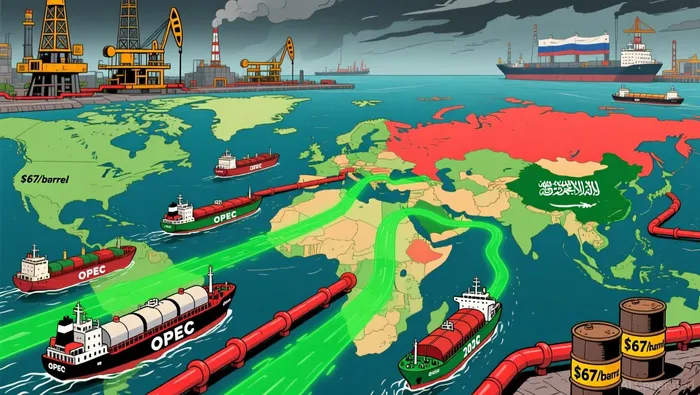
The U.S. sanctions have created a vacuum in global oil supply, with Russian exports accounting for 7% of global consumption before the restrictions, according to a Jordan News report. OPEC, recognizing this shift, has ramped up production by 2.7 million barrels per day in 2025 and plans to add 137,000 barrels daily in November, according to a BIPC analysis. Kuwait's oil minister, Tariq Al-Roumi, has explicitly stated that the group anticipates a "positive impact" from the sanctions, as demand pivots toward Gulf producers, the BIPC analysis notes. This strategic expansion positions OPEC to dominate a market increasingly starved of Russian crude, with Brent crude prices surging over 5% in Asian markets as traders anticipate tighter supplies, the Jordan News report observes.
For investors, OPEC's dominance offers a dual opportunity: exposure to stable, sanctioned-free suppliers and the potential for long-term pricing power. However, the risk lies in over-reliance on OPEC's production decisions, which could lead to volatility if geopolitical tensions in the Middle East escalate.
Secondary Sanctions: A Double-Edged Sword for Global Trade
The U.S. has weaponized secondary sanctions to deter non-U.S. entities from engaging with sanctioned Russian firms. For example, Lukoil's force majeure declaration at Iraq's West Qurna-2 oil field-linked to U.S. sanctions-has disrupted global supply chains and triggered a 20% drop in its stock price, the Discovery Alert report notes. Similarly, Hungary's temporary exemption for its refiner Mol highlights the complexity of navigating sanctions while maintaining energy security, Bloomberg reports.
These enforcement mechanisms create compliance risks for international investors, particularly in Asia. Indian refiners like Reliance Industries have paused Russian crude purchases to avoid secondary penalties, the Jordan News report observes, while Chinese buyers employ shadow financial structures to circumvent restrictions, the Discovery Alert report notes. For investors, the key risk lies in the unpredictability of U.S. enforcement, which could abruptly disrupt supply chains or trigger retaliatory measures from sanctioned nations.
Shifting Asian Buyer Behaviors: A Tale of Two Giants
India and China, Russia's largest oil buyers, are recalibrating their strategies. India has reduced Russian crude imports to 1.8 million barrels per day, the Jordan News report notes, while Chinese refiners leverage local-currency deals to maintain access, the same report notes. However, smaller Asian nations like Australia have exploited loopholes, importing Russian oil via Singapore to bypass direct sanctions, according to a Mezha report. This fragmented response underscores the economic imperative of energy security, even as geopolitical pressures mount.
For investors, the shift in Asian demand patterns presents opportunities in Middle Eastern and African suppliers. For instance, India's pivot to U.S. crude imports-reaching 540,000 barrels per day in October 2025-signals a growing U.S.-India energy partnership, the Jordan News report notes. Conversely, the rise of shadow fleets and alternative payment systems in China and Southeast Asia could destabilize traditional trading networks, creating volatility in pricing and logistics.
Underappreciated Risks and Opportunities
- De-Dollarization and Currency Volatility: Russia's pivot to barter trade and local-currency deals with Asian partners could accelerate the erosion of the U.S. dollar's dominance in energy markets, the Jordan News report notes. Investors in emerging-market currencies or commodities denominated in yuan or rupees may benefit, but hedging risks will become critical.
- Supply Chain Resilience: The rise of shadow fleets and alternative insurance markets (e.g., Singapore-based operators) could reduce costs for sanctioned buyers but increase operational risks for insurers and logistics providers, the Discovery Alert report notes.
- OPEC+ Pricing Power: As OPEC+ tightens output, it may leverage its market share to stabilize prices, creating a favorable environment for long-term investors in Gulf-based energy firms.
Strategic Entry Points for Investors
- OPEC-Linked Producers: Companies like Saudi Aramco and ADNOC are well-positioned to capitalize on increased demand.
- Energy Infrastructure in Asia: Firms involved in refining, storage, and logistics (e.g., Reliance Industries, Petronas) could benefit from shifting trade flows.
- Alternative Energy Corridors: Investments in African and Middle Eastern oil projects, such as Eni and Petronas's $15 billion Southeast Asia joint venture, offer exposure to emerging supply hubs.
Conclusion
The U.S. sanctions on Russian oil have catalyzed a profound realignment of global energy markets. While OPEC's expansion and Asian buyer adaptability present clear opportunities, the risks of secondary sanctions, de-dollarization, and supply chain fragility cannot be ignored. For investors, the path forward lies in balancing exposure to sanctioned-free suppliers with hedging against geopolitical volatility. The next phase of the energy transition will be defined not just by technology, but by the geopolitical chessboard-where every move reshapes the rules of the game.







Comentarios
Aún no hay comentarios