
Geopolitical Manufacturing Shifts and the Reshaping of Global Tech Supply Chains: Assessing Investment Risks and Opportunities in Chinese Tech Expansion
Geopolitical Drivers and Strategic Realignments
The U.S.-China trade relationship remains a pivotal factor. Recent diplomatic efforts, such as the meeting between Chinese Commerce Minister Wang Wentao and U.S. Ambassador David Perdue, underscore a mutual interest in stabilizing economic ties despite ongoing export restrictions and investment curbs according to reports. These policies have compelled Chinese firms to seek alternative production hubs, often through indirect partnerships or state-backed initiatives. For instance, Nvidia's collaboration with firms partially owned by the Chinese Communist Party highlights the delicate balance between compliance and commercial interests as research shows.
Key Expansion Regions and Case Studies
Southeast Asia has emerged as a primary destination. Thailand's push for electric vehicle (EV) production, with a target of 30% zero-emission vehicles by 2030, and Vietnam's $440 billion export surge (CAGR of 8.2% from 2019–2023) in electronics and semiconductors, exemplify this trend according to market analysis and as McKinsey reports. Chinese firms like CATL and Gotion are investing heavily: CATL's $1.5 billion EV battery complex in Indonesia and Gotion's $1.2 billion plant in Slovakia according to research.
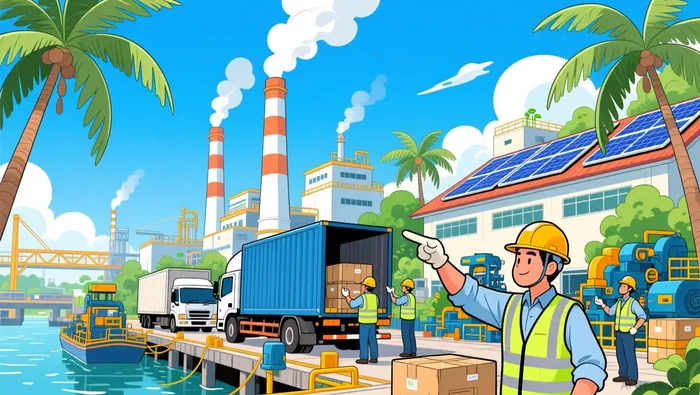 Eastern Europe is also attracting significant capital. Hungary's EUR 7.3 billion CATL battery facility and Türkiye's $800 million tax incentives for EV manufacturers reflect the region's strategic appeal according to market analysis. Meanwhile, the Middle East is becoming a renewable energy hub. Jinko Solar's localization efforts in Saudi Arabia and ACWA Power's 1 GW solar and wind projects in China illustrate the alignment of Gulf capital with Chinese clean energy ambitions according to Chinese media.
Investment Opportunities
- Renewable Energy and Infrastructure Gaps: The Gulf's $312 million investment in solar and wind projects according to Chinese media and Southeast Asia's fragmented logistics sector offer opportunities for firms specializing in warehousing, port facilities, and EV battery storage as McKinsey reports.
- EV and Battery Manufacturing: With China accounting for 31% of global clean energy investment in 2024 according to Chinese media, firms like BYD and CATL are leveraging lower-cost labor and favorable policies in Indonesia and Hungary.
- Strategic Partnerships: The Belt and Road Initiative has enabled companies like SANY Renewable Energy to transition from suppliers to project partners in emerging markets according to Chinese media.
Investment Risks
- Cybersecurity and Geopolitical Tensions: The December 2024 U.S. Treasury breach by Chinese hackers according to CBS News, while not involving classified data, underscores persistent cyber risks. Similarly, U.S. export controls and the recent controversy over a Chinese embassy in London according to Sky News highlight political volatility.
- Financial and Regulatory Challenges: Dun & Bradstreet reports rising risks in volatile tariff structures, opaque partner finances, and delayed payments in key markets according to Sky News. For example, Southeast Asia's low outsourcing rates and infrastructure gaps could deter new entrants as McKinsey reports.
- Geopolitical Stability: While Morocco and Türkiye offer political stability, regions like Eastern Europe face complex customs regulations and potential U.S.-China escalation risks according to market analysis.
Conclusion
Chinese tech firms' global expansion is a response to both necessity and opportunity. For investors, the key lies in balancing the promise of high-growth markets with the realities of geopolitical and operational risks. Southeast Asia's infrastructure gaps and the Middle East's renewable energy push offer compelling entry points, but due diligence on cybersecurity, regulatory environments, and partner reliability is critical. As supply chains continue to diversify, the ability to navigate these dynamics will define the success of investments in this evolving landscape.







Comentarios
Aún no hay comentarios