
The Geopolitical and Financial Risks of Stablecoin Expansion in Sanctioned Markets
The rapid adoption of stablecoins in Latin America's crypto-driven oil economy has created a dual-edged sword: a lifeline for economic resilience in sanctioned markets and a potential vector for illicit financial activity. As countries like Venezuela leverage stablecoins to bypass U.S. sanctions and Brazil builds regulatory frameworks to integrate digital assets, the region is becoming a testing ground for the intersection of geopolitics, institutional compliance, and financial innovation. However, the risks of sanctions evasion, money laundering, and regulatory fragmentation loom large, demanding urgent attention from global policymakers and institutional investors.
The Rise of Stablecoins in Sanctioned Oil Markets
Venezuela's oil sector has become a textbook case of how sanctioned economies exploit stablecoins to circumvent traditional financial systems. According to a report by , the Maduro administration began accepting USDT for oil exports as early as 2024, enabling it to bypass U.S. sanctions on PDVSA and the Central Bank. This strategy has been amplified by China, which accounted for 84% of Venezuela's oil exports in 2025, often facilitated by digital payments. The use of stablecoins here is not merely a technical workaround but a geopolitical maneuver, allowing sanctioned regimes to access hard currency while evading U.S. oversight.
Brazil, meanwhile, has taken a different approach. With 90% of its crypto transactions in 2025 linked to stablecoins, the country has positioned itself as a regulatory leader. The 2022 Virtual Assets Law and the Drex CBDC pilot have created a structured environment for stablecoin integration, particularly in cross-border oil trade settlements according to Chainalysis. However, even in Brazil, the lack of global reserve transparency standards for stablecoins-highlighted by the collapse of TerraUSD in 2022-raises concerns about systemic risks.
Institutional Compliance Challenges
Institutional adoption of stablecoins in Latin America's oil sector is hindered by fragmented regulatory frameworks. While Brazil has implemented KYC and AML requirements for VASPs according to Chainalysis, countries like Mexico and Colombia lag behind, creating compliance loopholes. For example, Mexico's strengthened AML rules for crypto providers according to Trmlabs contrast with Argentina's more permissive stance, where tax incentives for crypto declarations according to Trmlabs have inadvertently encouraged speculative stablecoin use.
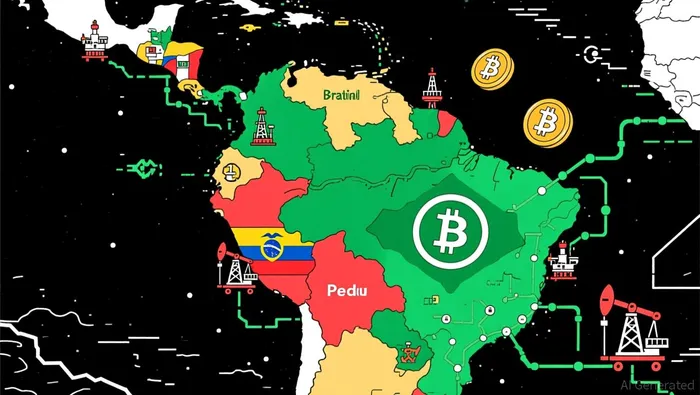
The oil sector's reliance on stablecoins for cross-border payments further complicates compliance. Platforms like Brazil's Pix and Mexico's CoDi enable seamless fiat-to-stablecoin conversions according to Chainalysis, but these systems must navigate jurisdictional differences. A 2025 Chainalysis report notes that 70% of Latin American institutions have integrated stablecoin infrastructure, yet only 29% cite regulatory uncertainty as a barrier-a stark contrast to the global average of 41% according to Fireblocks. This suggests a growing institutional confidence in stablecoins, even as risks like oracle manipulation and smart contract vulnerabilities persist according to Elliptic.
Geopolitical Implications and Illicit Finance
The geopolitical stakes are high. Stablecoins are not only tools for economic survival in sanctioned markets but also conduits for illicit finance. A 2025 GNET Research report reveals that Hezbollah-linked networks in Latin America have exploited stablecoins for sanctions evasion and money laundering. In Venezuela, where hyperinflation has rendered the bolívar nearly worthless, stablecoins have become a dual-use asset: a hedge for ordinary citizens and a vehicle for illicit actors to move funds across borders according to Bitso.
The U.S. GENIUS Act, enacted in July 2025, aims to address these risks by imposing stricter reserve and compliance requirements on stablecoins according to HK Law. However, its influence on Latin American regulators remains uncertain. While Brazil and Argentina have shown willingness to adopt structured frameworks according to Chainalysis, countries like Ecuador and Peru lack the institutional capacity to enforce similar standards. This regulatory asymmetry creates fertile ground for bad actors to exploit gaps in oversight.
Regulatory Responses and the Path Forward
The region's regulatory landscape is evolving rapidly. Brazil's Banco Central do Brasil has positioned itself as the AML/CFT authority for virtual assets according to Chainalysis, while Argentina's tokenized asset framework according to Trmlabs signals a proactive approach. Yet, the absence of a unified Latin American regulatory body means compliance remains a patchwork of national policies.
For institutional investors, the key risk lies in balancing innovation with compliance. Stablecoins offer efficiency gains in oil trade settlements and remittances, but their use in sanctioned markets demands rigorous due diligence. The collapse of TerraUSD and the risks of reserve mismanagement underscore the need for transparent reserve audits and redemption mechanisms.
Conclusion
Stablecoins are reshaping Latin America's oil economy, offering both opportunities and existential risks. While they provide a critical financial lifeline for sanctioned nations, their potential for misuse in sanctions evasion and money laundering cannot be ignored. Institutional investors must navigate this terrain with caution, prioritizing jurisdictions with robust regulatory frameworks like Brazil's while advocating for global standards to address cross-border compliance gaps. As the region's oil sector becomes increasingly intertwined with digital finance, the balance between innovation and oversight will determine whether stablecoins become a force for economic resilience-or a catalyst for geopolitical instability.







Comentarios
Aún no hay comentarios