
The Geopolitical and Economic Implications of Taiwan's Record US Trade Surplus for Global Tech and Semiconductor Investors
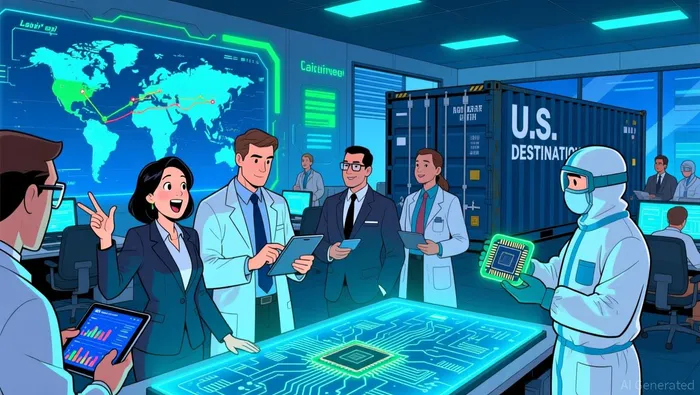
In Q4 2025, Taiwan's trade surplus with the U.S. hit a record $21.14 billion, driven by a 1,700% surge in semiconductor exports, particularly integrated circuits and data processing units. This growth underscores Taiwan's critical role in the global semiconductor supply chain, with U.S. exports accounting for 34.2% of its total exports. The U.S. remains Taiwan's largest market for advanced chips, with IC manufacturing and equipment exports to the U.S. reaching $92.5 billion and $2.4 billion, respectively, by mid-2025 according to U.S. trade data. However, this economic success is now intertwined with geopolitical risks, as U.S. tariff policies and shifting global dynamics test the resilience of Taiwan's chip sector.
Geopolitical Risks and U.S. Tariff Pressures
The Trump administration's 100% tariff on imported semiconductors, announced in August 2025, has reshaped the industry's landscape. While this policy aims to incentivize domestic manufacturing, it has also created uncertainty for global supply chains. Taiwan's semiconductor firms, led by TSMCTSM--, are navigating these challenges through strategic investments in U.S. facilities. TSMC's $65 billion commitment to build three advanced fabrication plants in Arizona, paired with a $6.565 billion U.S. government subsidy under the CHIPS and Science Act, exemplifies this pivot.
Yet, the tariffs have sparked concerns about long-term stability. A 2025 study highlights that diversification and stockpiling are insufficient to mitigate risks from prolonged disruptions, such as a potential Chinese quarantine or blockade. Taiwanese President Lai Ching-te has emphasized collaboration with the U.S. to maintain mutual economic interests, but skepticism persists about whether U.S. policies could inadvertently weaken Taiwan's strategic importance.
Investment Resilience and Strategic Adaptations
Despite these risks, Taiwan's semiconductor industry has demonstrated remarkable resilience. In 2025, nearly half of U.S. inbound greenfield FDI originated from Taiwan, driven by TSMC's expansion and its partners' efforts to secure tariff exemptions. TSMC's 2025 capital expenditures, projected at $40–$42 billion, reflect confidence in AI and high-performance computing (HPC) demand, with 70% allocated to advanced process technologies. This spending has fueled a 62% year-over-year increase in capital expenditures for the first half of 2025, solidifying TSMC's dominance in the sector.
The industry's adaptability is further supported by multilateral initiatives. The "triad cross-platform model"- encompassing Chip 4, the QUAD, and GAMS-has emerged as a key strategy to enhance supply chain resilience. These platforms aim to coordinate crisis management, share geopolitical risk assessments, and reduce reliance on China. For instance, Chip 4's collaboration among the U.S., Japan, South Korea, and Taiwan has already prioritized securing raw material flows and mitigating disruptions.
Investor Sentiment and Financial Performance
Investor confidence in Taiwan's semiconductor sector remains robust, despite short-term tariff pressures. TSMC's Q3 2025 earnings, for example, surged 39.1% year-on-year to NT$452.3 billion ($14.77 billion), driven by strong demand for 3nm and 5nm chips. The company's stock price rose over 55% year-to-date, outperforming broader market trends. Similarly, the sector's HPC segment, which includes AI applications, accounted for 57% of TSMC's Q3 revenue.
However, long-term challenges persist. While TSMC and its peers are expanding U.S. operations, lower-margin industries in Taiwan face intensified competition from Southeast Asia as global supply chains realign. Public sentiment in Taiwan toward the U.S. has also soured, with fears that U.S. policies may undermine the island's security and strategic value.
Conclusion
Taiwan's semiconductor industry is navigating a complex interplay of geopolitical risks and economic opportunities. While U.S. tariffs have introduced short-term volatility, the sector's resilience-bolstered by strategic investments, multilateral cooperation, and strong demand for AI/HPC technologies-positions it for sustained growth. For global investors, the key lies in balancing these risks with the sector's long-term potential. As TSMC and its partners continue to adapt, the industry's ability to innovate and collaborate will determine its role in shaping the future of global tech.





Comentarios
Aún no hay comentarios