
Geopolitical De-Escalation and Emerging Markets: A Fragile Path to Recovery
Geopolitical risk has long been a double-edged sword for emerging market equities, acting as both a catalyst for volatility and a driver of selective resilience. Recent de-escalation efforts, particularly between the United States and China, have offered a temporary reprieve, but their broader implications for investor sentiment and capital flows remain nuanced. As global markets navigate a fragmented landscape of trade tensions and regional conflicts, the interplay between diplomacy and economics is reshaping investment strategies in emerging economies.
The U.S.-China Tariff Truce: A Short-Term Balm
The 90-day extension of the U.S.-China tariff truce in August 2025 provided a fleeting boost to global markets. According to a report by Global Market News, the agreement spurred a rally in Asian equities, with Japan's Nikkei 225 and U.S. shipping and retail stocks rising to record highs. This truce, which reduced U.S. tariffs on Chinese goods from 145% to 30% and cut Chinese tariffs on U.S. goods from 125% to 10%, offered critical stability for supply chains during the holiday shopping season. Flexport, a major logistics firm, reported a 35% surge in Chinese import bookings, underscoring the immediate relief for trade-dependent sectors.
However, the truce's benefits are constrained by unresolved structural issues. Technology export controls, rare earths leverage, and trade deficit imbalances remain unaddressed, leaving investors wary of renewed escalations after November 10. This uncertainty has prompted a shift toward hedging strategies and geographic diversification, as highlighted by JPMorgan's analysis. While the MSCI Emerging Markets Index saw a modest rebound, the long-term trajectory hinges on whether these de-escalation efforts evolve into durable agreements, as discussed in a ScienceDirect analysis.
Regional Variations in Capital Flows: A Tale of Two Markets
The impact of geopolitical de-escalation on capital flows varies starkly across regions. Non-China emerging markets have shown relative resilience, with the Institute of International Finance projecting $71 billion in net inflows for 2024. Asia, excluding China, has benefited from robust macroeconomic fundamentals and policy stability, as noted by the OECD. For instance, JPMorgan's inclusion of India in a benchmark local currency bond index is expected to attract $15–20 billion in inflows to Indian government debt, bolstering the rupee, as shown by the BlackRock geopolitical dashboard.
Latin America, meanwhile, has emerged as a safe haven for capital amid global uncertainty. The IIF attributes this to the region's role as a commodity producer, geographic insulation from major conflicts, and nearshoring trends, a pattern noted in a Reuters report. Countries like Brazil and Mexico are attracting foreign direct investment (FDI) as multinational corporations diversify supply chains. Conversely, Africa and the Middle East have seen a $149 billion net inflow in 2024, driven by Egypt, Saudi Arabia, and the UAE's economic reforms and geopolitical stability.
China, however, remains an outlier. Brookings research highlights a significant decline in both portfolio and direct investment inflows, reflecting broader trends of financial deglobalization. This divergence underscores the uneven impact of U.S.-China tensions on emerging markets, with non-China economies gaining traction while China faces persistent outflows.
Investor Sentiment: A Mixed Bag Beyond the U.S.-China Axis
Investor sentiment in emerging markets is increasingly influenced by factors beyond the U.S.-China dynamic. A study published in the Journal of International Financial Markets, Institutions and Money found that sentiment significantly impacts short-term equity returns in markets like Brazil, South Africa, and Indonesia. For example, optimism about India's structural reforms and Africa's energy transition projects has driven inflows, even as global uncertainties persist.
Yet, the PwC Global Investor Survey 2024 notes a broader caution, with investors prioritizing supply chain resilience and technological innovation over speculative bets. This shift is evident in the growing preference for companies with diversified supply chains and reduced China exposure, a trend reflected in BlackRock's risk monitoring. While the survey does not quantify emerging market sentiment directly, it highlights a general trend toward risk mitigation in a fragmented global economy.
Risks and the Road Ahead
Despite the recent uptick in optimism, risks loom large. The International Monetary Fund (IMF) warns that unresolved military conflicts-such as the U.S. and Israeli strikes on Iran in mid-2025-could disrupt energy infrastructure and trigger renewed volatility. Additionally, rising trade protectionism and government interventions threaten to fragment globalization further, complicating long-term investment horizons.
For emerging markets, the path forward depends on balancing short-term gains from de-escalation with strategic investments in resilience. Policymakers must address domestic structural challenges while leveraging geopolitical lulls to attract capital. Investors, in turn, should adopt a nuanced approach, favoring regions and sectors with strong fundamentals and geopolitical buffers.
Conclusion
Geopolitical de-escalation has provided a temporary boost to emerging market equities, with regional variations highlighting the uneven distribution of benefits. While the U.S.-China tariff truce and Middle East tensions illustrate the fragility of this stability, the broader trend toward regional diversification and supply chain resilience offers a glimmer of hope. As the global economy navigates this complex landscape, the interplay between diplomacy and economics will remain a critical determinant of emerging market performance.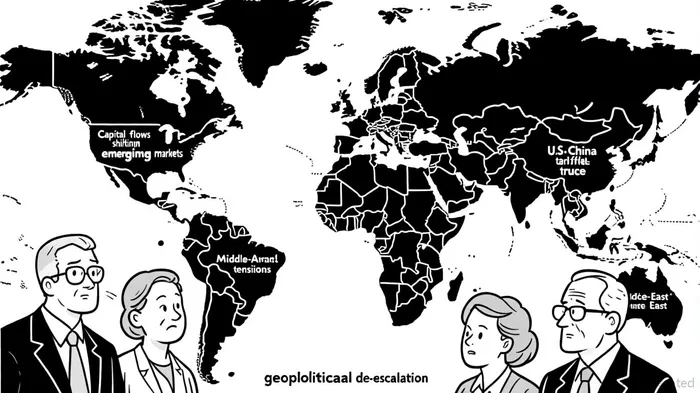






Comentarios
Aún no hay comentarios