
Geopolitical Cyber Risks and the Crypto Market: Assessing Long-Term Viability Amid Regulatory and Geopolitical Pressures
The Dual Threat: Geopolitical Cyber Incidents and Market Volatility
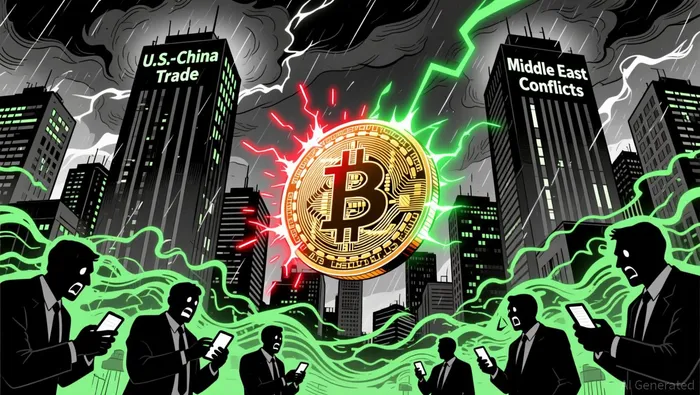
The October 2025 tariff announcement by President Trump exemplifies how geopolitical decisions can weaponize macroeconomic uncertainty against leveraged crypto positions. Open interest ballooned to $217 billion while liquidity shrank to 5% of normal levels, creating a domino effect of liquidations, according to a CryptoFrontNews analysis. Simultaneously, cybercriminals capitalized on the chaos, with phishing attacks surging 40% and malware like CLEARFAKE exploiting blockchain immutability to store malicious payloads, as noted in a Kroll report.
These events underscore a critical vulnerability: crypto's digital-first nature makes it a prime target for both state-sponsored actors and opportunistic hackers. According to a Kroll report, nearly $1.93 billion was stolen in crypto-related crimes in the first half of 2025 alone. However, the market's response to these threats is not purely reactive. Institutional investors, recognizing crypto's safe-haven potential amid geopolitical uncertainty, plan to increase BitcoinBTC-- holdings by 43% in the coming year, as the Kroll report notes.
CBDCs and Regulatory Divergence: A New Frontier
Central Bank Digital Currencies (CBDCs) are emerging as both a competitor and a collaborator to private cryptocurrencies. By 2025, 134 countries are exploring or developing CBDCs, with 11 already launched, according to a Mordor Intelligence analysis. China's e-CNY pilot, now active in 260 million wallets, and India's e-rupee trials highlight how governments aim to reclaim monetary sovereignty while addressing crypto's disruptive potential.
Regulatory frameworks are evolving rapidly but unevenly. The EU's Markets in Crypto-Assets (MiCA) regulation, fully operational by Q1 2025, mandates strict licensing for crypto service providers, according to a Relmin analysis. Meanwhile, the U.S. GENIUS Act imposes 1:1 backing requirements on stablecoins, mirroring the UK's 2026 stablecoin consultation, as reported by Yahoo Finance. These divergent approaches create a patchwork of compliance challenges, with 62% of firms maintaining dual regulatory stacks to navigate U.S.-EU differences, as the Mordor Intelligence analysis notes.
The Paradox of Resilience: Crypto as a Safe-Haven Asset
Despite the risks, cryptocurrencies are increasingly viewed as hedges against geopolitical instability. During the Russia–Ukraine war and the Israel–Palestine conflict, Bitcoin demonstrated price stability and increased trading volumes, reinforcing its role as a digital safe haven, according to a ScienceDirect article. This trend is echoed in institutional behavior: corporations like Sequans Communications are liquidating Bitcoin holdings to optimize debt structures, as reported by StreetInsider, while others are building stablecoin liquidity pools to hedge inflation, as noted in the Mordor Intelligence analysis.
However, this resilience is not universal. Altcoins like EthereumETH-- and XRPXRP-- face heightened selling pressure as traders favor short-term strategies amid regulatory ambiguity, according to a FXStreet report. The market's bifurcation-between speculative assets and utility-driven tokens-highlights the need for nuanced investment approaches.
Navigating the Future: Strategic Implications for Investors
For crypto to thrive long-term, stakeholders must address three critical challenges:
1. Cybersecurity: With hack losses dropping 85.7% in October 2025 despite growing threats, according to a CoinCentral report, the industry must adopt advanced RegTech tools like zero-knowledge proofs (ZKPs) to balance compliance and privacy, as noted in a Relmin analysis.
2. Regulatory Arbitrage: As the UAE's VARA and Singapore's licensing systems tighten, according to a Relmin analysis, firms will increasingly exploit jurisdictional gaps. Investors should prioritize projects with multi-jurisdictional compliance.
3. CBDC Integration: The projected $213 billion in CBDC transactions by 2025, as noted in the Mordor Intelligence analysis, signals a shift toward hybrid financial systems. Crypto projects that enable interoperability with CBDCs-such as cross-chain bridges-may capture significant value.
Conclusion
The crypto market's long-term viability hinges on its ability to adapt to geopolitical and regulatory headwinds while leveraging its inherent strengths. While cyber threats and CBDCs pose existential risks, they also catalyze innovation in security, compliance, and utility. For investors, the key lies in distinguishing between speculative noise and structural tailwinds-a task requiring both macroeconomic foresight and granular risk management.






Comentarios
Aún no hay comentarios