
The Geopolitical Crypto Risk: How Sanctioned Nations Are Weaponizing Digital Assets
The global crypto ecosystem, once hailed as a decentralized utopia for financial innovation, is increasingly becoming a battleground for geopolitical conflict. Sanctioned nations like Russia, Iran, and North Korea have weaponized digital assets to circumvent financial restrictions, destabilize global markets, and fund strategic objectives. As these actors exploit the pseudonymous and borderless nature of cryptocurrencies, the systemic risks to the crypto ecosystem-and the opportunities for regulatory and technological innovation-have never been more urgent.
The Rise of Adversarial Crypto Use
Sanctioned nations have developed sophisticated methods to leverage digital assets for sanctions evasion. Russia, for instance, has launched state-backed crypto initiatives such as the A7A5 ruble-backed token, which processed over $93.3 billion in transactions in 2025, enabling the country to move value outside traditional financial systems. Russian fintech firms like B-Crypto and Masterchain have also partnered with sanctioned banks to tokenize assets like diamonds and precious metals, creating alternative financial rails. Similarly, Iran has turned to large-scale BitcoinBTC-- mining to fund imports and bypass payment restrictions, with $300 million traced to sanctioned crypto services in 2025. North Korea, meanwhile, has stolen over $3 billion in cryptocurrencies through cyberattacks since 2015, laundering proceeds via mixers like Tornado CashTORN-- to finance its nuclear program.
These activities are not isolated incidents but part of a coordinated strategy to exploit crypto's weaknesses. Platforms like Bitpapa and NetEx24, which operate via Telegram bots without KYC/AML safeguards, have facilitated millions of dollars in transactions for OFAC-designated entities, including the Hydra Market dark web marketplace. The result is a growing reliance on decentralized, unregulated infrastructure to obscure financial flows and evade global sanctions.
Systemic Risks to the Crypto Ecosystem 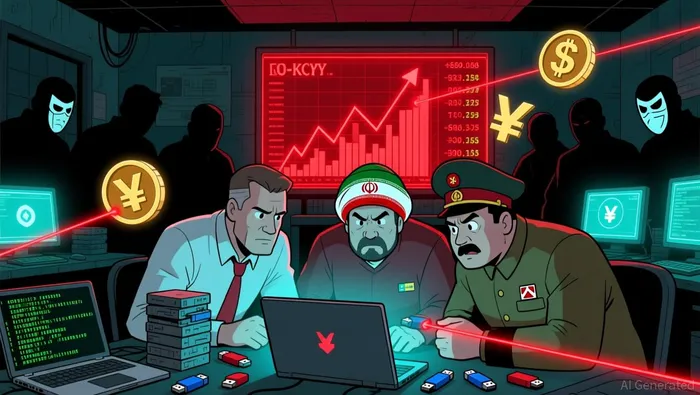
The adversarial use of crypto has introduced systemic risks that threaten market stability, trust, and regulatory coherence. By 2025, stablecoins accounted for 84% of illicit transaction volume, as sanctioned entities used them to bypass traditional financial systems. This trend has eroded confidence in crypto's legitimacy, with regulators warning of potential "runs on reserves" and cross-border coordination challenges. For example, the European Systemic Risk Board (ESRB) highlighted risks from stablecoins issued by EU and non-EU entities, including reserve liquidity crises and jurisdictional conflicts.
Regulatory fragmentation further exacerbates these risks. While the U.S. Treasury's Office of Foreign Assets Control (OFAC) has intensified efforts to dismantle illicit networks-such as sanctioning Russian-linked exchanges like Garantex-global enforcement remains inconsistent. Privacy coins and no-KYC exchanges continue to enable illicit finance, undermining the effectiveness of sanctions. This fragmentation not only weakens enforcement but also creates arbitrage opportunities for bad actors to exploit regulatory gaps.
Regulatory Responses and Compliance Innovations
The U.S. and its allies have responded with a mix of punitive measures and regulatory innovation. The GENIUS Act, signed into law in 2025, mandates 100% reserve backing for stablecoins and enforces strict AML programs, setting a global benchmark for stablecoin regulation. This framework has spurred institutional adoption, with traditional financial players entering the space to leverage blockchain for secure, compliant payments.
Meanwhile, technological advancements are reshaping compliance. AI-driven AML systems, for instance, are reducing false positives by 40% through real-time transaction monitoring. RegTech solutions, projected to exceed $22 billion by mid-2025, are enabling financial institutions to automate investigations and streamline due diligence. Privacy-enhancing technologies like zero-knowledge proofs are also gaining traction, allowing compliance without compromising user privacy.
In the decentralized finance (DeFi) space, compliance is becoming a core design principle. Protocols now require audited smart contracts, transaction monitoring, and blockchain-based KYC procedures to meet regulatory standards. For example, 15% of AML/KYC processes in 2025 are conducted via blockchain, leveraging immutable ledgers for tamper-proof records. These innovations are critical to addressing DeFi's unique risks while preserving its transformative potential.
Opportunities in a Fragmented Landscape
While the risks are significant, the adversarial use of crypto has also catalyzed innovation. The demand for robust compliance frameworks has created opportunities for firms specializing in on-chain analytics, cross-border intelligence sharing, and AI-driven investigations. For investors, this includes growth in RegTech, blockchain security, and AML-as-a-service providers.
Moreover, the push for international cooperation is fostering new alliances. The ESRB's call for legal reforms and cross-jurisdictional coordination, alongside the U.S. Treasury's designation of high-risk platforms, signals a shift toward unified oversight. These efforts, if sustained, could mitigate systemic risks while preserving crypto's utility for legitimate use cases.
Conclusion
The weaponization of digital assets by sanctioned nations underscores the dual-edged nature of crypto: a tool for both innovation and subversion. While adversarial actors exploit its pseudonymity and decentralization, regulators and technologists are racing to close loopholes and build resilient systems. For investors, the key lies in balancing exposure to the sector's transformative potential with a nuanced understanding of its geopolitical vulnerabilities. As the crypto ecosystem evolves, the interplay between sanctions evasion, regulatory innovation, and technological adaptation will define its trajectory-and its role in the global financial order.






Comentarios
Aún no hay comentarios