
Geopolitical Crossroads: How Trump's Foreign Policy Shifts Impact Defense Sector Equities
The U.S. under President Donald Trump has recalibrated its approach to NATO and Ukraine, introducing both opportunities and risks for defense sector equities. With over $69.7 billion in military aid to Ukraine since 2014—and plans for additional drawdowns—the administration's transactional stance on burden-sharing and its push for diplomatic solutions complicate the sector's trajectory. As the 2025 NATO summit in The Hague looms, defense equities are caught between geopolitical volatility and the structural shifts reshaping global military spending.
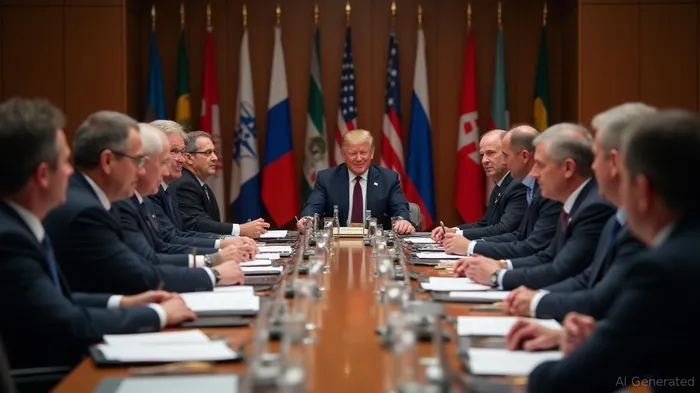
The Current Policy Landscape: A Transactional Turn
Trump's foreign policy prioritizes ending the Ukraine conflict through diplomacy, including a proposed 30-day ceasefire, while pressuring NATO allies to meet a 5% GDP defense spending target. However, European nations struggle to meet this goal, raising questions about NATO's future role in Ukraine's defense. The U.S. has opposed Ukrainian NATO membership, advocating instead for European-led solutions. This creates a paradox: while U.S. aid to Ukraine remains robust, NATO's internal fractures and shifting priorities could reduce long-term demand for certain defense systems.
The administration's focus on burden-sharing has also fueled debates over military spending efficiency. The Pentagon's reliance on Presidential Drawdown Authority (PDA) to supply Ukraine—totaling $31.7 billion since 2021—highlights the sector's direct ties to geopolitical events. Defense firms supplying air defense systems (e.g., Patriots), artillery, and armored vehicles stand to benefit, but prolonged uncertainty over NATO's cohesion could deter long-term investments in alliance-centric capabilities.
Historical Precedent: Geopolitical Events Drive Defense Sector Performance
The defense industry has long been a barometer of geopolitical tension. The 2014 Crimean annexation triggered a 50.6% spike in stock market reactions among global defense firms, with European and U.S. companies leading the surge. The Russia-Ukraine war amplified this effect, impacting 81.4% of defense equities as demand for arms, munitions, and logistics surged. By contrast, the 2023 Israel-Hamas conflict had localized impacts, underscoring how regional conflicts rarely translate into global defense sector booms.
This pattern suggests that sustained U.S. engagement in Ukraine—driven by Trump's transactional diplomacy—could maintain elevated defense spending. However, a sudden diplomatic resolution or NATO troop reductions could destabilize equities reliant on Ukraine-specific contracts.
Defense Industry Dynamics: Consolidation, Exports, and Tech Challenges
The post-Cold War era reshaped the defense industry through consolidation and globalization. By 1997, U.S. prime contractors dropped from 25 to 7, reducing competition but raising concerns about monopolistic practices. Today, the sector faces dual pressures: adapting to commercial tech (e.g., IT, biotech) while maintaining military uniqueness.
The U.S. has leaned on exports to offset domestic budget constraints, with arms sales rising to 70% of procurement outlays by 1999. This globalization, however, risks technology proliferation. Meanwhile, the Pentagon's outdated procurement system—rooted in WWII-era practices—struggles to integrate modern innovations, creating vulnerabilities.
Investment Considerations: Navigating Volatility and Growth
1. Sectors to Watch:
- Air Defense Systems: Firms supplying Patriots or Sky Shield Initiative components benefit from ongoing demand.
- Logistics and Munitions: Ukraine's prolonged conflict requires steady resupply, favoring companies with scalable production.
- European Defense Initiatives: Companies involved in NATO's Sky Shield or Franco-German tank programs may gain if allies increase spending.
2. Risks to Mitigate:
- Diplomatic Solutions: A ceasefire or peace deal could abruptly reduce U.S. aid, hurting firms reliant on Ukraine contracts.
- NATO Fragmentation: If burden-sharing fails, U.S. troop reductions could weaken demand for alliance-centric systems.
- Procurement Lag: The Pentagon's slow adoption of commercial tech may limit growth for IT/biotech-focused firms.
3. Strategic Plays:
- Diversified Portfolios: Invest in firms with exposure to both NATO and Ukraine-specific contracts (e.g., Raytheon Technologies, Lockheed Martin).
- ETFs with Geopolitical Exposure: Consider funds like the iShares U.S. Aerospace & Defense ETF (IAF) for broad sector exposure.
- Hedging with Diplomacy Plays: Short positions in defense equities could profit from sudden diplomatic breakthroughs.
Conclusion: A Delicate Balance
Defense equities under Trump's administration face a precarious equilibrium. While Ukraine-related spending and NATO's strategic pivot to Europe offer growth avenues, the sector's vulnerability to geopolitical shifts—whether diplomatic breakthroughs or allianceAENT-- fractures—demands caution. Investors should prioritize firms with diversified revenue streams, robust export channels, and exposure to tech integration. The 2025 NATO summit will be a pivotal moment: if cohesion is restored, defense equities could stabilize; if not, volatility will reign.
In this crossroads, agility and sector-specific analysis will be critical to capitalizing on the defense industry's evolving role in an era of U.S. transactional geopolitics.







Comentarios
Aún no hay comentarios