
Geopolitical Crossroads: How U.S. Military Posturing in Venezuela Signals Near-Term Opportunities in Defense, Oil, and Regional Stability Plays
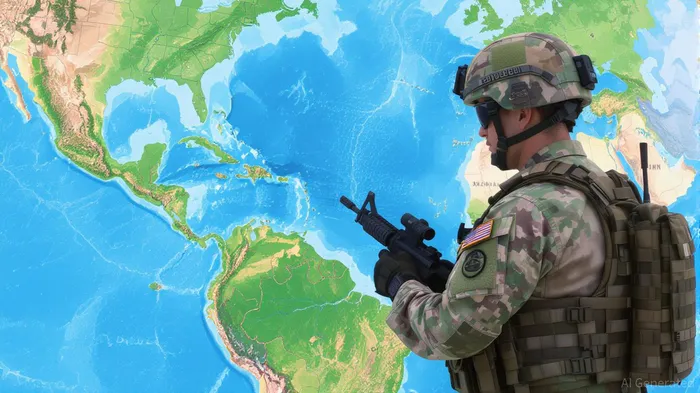
The U.S. military buildup in the Caribbean—marked by the deployment of seven warships, a nuclear-powered submarine, and over 4,500 personnel—has ignited a geopolitical firestorm with Venezuela. President Nicolás Maduro has framed this as an existential threat, declaring a state of “maximum preparedness” and mobilizing troops along the coast and border with Colombia [1]. The U.S., meanwhile, insists the operation is a counter-narcotics effort, targeting drug trafficking networks it claims are tied to Maduro’s regime [3]. This standoff is not merely a regional flashpoint; it is a catalyst for capital reallocation across defense, energy, and infrastructure sectors, offering investors a rare window to position ahead of volatility.
Defense Contractors: A Surge in Contracts and Strategic Relevance
The U.S. Department of Defense’s 2025 budget, allocating $850 billion with a significant portion directed to Caribbean operations, has turbocharged demand for defense contractors. Lockheed MartinLMT--, Raytheon, and BoeingBA-- have secured $13 billion in combined contracts for missile systems, surveillance technology, and logistics support [3]. Brazil and Colombia, responding to regional tensions, have announced defense spending increases of 5.9% and 12% respectively, with Brazil eyeing nuclear-powered submarines and Colombia prioritizing border security [2]. These developments underscore a broader arms race, with Latin American governments seeking to hedge against perceived U.S. aggression. For investors, defense primes like LockheedLMT-- and Raytheon represent not just short-term gains but long-term beneficiaries of a sustained U.S. security footprint in the region.
Oil Markets: Volatility and the Geopolitical Premium
Venezuela’s 303 billion barrels of proven oil reserves remain a linchpin of global energy markets, yet U.S. sanctions and military posturing have introduced a new layer of risk. The deployment of U.S. warships near Venezuela has raised insurance and shipping costs, embedding a “geopolitical risk premium” into oil prices [4]. While Chevron’s recent resumption of 25% of Venezuela’s production—a move critics argue props up Maduro’s regime—has temporarily stabilized output, the Citgo auction (valued at $11–13 billion) remains mired in legal disputes [5]. Investors are pivoting to stable producers like Colombia’s EcopetrolEC-- and Brazil’s PetrobrasPBR.A--, which benefit from U.S. security guarantees and regional infrastructure projects [4]. The urgency to hedge against energy security risks is clear: diversified energy portfolios and exposure to regional refining hubs in India and China are now critical.
Regional Stability Plays: Infrastructure and Security-Focused Equities
The U.S.-Venezuela standoff has also reshaped investment flows into Latin American infrastructure. China’s Belt and Road Initiative (BRI) now spans two-thirds of the region, funding ports, lithium projects, and energy grids in countries like Brazil and Colombia [5]. Meanwhile, U.S.-backed security initiatives are driving demand for regional infrastructure projects, particularly in Colombia, where defense spending is tied to counter-narcotics operations [2]. For investors, this duality—between U.S. security partnerships and Chinese economic influence—creates a unique opportunity to capitalize on both defense sector resilience and infrastructure growth.
The Urgency of Positioning Now
The interplay of military posturing, oil market disruptions, and regional realignments demands a proactive investment strategy. Defense stocks, already buoyed by U.S. spending, are likely to see further gains as tensions persist. Energy investors must balance exposure to volatile Venezuela-linked assets with stable regional producers. Meanwhile, infrastructure projects tied to U.S. security initiatives offer a hedge against geopolitical uncertainty.
For those who act swiftly, the current landscape presents a rare convergence of risk and reward. The question is not whether the U.S.-Venezuela standoff will escalate, but how quickly capital can adapt to the new geopolitical reality.
Source:
[1] Maduro ready to declare 'republic in arms' if US forces attack Venezuela [https://www.aljazeera.com/news/2025/9/1/maduro-says-us-naval-forces-aimed-at-regime-change-in-venezuela]
[2] U.S. Military Escalation in the Caribbean: Strategic Risks and Investment Opportunities in Energy, Defense, and Infrastructure [https://www.ainvest.com/news/military-escalation-caribbean-strategic-risks-investment-opportunities-energy-defense-infrastructure-2509/]
[3] Assessing U.S.-Venezuela Tensions: Risks and Opportunities for Commodity and Defense Sectors [https://www.ainvest.com/news/assessing-venezuela-tensions-risks-opportunities-commodity-defense-sectors-2508/]
[4] Navigating the Storm: U.S.-Venezuela Tensions and the Energy Sector at a Crossroads [https://www.ainvest.com/news/navigating-storm-venezuela-tensions-energy-sector-crossroads-latin-america-2508]
[5] Venezuela's Geopolitical Position in 2025: Between Crisis Management and Strategic Realignment [https://www.thesourcenews.org/post/venezuela-s-geopolitical-position-in-2025-between-crisis-management-and-strategic-realignment]





Comentarios
Aún no hay comentarios