
Geopolitical Chess: European Solidarity in Kyiv and the Investment Crossroads
The visit of European leaders to Kyiv on May 10, 2025, marked a pivotal moment in the geopolitical standoff with Russia. As European heads of state arrived to counterbalance the symbolism of China and Brazil’s attendance at Putin’s Victory Day parade, investors must parse the implications for markets, trade, and long-term stability. This analysis dissects the dual pathways of escalation or de-escalation and their economic ripple effects.
Geopolitical Dynamics: Solidarity vs. Stalemate
The leaders’ presence in Kyiv was a defiant rebuttal to Russia’s isolationist diplomacy. By aligning with Ukraine’s demands for an unconditional 30-day ceasefire—a proposal repeatedly rejected by Moscow—European powers reinforced Kyiv’s position as a moral and strategic linchpin. Meanwhile, the U.S. role remains critical: Vice President JD Vance’s condemnation of Russian “excessive concession demands” signals potential alignment with EU strategies, though Washington’s cautious approach to severing ties with Moscow adds uncertainty.
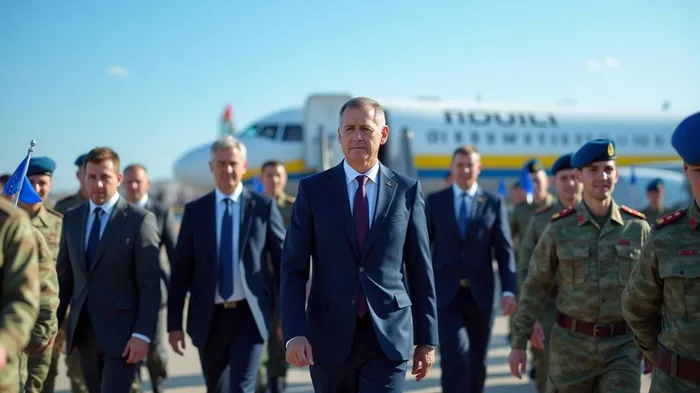
The visit also underscored the fragility of diplomatic progress. Russia’s unilateral three-day ceasefire (May 8–10), dismissed by Kyiv as a tactical ploy, highlights the asymmetry of trust. European foreign ministers’ announcement of a tribunal to prosecute Russian war crimes adds another layer of pressure, but legal actions alone may not shift battlefield realities.
Economic Implications: The Cost of Stalemate
The stakes for investors are starkly divided between two scenarios:
Scenario 1: Ceasefire Achieved
A temporary pause in hostilities could ease immediate market volatility. Energy prices, particularly European natural gas, have fluctuated sharply due to fears of Russian strikes on Ukrainian infrastructure. A ceasefire might stabilize gas prices, as seen in 2022 when reduced geopolitical tension drove the TTF (Title Transfer Facility) gas futures down by 20% within weeks.
Supply chains would also benefit. The UK’s post-Brexit strategic reliance on Ukraine’s agricultural exports—wheat, sunflower oil—could see reduced inflationary pressures if trade routes reopen. Conversely, the UK’s defense budget, strained by £1.7 billion in military aid to Ukraine since 2022, might see reprieve if reconstruction efforts shift from combat to rebuilding.
Scenario 2: Conflict Escalates
Persistent fighting risks deepening economic fractures. The U.S. intelligence warning of a “potentially significant air attack” on Ukraine could trigger another spike in energy prices. In 2023, similar threats drove Brent crude to $85/bbl, up 15% in a week. Meanwhile, European equities—particularly in defense and energy sectors—could see divergent outcomes:
The defense sector (e.g., Airbus, Leonardo) may gain from sustained demand for military hardware, while energy firms (e.g., RWE, Enel) face prolonged volatility tied to supply chain disruptions.
Investment Considerations: Positioning for Uncertainty
Energy Infrastructure Plays:
Companies like Siemens Energy (SIE:GR) and Aker Horizons (AKER:OS) could benefit from post-conflict reconstruction of Ukrainian power grids, backed by EU and IMF funding pledges.Emerging Market Bonds:
Eastern European ETFs (e.g., iShares MSCI EM Eastern Europe ETF: EES) have underperformed global EM indices by 8% since 2022 due to regional instability. A ceasefire could reverse this trend, as seen in 2020 when Turkish lira bonds rallied 14% on reduced conflict risks.Cybersecurity & Defense:
Persistent threats to energy grids (e.g., Ukraine’s 2022 cyberattacks) favor firms like Fortinet (FTNT) and Thales (HO:FR), which provide critical infrastructure protection.
Conclusion: A Fragile Equilibrium
The European leaders’ visit underscores a geopolitical pivot: solidarity with Kyiv versus the economic costs of prolonged conflict. Investors must weigh two realities:
- Geopolitical Momentum: The tribunal announcement and Western unity have isolated Russia diplomatically, as reflected in its -12% GDP contraction in 2022. Persistent sanctions and reduced trade flows (Russia’s EU exports fell 37% in 2023) signal long-term economic decay.
- Economic Volatility: Markets remain hostage to battlefield outcomes. A 30-day ceasefire could stabilize energy prices near $70/bbl for Brent crude, but escalation risks pushing them to $90/bbl—a 28% swing with direct impacts on global equities.
For now, defensive allocations in energy infrastructure and cybersecurity, paired with cautious exposure to EM Eastern Europe, offer a balanced hedge. The Kyiv visit is a pivotal moment, but the chess game continues.
The path forward hinges on whether symbolism translates into tangible peace—or becomes another chapter in the conflict’s costly narrative.







Comentarios
Aún no hay comentarios