
The Geopolitical Capital Play: Why South Korean Shipbuilders Are Anchoring America's Defense and Energy Resilience
The Biden administration’s push to “re-shore” critical industries and counter China’s economic dominance has created a golden opportunity for investors to profit from the strategic partnership between U.S. defense contractors and South Korea’s industrial giants. At the heart of this shift are two companies—Hanwha Group’s Philly Shipyard and HD Hyundai Heavy Industries (HHI)’s collaboration with Huntington IngallsHII-- Industries (HII)—which are positioned to capture massive value from U.S. infrastructure revitalization, Indo-Pacific security spending, and energy security mandates.
The Geopolitical Capital Thesis
Geopolitical capital formation refers to investments that directly align with a nation’s strategic priorities, creating assets that are both commercially valuable and essential to national security. The Hanwha and HHI-HII partnerships exemplify this: their shipyards are not just industrial facilities but strategic choke points in America’s defense and energy supply chains. Here’s why investors should act now:
1. Leveraging U.S. Infrastructure Spending
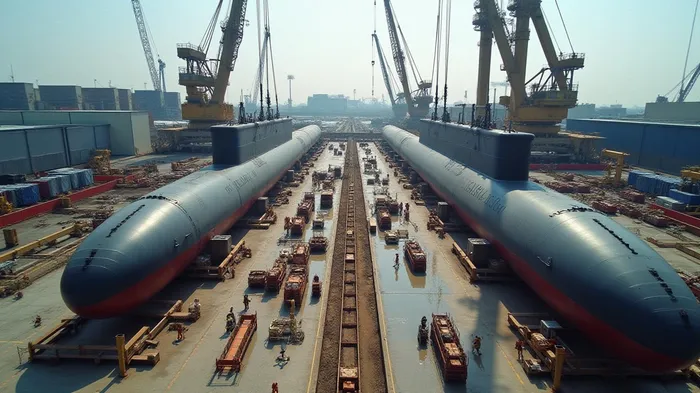
The Inflation Reduction Act (IRA) and the National Defense Authorization Act (NDAA) have committed $1.3 trillion to domestic manufacturing and defense modernization by 2030. Hanwha’s Philly Shipyard is already a key beneficiary. Since its 2019 acquisition, it has secured over $8 billion in U.S. government contracts, including submarine hull sections and Coast Guard cutters. Its expansion of dry docks and automation (see Figure 1) ensures it can scale production to meet growing demand.
2. MRO Capabilities: The Hidden Profit Engine
Maintenance, repair, and overhaul (MRO) services are often overlooked but are critical to sustaining naval readiness. HHI’s 2024 breakthrough—securing a $20 billion U.S. naval MRO agreement—gives it a monopoly-like position in this sector. Combined with HII’s expertise in warship construction, their partnership reduces dependency on Chinese shipyards and creates recurring revenue streams.
3. LNG Carrier Dominance: Fueling Indo-Pacific Alliances
South Korea’s near-monopoly in LNG carrier construction—86% of global orders since 2006—is a geopolitical asset. HD Hyundai’s collaboration with HII positions them to supply the Indo-Pacific’s surging LNG infrastructure needs, from U.S. exports to Taiwan’s energy security. With China’s fleet set to reach 435 battle-force ships by 2030, U.S. allies like Japan and Australia are accelerating LNG imports, ensuring steady demand.
4. Solar Manufacturing: Diversifying the Play
Hanwha’s subsidiary Hanwha Energy is a top-tier solar panel manufacturer, producing 18 GW annually—enough to power 10 million U.S. homes. Its partnership with the U.S. Army to install solar on military bases ties clean energy to defense resilience. Under the IRA’s tax credits and the Buy American Act, Hanwha’s solar division is a multi-year growth lever, insulating investors from cyclical shipbuilding downturns.
Compounding Value: The Policy Tailwind
President Trump’s “America First” agenda laid the groundwork for today’s industrial policy. The SHIPS Act, now bipartisan, aims to double U.S. naval shipbuilding capacity by 2030. For Hanwha and HHI-HII, this means:
- Tariff Incentives: U.S. Navy ships built abroad qualify for domestic tax breaks under the SHIPS Act.
- Mandated Buy American: New infrastructure projects must prioritize U.S. suppliers, boosting Philly Shipyard’s and HII’s margins.
- Energy Security: The U.S. aims to become an LNG exporter to Asia by 2030, directly benefiting HHI’s carrier orders.
Risks and the Case for Immediate Action
Critics cite labor strikes (e.g., Philly Shipyard’s 2023 slowdown) and China’s price competition. Yet these risks are mitigated by the strategic necessity of these partnerships. With Congress rushing to fund the 390-ship Navy goal, delays in production would only accelerate spending—not stop it.
Conclusion: Allocate Now to Anchor America’s Future
The Hanwha and HHI-HII partnerships are not just industrial plays—they’re geopolitical insurance policies. Their assets—MRO, LNG carriers, solar—are the literal and figurative anchors of U.S. defense and energy resilience. With $1.3 trillion in policy backing and Indo-Pacific tensions escalating, this is a once-in-a-generation opportunity to profit from the re-shoring of critical industries.
Investors should prioritize HII (HII) for its naval dominance and MRO upside, Hanwha’s solar division (listed as Hanwha Solutions, HWSOF) for diversification, and HHI’s U.S. projects (via its partnership with HII) for LNG carrier exposure. The clock is ticking—act before geopolitical capital becomes a zero-sum game.
This article is for informational purposes only. Investors should conduct their own due diligence before making decisions.





Comentarios
Aún no hay comentarios