
The GENIUS Act and the Explosive Growth of Stablecoin Payments
Regulatory Clarity as a Catalyst for Institutional Adoption
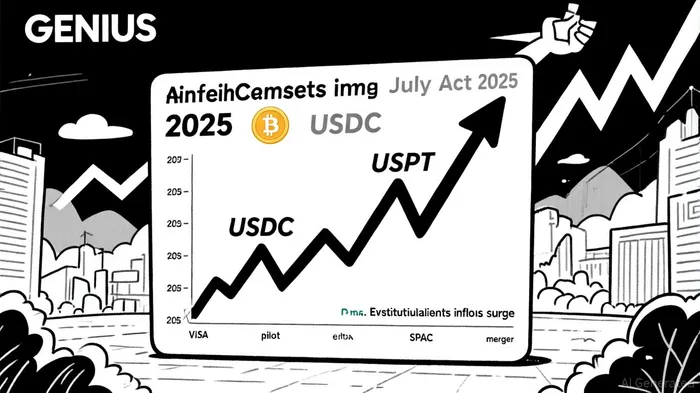
The GENIUS Act's core provisions have addressed long-standing concerns about transparency and systemic risk. Stablecoin issuers are now required to maintain reserves of U.S. dollars or highly liquid assets, with monthly disclosures and annual audits for entities exceeding $500 billion in market capitalization, after the Senate passes the GENIUS Act. This has instilled confidence in institutions, enabling them to integrate stablecoins into treasury operations, cross-border settlements, and liquidity management. For example, VisaV-- has launched pilot programs leveraging stablecoins to reduce the need for holding multiple currency reserves, while Tether's new U.S.-compliant stablecoin, USAT, demonstrates how legacy crypto players are aligning with regulatory expectations, according to a Cointelegraph report.
The Act also distinguishes between payment-focused stablecoins and yield-generating tokenized money market products, effectively redefining the DeFi landscape. While yield-bearing stablecoins are now prohibited, the regulatory clarity has spurred innovation in other areas, such as programmable smart contracts and blockchain-based payment systems, according to FTI Consulting. This bifurcation creates a fertile ground for institutional investors to explore non-yield-bearing stablecoins as foundational instruments for global commerce.
Market Trends and Strategic Entry Points
The stablecoin market has already seen a 30% year-over-year growth in usage, with over $10 billion transacted in August 2025 alone, according to Coinotag. USDT, the dominant stablecoin with a $182 billion market cap, has expanded to 500 million users, while USDCUSDC-- trails at $75 billion, per Stablecoin Flows. These figures underscore the importance of regulatory compliance in maintaining market leadership. The GENIUS Act's reserve requirements and audit mandates are likely to level the playing field, encouraging new entrants and fostering collaboration among existing players.
For institutional investors, strategic entry points include:
1. Regulated Investment Vehicles: Special Purpose Acquisition Companies (SPACs) are emerging as a key avenue. Evernorth's XRP treasury, for instance, is leveraging a SPAC merger and Nasdaq listing under the ticker "XRPN" to provide traditional investors with a regulated entry into the XRPXRP-- market.
2. Compliance-Driven Partnerships: Collaborations between stablecoin issuers and institutional custodians are accelerating. Circle's partnership with BlackRock, which positioned USDC as a preferred stablecoin for institutional portfolios, exemplifies how alignment with regulatory standards can attract capital, according to a Whiteford Law alert.
3. Cross-Border Treasury Solutions: The convergence of U.S. and EU regulatory frameworks (e.g., MiCA) is enabling multinational corporations to streamline operations. Tether's efforts to align with MiCA requirements, including enhanced reserve disclosures, highlight the growing legitimacy of stablecoins in global treasury management, per a Brookings article.
Case Studies: Compliance as a Competitive Advantage
The success of stablecoin issuers under the GENIUS Act hinges on their ability to navigate compliance. Fireblocks' acquisition of Dynamic, for instance, has enhanced its institutional-grade services by integrating advanced wallet infrastructure to support 50 million on-chain accounts, according to Coinotag. This move aligns with the Act's emphasis on robust anti-money laundering (AML) and know-your-customer (KYC) protocols. Similarly, CoinbaseCOIN-- Custody's growth from $7 billion in assets under custody in 2020 to over $25 billion by 2025 demonstrates how trust-building measures can establish institutional credibility, as a Coinbase press release shows.
Foreign issuers are also adapting. The Act's requirement for foreign stablecoins to operate under "comparable regulatory regimes" has spurred alignment with U.S. standards, reducing arbitrage risks and opening doors for global institutional participation, as the Whiteford Law alert notes.
Conclusion: A New Era for Institutional Capital
The GENIUS Act has redefined the stablecoin ecosystem, transforming it into a cornerstone of modern finance. For institutional investors, the path forward lies in leveraging regulatory clarity to access high-liquidity, low-volatility instruments. By prioritizing compliance-driven strategies, exploring regulated investment vehicles, and capitalizing on cross-border opportunities, institutions can position themselves at the forefront of this $300+ billion market, per a Mitrade report. As Senator Elizabeth Warren emphasized, the swift implementation of the Act is not just a regulatory imperative-it is a strategic opportunity for those ready to embrace the future of digital finance.





Comentarios
Aún no hay comentarios