
Next-Generation Privacy Coins: Balancing Scalability and Mining Efficiency in 2025
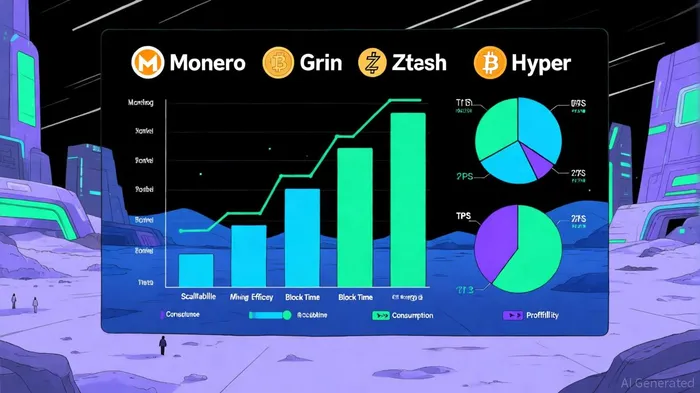
In 2025, the cryptocurrency landscape is witnessing a paradigm shift in privacy-focused digital assets. As demand for financial privacy intensifies, next-generation privacy coins are redefining scalability and mining efficiency to address long-standing challenges in blockchain adoption. Monero (XMR), Grin (GRIN), Zcash (ZEC), and BitcoinBTC-- Hyper stand out as pioneers in this space, each leveraging innovative protocols to balance privacy, performance, and accessibility.
Monero: ASIC Resistance and Transaction Volume
Monero remains a cornerstone of privacy-centric innovation, with its RandomX algorithm ensuring ASIC resistance and enabling CPU/GPU mining[2]. As of 2025, Monero processes approximately 23,500 daily transactions, averaging 9.09 million transactions between 2021 and 2022[5]. Its 2-minute blockXYZ-- time supports moderate throughput, though transaction size remains larger than non-privacy coins due to ring signatures and stealth addresses[4]. Mining profitability for XMR is estimated at $8.50 per month, with energy efficiency bolstered by its accessibility to consumer-grade hardware[1].
Grin: MimbleWimble and Dual-Algorithm Flexibility
Grin's adoption of the MimbleWimble protocol enables lightweight transactions and data pruning, significantly reducing blockchain bloat[4]. Its dual-algorithm approach—Cuckatoo32+ for ASICs and Cuckaroo29 for GPUs—ensures flexibility for miners while maintaining decentralization[4]. With a block time of 60 seconds and a monthly mining reward of 60 GRIN, Grin's profitability is projected at $43.32 per month[1]. This scalability advantage, combined with its GPU-friendly design, positions Grin as a compelling option for eco-conscious miners.
Zcash: Selective Privacy and Equihash Efficiency
Zcash's Equihash algorithm prioritizes GPU mining, though ASICs are increasingly adopted for higher efficiency[2]. The coin's zk-SNARKs technology allows users to toggle between shielded (private) and transparent transactions, offering a unique balance of privacy and scalability[3]. Zcash's 2.5-minute block time and 2.5 ZEC/block reward yield an estimated $100 in monthly mining profits[1]. However, its energy consumption per transaction is higher than Monero and Grin, reflecting the computational demands of zero-knowledge proofs[2].
Bitcoin Hyper: Layer 2 Solutions for Bitcoin's Scalability
Bitcoin Hyper introduces a Layer 2 framework to Bitcoin, enabling smart contracts and DeFi integration without compromising the security of the Bitcoin network[4]. By offloading complex computations to secondary layers, Bitcoin Hyper enhances transaction throughput while maintaining Bitcoin's censorship resistance. Though not a privacy coin by default, its integration with Bitcoin's ecosystem makes it a strategic play for scalability in the privacy-adjacent space[4].
Mining Efficiency and Energy Consumption
The energy efficiency of next-gen privacy coins is a critical factor for investors. Monero and Grin, with their ASIC-resistant designs, allow mining on consumer hardware, reducing energy costs compared to ASIC-dependent coins like Bitcoin[1]. Zcash's Equihash algorithm, while efficient for GPUs, incurs higher energy consumption due to its proof-of-work complexity[2]. Bitcoin Hyper's Layer 2 solutions further optimize energy use by minimizing main-chain congestion[4].
Investment Outlook
For investors, the next-generation privacy coin market presents a nuanced trade-off between privacy, scalability, and mining efficiency. Monero's robust transaction volume and accessibility, Grin's MimbleWimble-driven scalability, Zcash's selective privacy model, and Bitcoin Hyper's Layer 2 innovations each cater to distinct use cases. As regulatory scrutiny intensifies, these projects' ability to adapt—through algorithmic updates, energy-efficient protocols, and hybrid privacy models—will determine their long-term viability.







Comentarios
Aún no hay comentarios