
Next-Generation Nuclear: A Strategic Investment for Global Energy Security?
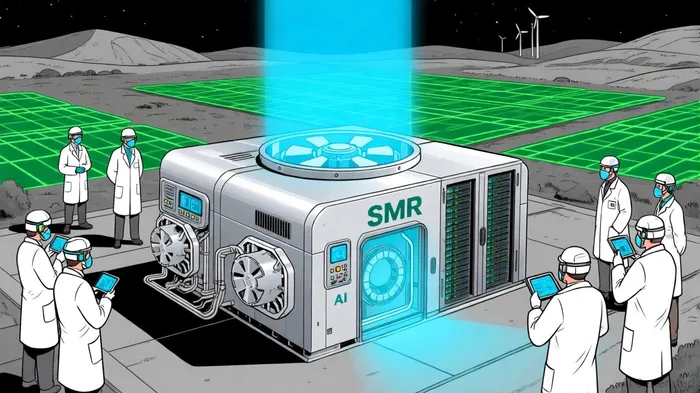
The global energy landscape is at a crossroads. As demand for reliable, low-carbon power surges—driven by AI, data centers, and industrial electrification—nuclear energy is reemerging as a critical pillar of energy security. Next-generation nuclear technologies, particularly small modular reactors (SMRs) and advanced reactor designs, are attracting unprecedented investment and policy support. Yet, their potential must be weighed against persistent financial, technical, and regulatory challenges.
A Policy-Driven Renaissance
The U.S. nuclear sector is undergoing a transformation fueled by legislative and regulatory reforms. The Accelerating Deployment of Versatile, Advanced Nuclear for Clean Energy Act (ADVANCE Act) has streamlined licensing processes, enabling faster deployment of advanced reactors[1]. NuScale Power's SMRs recently received standard design approval from the Nuclear Regulatory Commission (NRC), while Kairos Power's Hermes reactor has entered construction[1]. These developments are bolstered by executive orders granting the Department of Energy (DOE) and Department of Defense (DOD) presumptive authority to conduct reactor design reviews, bypassing traditional bureaucratic bottlenecks[1].
Globally, China's advancements in high-temperature gas-cooled reactors and the UN's climate agreement to triple nuclear capacity by 2050 underscore a shared recognition of nuclear energy's role in decarbonization[2]. Meanwhile, the U.S. Department of Energy's $500 million investment in X-energy and Microsoft's partnership with ConstellationCEG-- to restart the Three Mile Island reactor highlight the sector's growing appeal to private capital[1].
Market Growth and Investment Trends
The nuclear energy market is projected to grow from $200.13 billion in 2025 to $311.8 billion by 2033, with a compound annual growth rate (CAGR) of 5.7%[3]. SMRs, which account for over 15% of global nuclear development pipelines, are central to this growth. With over 80 diverse designs in development—including NuScale's VOYGR and GEGE-- Hitachi's BWRX-300—SMRs promise scalability, cost efficiency, and enhanced safety[3].
Private-sector investment is surging, particularly from tech giants. Amazon's Climate Pledge Fund has allocated $500 million to X-energy, while Microsoft's collaboration with Constellation to revive Three Mile Island underscores the sector's alignment with energy-intensive industries[1]. These partnerships reflect a strategic shift: nuclear is no longer seen as a standalone energy source but as a complementary solution to renewables, providing dispatchable power for AI and data centers[1].
Risks and Realities
Despite optimism, the sector faces significant hurdles. Historical cost overruns and delays—such as the Vogtle plant's $9.3 billion price tag and Hinkley Point's protracted timeline—highlight the risks of capital-intensive projects[4]. A 2025 IEEFA report notes that SMRs, while marketed as cheaper and faster to build, often exceed $100 per MWh in real-world scenarios, outpacing renewables and battery storage[4].
Technical challenges persist, too. SMRs generate two to thirty times more spent fuel per unit of energy than traditional reactors, complicating waste management[4]. Regulatory delays and public safety concerns further constrain growth, with over 55% of global nuclear projects experiencing delays[3].
Strategic Considerations for Investors
For investors, the key lies in balancing long-term potential with near-term risks. Advanced reactor projects like TerraPower's Natrium and BWX Technologies' Project Pele are nearing commercialization, offering a glimpse of next-gen capabilities[1]. However, success hinges on robust risk mitigation strategies, including joint development agreements and government-backed financing[4].
The Asia-Pacific region, particularly China and India, presents high-growth opportunities, driven by rapid energy demand and policy support[3]. Conversely, the U.S. market's focus on reviving shuttered plants (e.g., Palisades in Michigan) underscores the industry's emphasis on leveraging existing infrastructure[1].
Conclusion
Next-generation nuclear technologies are poised to reshape global energy security, but their success depends on navigating a complex interplay of policy, finance, and public perception. While challenges like cost overruns and waste managementWM-- remain, the sector's alignment with decarbonization goals and industrial demand makes it a compelling long-term investment. For now, investors must tread carefully, prioritizing projects with strong regulatory backing, proven technical feasibility, and diversified risk profiles.





Comentarios
Aún no hay comentarios