
Generating Income in a Low-Yield World: ETF Distributions and Risk-Adjusted Returns in 2025
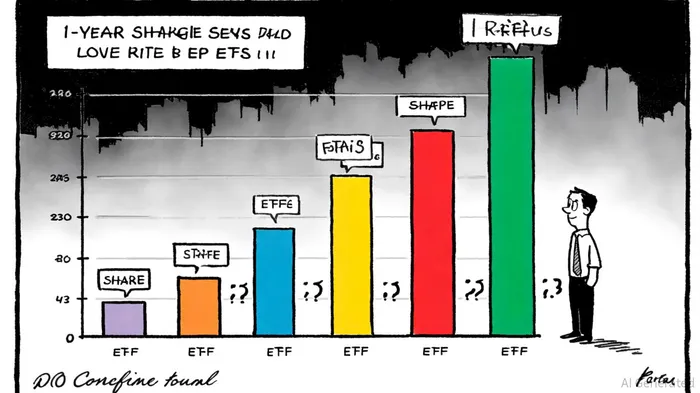
In 2025, the global financial landscape remains stubbornly low on yield, with central banks maintaining cautious monetary policies and bond markets offering minimal returns. For income-focused investors, this environment demands a nuanced approach: balancing yield generation with risk management. Exchange-traded funds (ETFs) have emerged as a critical tool, offering structured strategies to navigate these challenges. This analysis examines how specific ETFs—ranging from low-volatility equities to option-covered income strategies—are delivering returns while mitigating risk, as measured by the Sharpe ratio, a key metric for evaluating risk-adjusted performance[1].
The Rise of Active and Low-Volatility ETFs
The first quarter of 2025 saw a notable shift in investor behavior. Active ETFs, which account for 48% of net ETF flows in Q1, outperformed passive alternatives amid tariff-related volatility[2]. This trend reflects a growing preference for strategies that adapt to macroeconomic uncertainty. Low-volatility equity ETFs, such as the iShares MSCI USA Min Vol Factor ETF (USMV) and the InvescoIVZ-- S&P 500 Low Volatility ETF (SPLV), have gained traction for their defensive characteristics. These funds focus on sectors like healthcare and consumer staples, which historically exhibit resilience during downturns[3].
For instance, USMV has delivered a 1-year Sharpe ratio of 0.37, while SPLV trails at 0.26[4]. Though these figures fall below the “very good” threshold of 2.0[5], they outperform broader market benchmarks, which typically hover around 0.90[6]. This suggests that low-volatility strategies are effectively reducing downside risk without sacrificing returns.
Bond ETFs: Stability in a Low-Yield World
Fixed-income ETFs remain a cornerstone for income generation, though yields remain modest. The iShares Core U.S. Aggregate Bond ETF (AGG) offers a 3.8% yield but lags in risk-adjusted returns, with a 1-year Sharpe ratio of 0.32[7]. In contrast, the Vanguard Short-Term Bond ETF (BSV) demonstrates superior efficiency, posting a Sharpe ratio of 2.51 over the same period[8]. BSV's shorter duration reduces exposure to interest rate fluctuations, making it a preferred choice for capital preservation.
Dividend-Oriented ETFs: Balancing Yield and Volatility
For retirees and income-focused investors, dividend-paying ETFs provide a middle ground between growth and stability. The Franklin U.S. Low Volatility High Dividend ETF (LVHD) and the Invesco S&P 500 High Dividend Low Volatility ETF (SPHD) stand out. LVHD, with a 3.3% yield and a Sharpe ratio of 1.04[9], combines defensive holdings with consistent payouts. SPHD, offering a mid-3% yield and a Sharpe ratio of 0.66[10], focuses on the least volatile S&P 500 stocks, though its risk-adjusted returns are less compelling.
The Vanguard High Dividend Yield ETF (VYM), with a 1-year Sharpe ratio of 1.07[11], further illustrates the appeal of broad, low-cost exposure to high-dividend equities. These funds highlight a broader trend: investors are prioritizing quality and consistency over aggressive growth in uncertain markets.
Structured Products: High Yields with Caveats
YieldMax® ETFs, such as the Ultra Option Income Strategy ETF (ULTY) and the Crypto Industry & Tech Portfolio Option Income ETF (LFGY), have captured attention with their high distribution rates. ULTY's 85.60% distribution rate and LFGY's 65.50%[12] are enticing, but these figures mask structural risks. Unlike traditional dividends, these distributions are not guaranteed and may include a significant return of capital (ROC) component[13]. ULTY's Sharpe ratio of 1.11[14] and LFGY's 1.04[15] suggest strong risk-adjusted returns, but investors must weigh these against the complexity and liquidity risks inherent in option-covered strategies.
The Sharpe Ratio: A Critical Lens
The Sharpe ratio remains indispensable for evaluating ETF performance in low-yield environments. A ratio above 1.0 is considered acceptable, while values exceeding 2.0 are exceptional[16]. BSV's 2.51 ratio[17] and ULTY's 1.11[18] exemplify how different strategies can optimize risk-adjusted returns. However, the metric has limitations: it assumes normal return distributions and may understate risks in non-linear products like leveraged or inverse ETFs[19].
Conclusion: Navigating the Trade-Offs
In 2025, income generation in a low-yield world requires a dual focus on yield and risk management. Low-volatility equities, short-duration bonds, and structured products each offer unique advantages, but their effectiveness depends on an investor's risk tolerance and time horizon. For conservative investors, BSV and VYM provide stability and modest growth. For those seeking higher yields, ULTY and LFGY offer compelling—but complex—opportunities. Ultimately, the Sharpe ratio serves as a vital tool to quantify these trade-offs, ensuring that investors are compensated for the risks they take.







Comentarios
Aún no hay comentarios