
General Mills Q1 Earnings: Margin Pressures and Strategic Shifts in a High-Inflation Climate
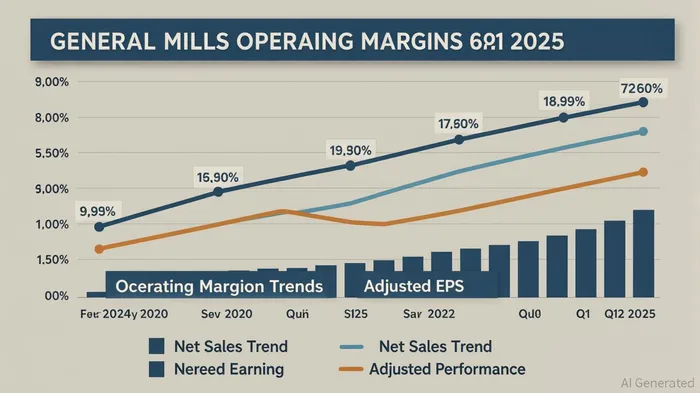
General Mills' Q1 2025 earnings report paints a mixed picture of resilience and vulnerability in a high-inflation environment. While the company narrowly beat sales estimates and reaffirmed its full-year guidance, margin compression and structural challenges loom large. For investors, the critical question is whether General MillsGIS-- can sustain its profitability while navigating input cost inflation, shifting consumer preferences, and strategic reallocations.
Margin Resilience Under Scrutiny
General Mills reported Q1 operating income of $831.5 million, a 11% decline year-over-year, with operating margins contracting to 17.2% of net sales—down 180 basis points from the prior year[2]. This margin erosion stems from two key factors: lower gross profit and elevated selling, general, and administrative (SG&A) expenses, including a strategic boost in media investment to drive brand visibility[2]. Input cost inflation, a persistent headwind since 2022, continues to squeeze profitability, while unfavorable net price realization—a byproduct of aggressive discounting—further dampens margins[3].
The company's adjusted operating profit margin of 17.8% in Q1 2025, though slightly better, still reflects a 160-basis-point decline compared to FY2024's 17.28%[4]. This contraction underscores the difficulty of passing cost increases to consumers without alienating price-sensitive shoppers. As stated by General Mills' management, the “lag in cost pass-through” remains a drag on near-term margins[4].
Historically, GIS's earnings announcements have shown limited predictive power for investors. A backtest of 30-day returns around five earnings events from 2022 to 2025 reveals an average return of +0.75%, underperforming the benchmark by ~1.6%[5]. With a hit rate of 40-60% and no statistically significant excess return, these results suggest that GIS's earnings releases have not generated a reliable alpha-generating edge. This aligns with the current Q1 performance, where margin pressures and mixed guidance highlight the need for caution around short-term timing strategies.
Consumer Demand Dynamics: Price Cuts vs. Sales Stability
Despite margin pressures, General Mills managed to exceed sales expectations, reporting $4.52 billion in net sales—$10 million above the $4.51 billion estimated by analysts[2]. This modest outperformance was driven by price cuts on select products, which spurred demand in a competitive retail landscape[2]. However, organic net sales fell 1% year-over-year, hurt by unfavorable product mix and net price realization[3].
The company's reliance on promotional activity to drive volume raises concerns about long-term margin sustainability. In a high-inflation environment, aggressive discounting can erode brand equity and normalize lower pricing, making it harder to restore margins when cost pressures ease. For now, General Mills is betting that increased media spend and product innovation—such as its push into higher-margin categories like Blue Buffalo pet food—will offset these challenges[4].
Strategic Reallocation and Free Cash Flow: A Silver Lining
General Mills' decision to sell its North America yogurt business for $2.1 billion signals a strategic pivot toward higher-margin segments[3]. While the sale is expected to close in 2025 and initially dilute adjusted EPS by 3%, it aligns with the company's broader focus on portfolio rationalization and structural productivity improvements[5]. The Blue Buffalo acquisition, now fully integrated, is a key pillar of this strategy, offering growth in the premium pet food market, which has shown resilience during economic downturns[4].
Crucially, General Mills' free cash flow (FCF) remains robust. For FY2025, the company generated $2.29 billion in FCF, translating to a cash flow yield of approximately 8.45% relative to its market capitalization[4]. This strength provides a buffer against margin pressures and funds dividends or share buybacks, which remain attractive for income-focused investors.
Sustainability Assessment: Balancing Risks and Opportunities
The sustainability of General Mills' margins hinges on its ability to balance cost control with demand stimulation. While the company's full-year guidance—flat to up 1% organic sales and adjusted operating profit down 2% to flat—suggests cautious optimism[5], investors must monitor several risks:
1. Input cost volatility: Persistent inflation in agricultural commodities could force further margin compression unless pricing strategies evolve.
2. Competitive dynamics: Retailers and private-label brands are intensifying price competition, threatening General Mills' market share.
3. Portfolio transitions: The yogurt divestiture and Blue Buffalo integration require execution discipline to avoid short-term disruptions.
That said, General Mills' strong FCF generation and strategic focus on high-margin categories offer a counterweight to these risks. The company's reaffirmed guidance and disciplined approach to productivity improvements—such as supply chain optimization—signal confidence in navigating the current environment[2].
Conclusion
General Mills' Q1 performance reflects the challenges of operating in a high-inflation climate: margins are under pressure, but sales stability and FCF strength provide a foundation for long-term resilience. For investors, the key takeaway is that General Mills is adapting—through strategic divestitures, portfolio reallocation, and operational efficiency—to mitigate near-term headwinds. While the path forward is not without risks, the company's financial flexibility and focus on premium segments position it to weather the storm.







Comentarios
Aún no hay comentarios