
General Dynamics' Strategic Resilience and Diversification: A Cornerstone for Long-Term Defense and Cybersecurity Growth
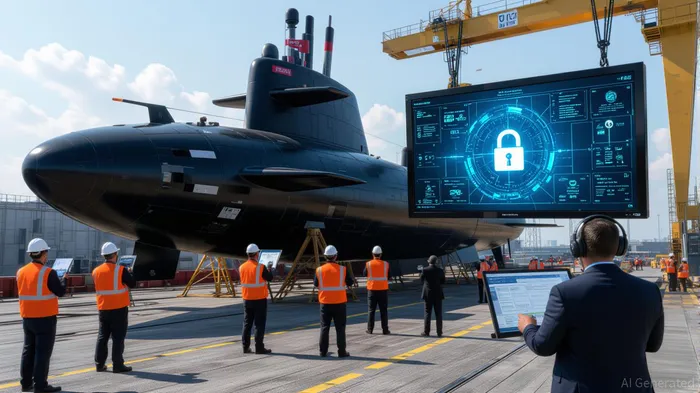
In an era marked by geopolitical volatility and rapid technological evolution, defense contractors must balance operational resilience with strategic diversification to thrive. General DynamicsGD-- (GD) exemplifies this duality, leveraging its robust financial performance and forward-looking investments to position itself as a leader in both traditional defense and emerging cybersecurity markets. With a record $103.7 billion backlog and a 38% surge in Marine Systems backlog driven by submarine contracts[1], the company is not merely reacting to market dynamics—it is shaping them.
Financial Fortitude Fuels Strategic Flexibility
General Dynamics' Q2 2025 results underscore its financial strength, with revenue climbing 8.9% year-over-year to $13 billion and earnings per share (EPS) rising 14.7% to $3.74[1]. The company generated $1.6 billion in operating cash flow—158% of net earnings—while simultaneously reducing debt by $897 million and maintaining a disciplined capital allocation strategy[1]. This financial discipline provides a critical buffer for strategic investments, such as its $198 million in capital expenditures during the quarter[1].
The Marine and Aerospace segments, in particular, highlight GD's ability to capitalize on sustained demand. A book-to-bill ratio of 2.2-to-1 for these segments[1] reflects strong order inflows, particularly for Virginia-class Block VI submarines. The $1 billion contract for these advanced naval platforms[3] not only secures long-term revenue but also reinforces GD's dominance in shipbuilding, a sector poised for growth amid modernization efforts by the U.S. Navy.
Cybersecurity as a Strategic Pillar
While defense hardware remains a cornerstone, General Dynamics is increasingly pivoting toward cybersecurity—a sector projected to expand as governments prioritize digital infrastructure protection. Through its General Dynamics Information Technology (GDIT) division, the company has forged a strategic partnership with AmazonAMZN-- Web Services (AWS) to develop cutting-edge cloud, AI, and cybersecurity solutions for government agencies[4]. This collaboration aligns with broader trends in the defense sector, where zero-trust architectures and AI-driven threat detection are becoming table stakes[6].
GDIT's recent expansion of its Cyber Center of Excellence further underscores its commitment to this space. The center focuses on full-spectrum cyber capabilities, including automated defense systems and high-speed encryption[2], addressing the growing sophistication of cyber threats. This investment is already paying dividends: a $396 million contract with the U.S. Special Operations Command (SOCOM) to enhance IT networks with advanced cybersecurity solutions[5] highlights GD's ability to secure high-value, mission-critical contracts.
Diversification in a Shifting Geopolitical Landscape
General Dynamics' strategic resilience is further bolstered by its diversified portfolio. While the Marine Systems segment accounts for a significant portion of its backlog, the Technologies segment—focused on IT, cybersecurity, and digital modernization—is rapidly gaining traction[2]. This diversification mitigates risks associated with sector-specific downturns and positions GD to benefit from cross-cutting trends such as hybrid warfare and AI-driven logistics.
Moreover, GD's debt reduction efforts and strong operating cash flow[1] provide flexibility to navigate potential economic headwinds. In a sector where long-term contracts and R&D cycles are the norm, financial agility is a critical differentiator. The company's ability to reinvest in innovation while maintaining shareholder returns—through $402 million in dividends during Q2 2025[1]—demonstrates a balanced approach to growth and value creation.
Looking Ahead: A Compelling Long-Term Play
As global defense budgets rise and cyber threats evolve, General Dynamics is uniquely positioned to capitalize on both macroeconomic tailwinds and technological innovation. Its record backlog[1], strategic partnerships[4], and targeted investments in cyber capabilities[2] suggest a company that is not only resilient but also proactive in shaping its future. For investors, GD represents a rare combination of stable, capital-intensive defense operations and high-growth cybersecurity ventures—a duality that could drive sustained value creation in the years ahead.





Comentarios
Aún no hay comentarios