
General Dynamics' Strategic AI-Cloud Partnership with Google Positions It for Defense and Civilian Tech Dominance
Strategic Terms and Technological Innovations
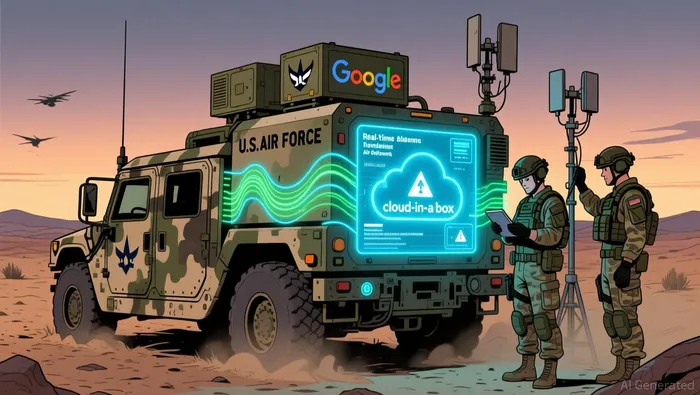
GDIT's collaboration with Google has yielded tangible advancements, particularly in secure, edge-based computing. A landmark demonstration occurred during the Mobility Guardian 2025 exercise, where the duo deployed a ruggedized, air-gapped GDC "cloud-in-a-box" system. This portable solution enabled secure collaboration in Denied, Disrupted, Intermittent, and Limited (D-DIL) environments, supporting critical use cases like real-time language translation and optical character recognition. The system's integration with GDIT's Luna AI further enhanced low-latency data processing for air defense, showcasing a unique ability to operate offline while maintaining mission readiness.
Financially, the partnership has already secured a $1.5 billion enterprise IT modernization contract with the U.S. Strategic Command (STRATCOM). This contract emphasizes digital engineering, AI, and zero-trust security to modernize STRATCOM's hybrid cloud infrastructure, including its nuclear command and control systems according to official announcements. Such high-value contracts underscore GDIT's ability to align with the Department of Defense's (DOD) $13.4 billion AI spending roadmap as reported by industry analysts, ensuring sustained revenue streams.
Competitive Advantages and Market Positioning
GDIT's edge over rivals like Palantir and C3.ai lies in its dual focus on secure, tactical AI and robust government relationships. While Palantir has long dominated defense data analytics, its reliance on traditional cloud connectivity makes it less suited for D-DIL scenarios. Conversely, C3.ai's recent struggles-including a 54% stock price drop and a $116.8 million Q1 2025 net loss according to financial reports-highlight its vulnerability in a market demanding resilient, offline-capable solutions. GDIT's air-gapped GDC appliances, authorized for Secret-level operations, fill this gap, offering a unique value proposition in contested environments.
Moreover, Google's recent $200 million DOD contract and a £400 million UK defense deal according to industry sources reinforce the credibility of its cloud and AI offerings. By leveraging Google's technological prowess, GDIT avoids the R&D costs of developing proprietary solutions, allowing it to scale rapidly. This is a stark contrast to competitors like C3.ai, which face leadership instability and declining investor confidence.
Long-Term Growth and Investment Implications
The U.S. government's push for AI-driven modernization ensures a favorable backdrop for GDIT. With STRATCOM's contract and the Navy's $1.7 billion oiler-building program according to official announcements, the company is diversifying its revenue base across defense and civilian sectors. Additionally, GDIT's ability to reduce operational costs for agencies-such as a 40% drop in call volume for a major client through AI-driven citizen engagement according to performance metrics-demonstrates its value beyond traditional defense work.
However, risks remain. Google's dominance in the partnership could expose GDIT to pricing pressures or dependency on a single cloud provider. Yet, given Google's recent defense contracts and GDIT's deep integration of its solutions, this dependency appears manageable. For investors, the key is to monitor GDIT's ability to replicate its Mobility Guardian success in other theaters and expand its AI offerings to civilian agencies.
Conclusion
GDIT's partnership with Google is more than a technological leap; it's a strategic repositioning in a market where secure, edge-based AI is becoming indispensable. By combining Google's innovation with its own mission-critical expertise, GDIT is not only addressing the DOD's immediate needs but also building a moat against competitors. As the U.S. government accelerates its AI adoption, GDIT's long-term growth potential appears robust-provided it continues to execute on high-impact projects like those demonstrated in 2025.





Comentarios
Aún no hay comentarios