
Genco Shipping's Dividend Resilience Amid Earnings Pressure: A Strategic Play in a Volatile Drybulk Market?
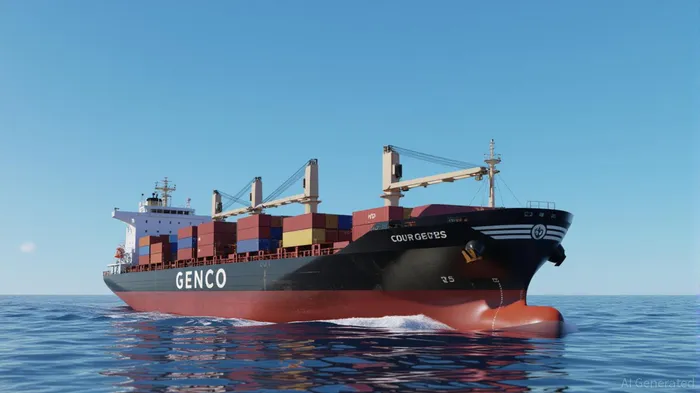
In the volatile world of drybulk shipping, where freight rates swing like a pendulum between boom and bust, Genco Shipping & Trading Limited (GNK) has carved out a reputation for disciplined capital allocation and shareholder-centric policies. The company's Q2 2025 earnings report—marked by a net loss of $6.8 million and a 23% year-over-year revenue decline—might seem at first glance like a red flag. Yet, Genco's decision to maintain its 24th consecutive quarterly dividend of $0.15 per share, even as it navigated a challenging market, raises a critical question: Is this a calculated bet on future cash flow, or a sign of overreach in a sector prone to cyclical downturns?
Financial Resilience: Liquidity as a Lifeline
Genco's ability to fund dividends despite a net loss hinges on its robust liquidity position. As of June 30, 2025, the company held $335.6 million in total liquidity, including $235.6 million in cash and $100 million in undrawn revolver availability under its newly expanded $600 million revolving credit facility (RCF). This liquidity buffer allowed Genco to reduce its voluntary quarterly reserve from $19.5 million to $7.91 million, freeing up $6.58 million in operating cash flow to fund the dividend.
The company's dividend policy—allocating 100% of quarterly operating cash flow minus a voluntary reserve—has been a cornerstone of its strategy. For Q2 2025, operating cash flow was $14.49 million, a figure that, while lower than prior periods, still provided sufficient runway to sustain payouts. This approach mirrors the playbook of high-quality industrial companies that prioritize shareholder returns even in down cycles, betting on their ability to recover as market conditions normalize.
Strategic Intent: Fleet Modernization and Debt Management
Genco's recent acquisition of a scrubber-equipped Capesize vessel for $63.6 million, funded by a combination of cash and a drawdown from its RCF, underscores its dual focus on growth and efficiency. The Capesize segment, which accounts for a significant portion of Genco's fleet, has shown relative resilience in 2025, with analysts projecting daily Time CharterCHTR-- Equivalent (TCE) rates to average $19,000–$21,000. This is driven by strong demand for iron ore and bauxite, particularly from projects like Guinea's Simandou mine.
The company's conservative net loan-to-value (LTV) ratio of 7% (projected to rise to 13% post-acquisition) further highlights its risk-averse approach. By maintaining low leverage and expanding its RCF with favorable terms (1.75% over SOFR, 0.61% commitment fee), Genco has positioned itself to weather market volatility while retaining flexibility for strategic investments.
Market Realities: A Mixed Outlook for Drybulk
The drybulk sector in 2025 is a study in contrasts. While the Capesize segment benefits from structural tailwinds—aging fleets, green technology adoption, and iron ore demand—Panamax and Supramax vessels face oversupply and weak coal markets. The Baltic Dry Index (BDI) fell 21% between March and April 2025, reflecting broader weakness.
Genco's fleet composition—16 Capesizes, 15 Ultramaxes, and 11 Supramaxes—positions it to capitalize on the Capesize strength while mitigating exposure to weaker segments. However, the company's Q2 2025 results, with a daily TCE rate of $13,631 (down from $19,938 in Q2 2024), highlight the sector's fragility. Analysts project that Genco's earnings will grow at an annualized rate of 22.7% through 2026, but revenue is expected to decline 18.2% annually over the same period.
Dividend Sustainability: Confidence or Overextension?
The key to evaluating Genco's dividend strategy lies in its ability to generate consistent cash flow. The company's Q2 2025 operating cash flow of $14.49 million, while down from previous quarters, was sufficient to fund the dividend after reducing the voluntary reserve. For Q3 2025, the voluntary reserve is expected to return to $19.5 million, providing a buffer for debt repayments and fleet investments.
Critics may argue that maintaining a 41% yield (based on cumulative dividends of $6.915 per share relative to the current share price) in a down cycle is unsustainable. However, Genco's liquidity position—$335.6 million in cash and credit—suggests otherwise. The company's ability to fund a $63.6 million vessel acquisition without tapping additional debt further demonstrates its financial flexibility.
Investment Implications
For investors, Genco's strategy presents a high-conviction bet on the drybulk sector's cyclical recovery. The company's focus on fleet modernization, low leverage, and disciplined capital returns aligns with long-term value creation. However, the risks are clear: a prolonged downturn in freight rates, particularly in the Panamax and Supramax segments, could strain cash flow.
The dividend's sustainability will depend on two factors:
1. Market Recovery: A rebound in iron ore and bauxite demand, coupled with improved coal shipments, could drive TCE rates higher.
2. Cost Management: Genco's ability to control operating expenses and maintain its RCF as a liquidity lifeline will be critical.
Conclusion: A Calculated Gamble
Genco Shipping's dividend resilience is less a sign of overextension and more a reflection of strategic foresight. By leveraging its liquidity, modernizing its fleet, and maintaining a conservative balance sheet, the company has positioned itself to outperform peers during the next upcycle. For investors willing to stomach short-term volatility, Genco offers a compelling case: a business that rewards shareholders even in adversity, with the potential to capitalize on a sector poised for structural growth.
In the end, the question is not whether Genco can afford its dividend today, but whether it can outlast the market's headwinds and emerge stronger on the other side. The answer, for now, appears to be a cautious yes.







Comentarios
Aún no hay comentarios