
Why GeeFi (GEE) is Positioning Itself as a High-Yield, Utility-Driven Alternative to Solana (SOL) for Loss Recovery and Portfolio Growth
In the rapidly evolving crypto landscape of 2025, investors are increasingly seeking projects that balance high-yield returns with tangible utility. While SolanaSOL-- (SOL) remains a dominant force in blockchain infrastructure, GeeFi (GEE) has emerged as a compelling alternative, offering a unique blend of staking rewards, real-world financial tools, and a deflationary token model. This analysis explores why GEE is gaining traction as a strategic investment for loss recovery and portfolio diversification, particularly in comparison to SOLSOL--.
High-Yield Staking and Immediate Returns
GeeFi's most striking feature is its high-yield staking protocol, which allows token holders to earn up to 55% annual percentage rate (APR) by locking their assets according to Fidelity. This is significantly higher than traditional staking or lending yields on Solana, where returns are more incremental and speculative as per a report. For investors seeking rapid capital appreciation, GEE's staking mechanism provides a clear advantage. Additionally, the platform's referral program offers a 5% bonus to participants who invite others, further amplifying potential earnings according to a press release.
In contrast, Solana's staking rewards, while competitive in the broader market, have faced volatility due to macroeconomic factors and regulatory uncertainties as reported by Fox2Now. While SOL's reduced staking emissions aim to enhance scarcity, these adjustments have not translated into consistent high-yield opportunities for retail investors according to analyst projections.
Real-World Utility and Ecosystem Expansion
GeeFi's utility extends beyond staking. The GEE token serves as the native currency for a multichain non-custodial wallet, a decentralized exchange (DEX), and upcoming crypto card services as detailed in a guide. These tools are designed to bridge digital assets with everyday commerce, addressing a critical gap in the DeFi space. For instance, the planned crypto debit card, compatible with VISA and Mastercard, will enable users to spend their tokens seamlessly, enhancing GEE's practical value as noted in a Solana analysis.
Solana, on the other hand, is positioned as a high-performance blockchain for developers and institutions. While it supports robust DeFi applications and has attracted major stablecoin issuers like Circle and TetherUSDT-- as reported by Redstone, its utility for retail users remains abstract. SOL's focus on infrastructure-such as its Proof of History (PoH) consensus mechanism-caters to scalability and speed but lacks the direct consumer-facing tools that GEE is developing according to MEXC insights.
Market Positioning and Investor Confidence
GeeFi's presale success underscores its growing market appeal. Phase 1 of its token sale sold out rapidly, and Phase 2 has already surpassed 80% of its allocation, raising over $1.3 million according to a market analysis. This demand reflects confidence in GEE's vision of a user-centric DeFi ecosystem. Analysts project the token could reach $3, delivering a 4,900% return on a $1,800 investment as forecasted by MEXC, a figure that dwarfs even the most optimistic SOL price forecasts for 2025 according to CoinCub.
Solana, despite its institutional backing and $3.6 billion in total value locked (TVL), has faced challenges such as network instability and price stagnation as reported by Cryptopolitan. While its 2025 roadmap includes upgrades like Firedancer and expanded block space, these improvements are long-term and do not address immediate investor concerns about volatility according to Business Insider.
Risk Mitigation and Tokenomics
GeeFi's deflationary tokenomics further differentiate it from SOL. The project incorporates a token burn mechanism, reducing supply as the ecosystem grows, which could drive long-term value appreciation as predicted by market analysts. Additionally, its non-custodial wallet and multi-chain support (14 blockchains) provide users with flexibility and security, mitigating risks associated with centralized platforms as detailed in a Superex report.
Solana's risk profile is more complex. While its sub-cent transaction fees and 100% uptime for 1.5 years are strengths as noted by Redstone, recent price declines and network outages have raised questions about its reliability as reported by Fox2Now. For risk-averse investors, GEE's structured utility and immediate yield opportunities present a more stable alternative.
Conclusion
GeeFi (GEE) is carving out a unique niche in 2025's crypto market by combining high-yield staking with real-world utility. Its 55% APR, referral incentives, and expanding ecosystem make it an attractive option for investors seeking both loss recovery and growth. While Solana (SOL) remains a foundational blockchain, its focus on infrastructure and institutional adoption leaves room for projects like GEE to address retail user needs directly. As the crypto market matures, the balance between yield, utility, and risk will define successful investments-and GEE appears well-positioned to lead this next wave.
Additional Considerations
For those unfamiliar with the dynamics of high-yield staking, it may be helpful to visualize how these mechanisms differ across projects. 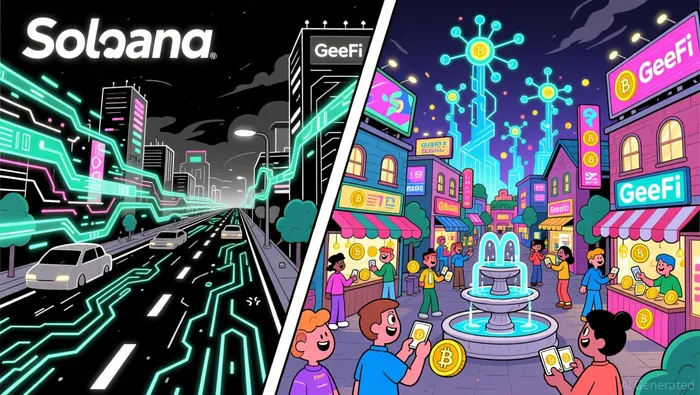 This contrast highlights not just the technological differences but also the varying investment philosophies between infrastructure-focused platforms and utility-driven ecosystems.
When evaluating the long-term viability of projects like GEE and SOL, investors often turn to price and trend data to inform their decisions. By examining GEE's historical price movements and momentum indicators, investors can better understand its trajectory and volatility compared to more traditional crypto benchmarks. This data helps in aligning investment goals with the characteristics of each token.






Comentarios
Aún no hay comentarios