
Why GeeFi (GEE) Outpaces Ripple (XRP) as a 100x Investment Opportunity in 2025
The cryptocurrency market in 2025 is witnessing a stark divergence between two distinct investment paradigms: institutional-driven assets like Ripple (XRP) and utility-first projects like GeeFi (GEE). While XRPXRP-- has capitalized on regulatory clarity and institutional partnerships, GeeFi is capturing retail and institutional attention through its deflationary tokenomics, real-world utility, and explosive presale performance. This analysis explores why GeeFi's ecosystem and token design position it as a superior 100x opportunity compared to XRP's slower, ETF-dependent growth.
Presale Momentum and Projected Listing Gains
GeeFi's presale has already raised $1.2 million in just over a month, with Phase 1 nearing 80% completion and Phase 2 surpassing $680,000 raised. At a current presale price of $0.06, analysts project a listing price of $0.40, offering a guaranteed 667% return for early investors. More ambitious forecasts suggest the token could reach $3 by 2026, translating to a 4,900% return on investment. This velocity contrasts sharply with XRP's institutional-driven growth, which, despite $180 million in ETF inflows and a $1.25 billion acquisition of Hidden Road, has seen only a 7% price increase in 2025.
GeeFi's presale success is further amplified by its deflationary model. By systematically burning tokens as the ecosystem grows, GeeFi reduces supply scarcity, a mechanism absent in XRP's fixed 100 billion token supply. This creates a tailwind for price appreciation, particularly as the project nears its planned exchange listing-a milestone expected to trigger exponential demand.
Utility-Driven Ecosystem vs. Institutional Infrastructure
Where XRP relies on institutional infrastructure (e.g., RippleNet for cross-border payments), GeeFi is building a decentralized, user-first ecosystem. Its platform includes a non-custodial wallet, a decentralized exchange (DEX), and crypto-linked debit cards integrated with VISA and Mastercard, enabling real-world spending at millions of merchants. These features create immediate utility for retail investors, who can stake tokens for up to 55% annual returns or earn 5% referral bonuses. According to reports, GeeFi has gained interest from Ripple (XRP) holders as Phase 2 sells out.
Ripple, by contrast, faces challenges in translating institutional partnerships into retail adoption. While its RLUSD stablecoin and On-Demand Liquidity (ODL) service have streamlined cross-border transactions, XRP's on-chain activity remains low, with many institutional partners using RippleNet without actively transacting in XRP. This disconnect highlights a critical weakness: XRP's value is tied to corporate infrastructure rather than direct user engagement.
Deflationary Tokenomics and Scarcity
GeeFi's deflationary design is a structural advantage over XRP's static supply. 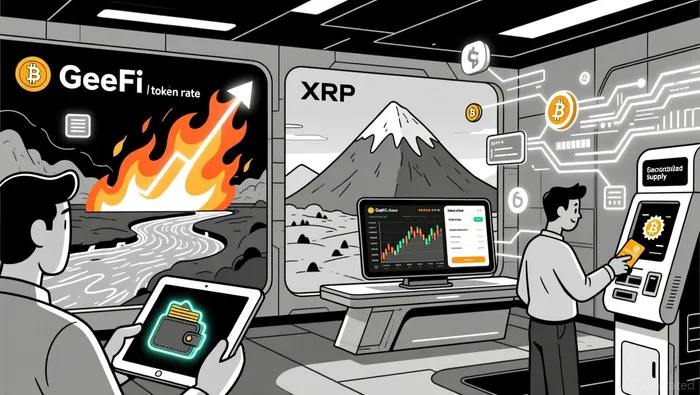 By burning tokens as the ecosystem scales, GeeFi ensures that demand outpaces supply, a dynamic absent in XRP's tokenomics. This scarcity-driven model is particularly attractive in a market where investors seek assets with intrinsic value creation.
For example, GeeFi's staking program allows investors to lock tokens for a full year and earn up to 55% APRAT--, incentivizing long-term holding. Meanwhile, XRP's fixed supply offers no such mechanism, leaving its value dependent on external factors like ETF inflows or regulatory developments.
Projected Returns and Market Position
Analysts project that GeeFi could outperform even high-growth assets like AvalancheAVAX-- (AVAX) and SolanaSOL-- (SOL) in 2026. A $3 price target for GEE implies a 4,900% return for presale participants, far exceeding XRP's projected 7% gain in 2025. This disparity is driven by GeeFi's dual focus on utility and scarcity, whereas XRP's growth is constrained by its reliance on institutional infrastructure and regulatory outcomes.
Moreover, GeeFi's referral program and aggressive utility roadmap are attracting attention from established crypto communities, including Ripple (XRP) holders who are shifting investments to GEE. This migration underscores a broader trend: investors are prioritizing projects with tangible use cases and deflationary incentives over those dependent on institutional adoption alone.
Conclusion
GeeFi (GEE) represents a paradigm shift in the crypto market, combining explosive presale performance, deflationary tokenomics, and real-world utility to create a 100x investment opportunity. While Ripple (XRP) has secured institutional traction through ETFs and corporate partnerships, its fixed supply and lack of retail engagement limit its upside. For investors seeking exponential growth, GeeFi's ecosystem and token design offer a compelling alternative-one that leverages scarcity, utility, and community-driven adoption to outpace even the most established players.






Comentarios
Aún no hay comentarios