
Gearbox's Strategic Resurgence in DeFi Lending: A Case for Credit Innovation and TVL Recovery
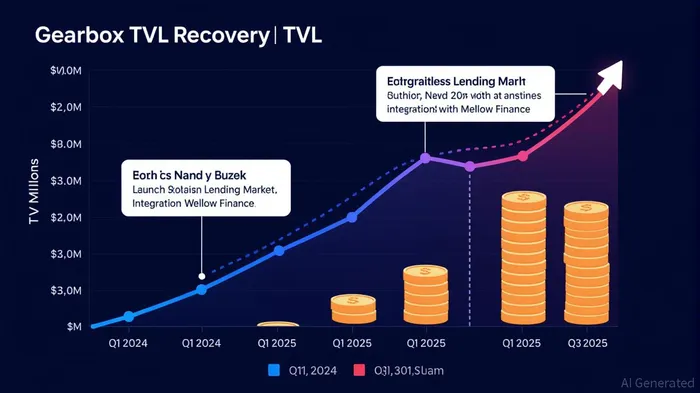
The DeFi Rebound: Gearbox's Credit Model Redefines Risk and Resilience
The decentralized finance (DeFi) sector has long grappled with volatility, regulatory uncertainty, and sustainability challenges. Yet, Gearbox Protocol's strategic resurgence in 2025 offers a compelling case study in how credit innovation and composability-driven growth can stabilize and scale DeFi lending. By leveraging a unique Credit Account model[1] and prioritizing long-term risk management[2], Gearbox has not only recovered its total value locked (TVL) but also positioned itself as a cornerstone of a more resilient DeFi ecosystem.
Credit Innovation: Beyond Leverage to Structural Stability
Gearbox's Credit Account model[1] distinguishes itself by enabling users to deploy leveraged capital across multiple DeFi markets without liquidation risks—a stark contrast to traditional over-collateralized lending platforms like AaveAAVE-- or Compound. This innovation hinges on two pillars: dynamic risk assessment and permissionless market expansion.
For instance, the launch of the Permissionless Lending Market[1] in 2025 allowed third-party developers to onboard new markets without governance votes, accelerating TVL growth by $250 million. This approach reduces friction in protocol expansion while fostering composability, a critical factor in DeFi's ability to interoperate with traditional finance. As noted in academic research, DeFi lending protocols now account for 25% of the $200 billion TVL in DeFi[3], underscoring their growing systemic importance.
Moreover, Gearbox's integration with platforms like Mellow Finance[1] has unlocked liquidity from previously illiquid assets, addressing a key pain point in DeFi. This synergy with traditional finance—where digital assets increasingly reflect macroeconomic pressures like inflation and interest rates[2]—highlights Gearbox's adaptability to external shocks.
TVL Recovery: A Test of Resilience
Gearbox's TVL recovery from an 80% decline in 2024 to $340 million in 2025[1] is a testament to its strategic agility. While competitors struggled with the ezETH depeg incident[1], Gearbox maintained a zero bad debt record since its 2021 inception[1], reinforcing trust in its risk management framework.
This resilience is further amplified by Gearbox's expansion to new blockchains[1], diversifying its exposure to network-specific risks. Meanwhile, broader DeFi lending activity has surged, with Ethereum-based protocols hitting $22.6 billion in active loans in July 2025[2]. Gearbox's ability to capture this demand—while maintaining composability—positions it as a key beneficiary of the sector's maturation.
Sustainability and the Future of DeFi
The intersection of DeFi and environmental sustainability also plays a role in Gearbox's success. Green blockchain innovations, such as tokenized carbon credits[3], align with Gearbox's focus on long-term value creation. By reducing environmental footprints and enhancing transparency, these initiatives address investor concerns about the ecological impact of DeFi, further solidifying Gearbox's appeal.
Academic studies[2] emphasize that DeFi's interconnectedness with traditional finance is no longer theoretical. As macroeconomic pressures ripple into digital assetDAAQ-- markets, protocols like Gearbox that balance innovation with risk mitigation will likely outperform peers.
Conclusion: A Model for DeFi's Next Phase
Gearbox's resurgence underscores a broader shift in DeFi: from speculative experimentation to structured, sustainable growth. Its Credit Account model and permissionless architecture not only enhance composability but also address systemic risks that have plagued earlier iterations of the sector. For investors, this represents a rare opportunity to back a protocol that is redefining the boundaries of DeFi lending while aligning with macroeconomic and environmental trends.
As the TVL recovery trajectory continues, Gearbox's ability to adapt to evolving market conditions—without compromising its core principles—will be critical. For now, the data[1][2][3] suggests that the protocol is not just surviving but thriving in a landscape where sustainability and scalability are no longer optional but essential.






Comentarios
Aún no hay comentarios