
GE Vernova (GEV): A Catalyst-Driven Re-Rating in the Energy Transition Era
In the rapidly evolving energy transition landscape, GE VernovaGEV-- (GEV) has emerged as a standout player, combining robust financial performance with a forward-looking strategy to address decarbonization challenges. As of October 2025, the stock trades at $606.12, with a market capitalization of $165.00 billion-a 144.62% surge year-over-year and a 362.04% leap since March 2024, according to GE Vernova's Q1 2025 release. While its P/E ratio of 144.48 exceeds the Energy sector average of 39.69, it remains below the broader market's 279.59, suggesting a valuation that balances optimism with discipline, according to MarketBeat. Analysts, with 18 "buy" and 9 "hold" ratings, underscore its moderate upside potential, per MarketBeat. But what lies beneath these numbers? A closer look reveals a company poised for a re-rating driven by strategic innovation, capital efficiency, and alignment with global decarbonization megatrends.
Financial Momentum and Shareholder Returns
GE Vernova's first-quarter 2025 results highlight its operational strength. Orders surged to $10.2 billion, while revenue hit $8.0 billion, reflecting strong demand for its gas power and grid solutions, as detailed in the Q1 release. The company has also prioritized shareholder returns, repurchasing shares and launching an inaugural dividend, returning $1.3 billion in capital. This capital discipline, coupled with a $9 billion global capex and R&D plan through 2028, signals a balance between reinvestment and value creation, according to MarketBeat.
Strategic Catalysts for Re-Rating
GE Vernova's untapped upside hinges on its ability to monetize its energy transition initiatives. A key catalyst is its hydrogen-ready gas turbines, which bridge traditional and renewable energy systems. These turbines, compatible with carbon capture and storage (CCS), are critical for grid stability in a low-carbon future, as described in a GE Vernova article. For instance, the Net-Zero Teesside Power Station in the UK-a GE Vernova project-aims to capture 2 million metric tonnes of CO₂ annually. Such projects position the company as a linchpin in the transition, attracting long-term contracts and government incentives.
Equally transformative is its Direct Air Capture (DAC) technology. GE Vernova has moved beyond lab-scale prototypes, securing partnerships with Chevron, Technip Energies, and NRG Energy to deploy DAC in high-emission sectors, per an Enkiai analysis. A $105 million investment in its Niskayuna, NY facility and a C$70 million commitment to a Canadian SMR engineering center underscore its resolve to scale these solutions. With 29 gigawatts of gas power equipment in backlog and 21 gigawatts in slot reservations, the company is well-positioned to capitalize on near-term demand while building a pipeline for long-term growth, as noted in the Q1 release.
Manufacturing Expansion and Global Footprint
To meet surging demand, GE Vernova is investing nearly $600 million in U.S. manufacturing and facilities over the next two years, creating over 1,500 jobs, according to MarketBeat. This includes $300 million for gas turbine production, $20 million for grid solutions, and $100 million for wind and advanced research. These investments not only bolster domestic supply chains but also align with U.S. policy priorities like energy affordability and national security. Globally, the company is expanding DAC and decarbonization partnerships across North America, Europe, and the Middle East, including collaborations with Svante and the Dogger Bank Offshore Wind Farm, as highlighted in industry coverage.
Valuation and Risk Considerations
Despite its growth, GE Vernova's P/E ratio of 144.48 appears elevated. However, this is justified by its projected 67.83% earnings growth to $11.06 per share, per MarketBeat. The company's focus on free cash flow generation-highlighted by CFO Ken Parks in the Q1 release-further supports its ability to sustain this growth. Risks include regulatory shifts and the pace of energy transition adoption, but GE Vernova's diversified portfolio and strategic partnerships mitigate these concerns.
Conclusion
GE Vernova's combination of financial strength, technological innovation, and strategic alignment with decarbonization trends positions it as a compelling long-term investment. While its valuation reflects optimism, the company's pipeline of projects, capital efficiency, and leadership in hydrogen and DAC technologies provide a strong foundation for a re-rating. For investors seeking exposure to the energy transition, GEVGEV-- offers a rare blend of near-term execution and long-term vision.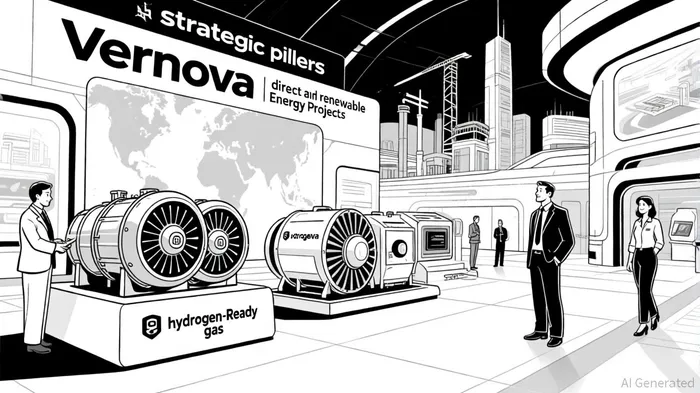





Comentarios
Aún no hay comentarios