
GE Vernova (GEV): Is the AI-Driven Energy Transition Justifying the Premium Valuation?
In the ever-evolving landscape of energy transition, GE VernovaGEV-- (GEV) has emerged as a standout name, trading at a trailing P/E ratio of 100–107 and a forward P/E of 52.36 as of late December 2025. With a market cap of $173.49–$178.60 billion, GEV dwarfs the combined market cap of its entire energy equipment and services industry peers. Yet, the question remains: does the company's aggressive valuation align with its fundamentals, or is the market overbidding on speculative tailwinds?
Valuation Metrics: A Tale of Two Realities
GEV's valuation appears disconnected from its sector's broader dynamics. While the company's P/E ratio suggests optimism, the Energy Equipment & Services industry's average PEG ratio of 0.45 (as of late 2025) indicates undervaluation relative to earnings growth. In contrast, GEV's PEG ratio of 1.69–2.83 implies that investors are paying a premium for growth expectations that may not materialize. This disconnect raises red flags. A PEG ratio above 1 typically signals overvaluation unless the company's growth prospects are exceptionally robust.
However, GEV's recent guidance and capital allocation moves have fueled bullish sentiment. The company raised its 2025–2028 financial outlook, projecting $52 billion in revenue and a 20% adjusted EBITDA margin by 2028-up from $45 billion and 14% previously. Cumulative free cash flow is now forecasted at $22 billion through 2028, a $8 billion increase from earlier estimates. These revisions, coupled with a doubled quarterly dividend ($0.50/share) and a $10 billion share repurchase authorization (with $3.3 billion already deployed), signal confidence in its ability to generate returns.
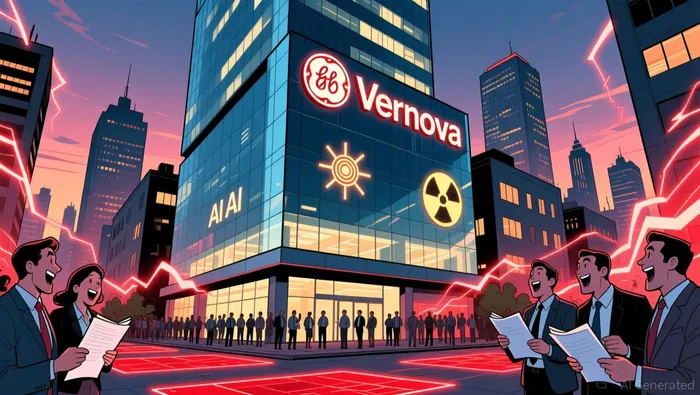
Sector Tailwinds and Strategic Bets
The energy transition is a megatrend GEVGEV-- is positioning itself to dominate. The global Energy Equipment Service Market is projected to grow at a 4.92% CAGR through 2035, driven by AI-driven grid modernization, carbon capture, and small modular nuclear reactors. GEV's investments in AI, robotics, and automation align with these trends, particularly as data centers and renewable energy infrastructure demand smarter grid solutions.
Yet, the company's reliance on long-term, capital-intensive projects introduces execution risk. For instance, small modular reactors and carbon capture technologies remain unproven at scale, and their commercial viability hinges on regulatory and technological breakthroughs. While GEV's R&D spending is undisclosed, its focus on "breakthrough energy technologies" suggests a high-stakes bet on innovation.
The Buyback Conundrum
GEV's $10 billion buyback program, with $6.7 billion remaining as of December 2025, could temporarily buoy the stock price by reducing shares outstanding. However, buybacks are a double-edged sword. If the company's valuation remains stretched, repurchasing overpriced shares could erode shareholder value. Conversely, if GEV's guidance proves accurate and its AI-driven initiatives gain traction, the buybacks could enhance returns.
Balancing the Equation
The key to GEV's valuation realism lies in its ability to deliver on its ambitious targets. A 20% EBITDA margin by 2028 would represent a 43% margin expansion from current levels-a feat that demands operational discipline and pricing power in a cyclical industry. Meanwhile, the company's PEG ratio suggests that the market is pricing in growth rates significantly higher than the sector's historical 8.16% revenue CAGR.
For investors, the calculus hinges on two questions:
1. Can GEV sustain its margin expansion and free cash flow growth in a sector prone to volatility?
2. Will its AI and energy transition bets translate into scalable, profitable technologies?
Conclusion: A High-Stakes Gamble
GEV's valuation is a paradox. On one hand, its premium multiples reflect skepticism about its ability to justify them. On the other, its guidance, buybacks, and strategic alignment with energy transition trends offer a compelling narrative for growth. The company's success will depend on its execution against its 2028 targets and the pace of technological adoption in energy markets. For now, the stock remains a high-risk, high-reward proposition-justified for those who believe in its long-term vision but perilous for those who prioritize near-term fundamentals.





Comentarios
Aún no hay comentarios