
GE Vernova's Dividend Stability: A Beacon of Financial Resilience in the Energy Transition
In an era of rapid energy transformation, few metrics signal corporate health as clearly as a consistent dividend policy. For GE VernovaGEV-- (NYSE: GEV), the recently spun-off energy division of General ElectricGM--, maintaining a steady dividend—despite industry turbulence—has become a hallmark of its financial discipline. This article explores how GE Vernova's dividend stability aligns with its pivot to sustainable energy, offering investors a compelling mix of income and growth potential in a shifting market.
Dividend Consistency Amid Transition: A Strategic Priority
GE Vernova began paying dividends in late 2024, with a quarterly payout of $0.25 per share, marking its first such distribution after decades of reinvesting profits. By mid-2025, this policy had already been reaffirmed twice, signaling confidence in cash flow. With an annualized yield of ~2.5% as of June 2025, GEV's dividend now outpaces the broader market—offering downside protection in volatile energy markets.
The low payout ratio of 27.7% (based on 2024 earnings of $1.07 per share) underscores this stability. Even as the company invests heavily in renewable infrastructure, its dividend consumes a mere fraction of profits, leaving ample room for reinvestment and shareholder returns.
Financial Resilience: Backed by Cash Flow and Diversification
GE Vernova's dividend is underpinned by robust financial metrics:
- 2024 Revenue: $34.9 billion (+5% YoY), driven by its Power and Electrification segments.
- Net Income: Jumped to $1.6 billion, reversing a $474 million loss in 2023.
- Free Cash Flow: Improved to $1.7 billion, with a 2025 target of $2.0–$2.5 billion.
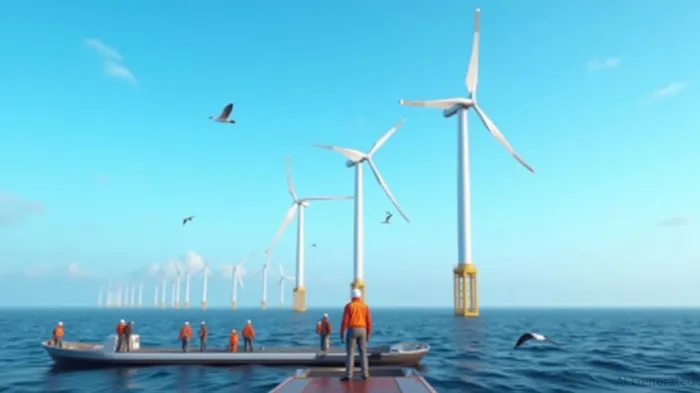
Crucially, its three business segments—Power, Wind, and Electrification—create a balanced portfolio:
1. Power: Generates recurring revenue through gas turbine maintenance and grid reliability solutions.
2. Wind: Despite near-term setbacks (e.g., offshore project delays), onshore orders surged 76% in 2024, and EBITDA losses narrowed by $400 million.
3. Electrification: Delivers high-margin grid and storage tech, with 19% organic revenue growth in 2024.
This diversification shields GE Vernova from relying on any single energy source, a critical advantage as governments push decarbonization agendas.
Renewable Growth: Fueling Long-Term Resilience
GE Vernova's $44.1 billion in 2024 orders reflect soaring demand for sustainable energy solutions:
- Wind: Secured $7.1 billion in orders (including $14.2 billion for Saudi Arabia's grid modernization).
- Electrification: Grew orders to $15.7 billion, driven by grid upgrades and solar storage.
The company's 57,000 global turbines and 120 GW of installed capacity provide a moat of recurring maintenance revenue, while its R&D focus on next-gen wind blades and grid stability tech positions it to capitalize on the $1.2 trillion in global energy transition spending by 2030.
Risks and Challenges: Offshore Wind and Regulatory Headwinds
Despite its strengths, GE Vernova faces hurdles:
1. Offshore Wind Setbacks: Blade failures and regulatory delays (e.g., the U.S. Vineyard Wind project) have caused losses.
2. Supply Chain Costs: Persistent inflation and labor shortages pressure margins, especially in offshore projects.
3. Policy Uncertainty: EU green mandates and U.S. local-content rules (e.g., IRA requirements) could raise compliance costs.
These risks are mitigated by GEV's $8.2 billion cash balance (as of 2024) and its focus on high-margin segments like Electrification, which delivered a 9.0% EBITDA margin in 2024, up from 3.7% in 2023.
Investment Thesis: A Long-Term Play on Energy Transition
For investors, GE Vernova offers a rare blend of income and growth:
- Dividend Safety: The 27.7% payout ratio and $2.6 billion in 2024 operating cash flow suggest the $0.25/quarter dividend is secure.
- Upside Catalysts:
- Electrification's grid projects (e.g., Saudi Arabia's $14.2 billion deal).
- Onshore wind recovery and offshore project execution in 2025–2026.
- Valuation: Trading at ~8x 2025E EBITDA, GEVGEV-- is undervalued relative to peers like Vestas Wind Systems (VWS.CO), which trades at ~12x.
Conclusion: A Dividend Anchor in a Turbulent Sea
GE Vernova's dividend stability is no accident—it reflects a company repositioning for the energy future while maintaining fiscal prudence. For investors with a 3–5 year horizon, the stock offers:
- A 2.5% yield in a low-yield world.
- Exposure to the $1.2 trillion energy transition.
- A diversified portfolio insulated from single-sector risks.
While near-term offshore wind execution remains a concern, GEV's cash reserves, recurring revenue streams, and strategic focus on high-margin segments justify a hold or buy rating. In a market where energy companies are buffeted by policy and commodity swings, GE Vernova's dividend consistency is more than a payout—it's a promise of resilience.
Consider this article for informational purposes only. Always conduct your own research or consult a financial advisor before making investment decisions.





Comentarios
Aún no hay comentarios