
GE HealthCare's Q3 2025 Dividend: A Conservative Strategy for Long-Term Stability
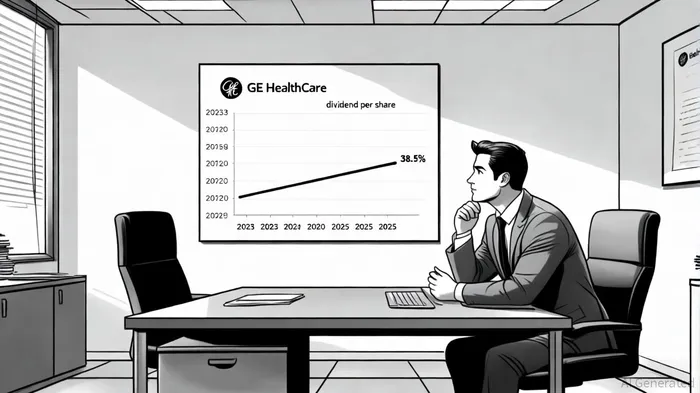
In the third quarter of 2025, GE HealthCareGEHC-- Technologies (GEHC) reaffirmed its commitment to a cautious dividend policy, declaring a quarterly payout of $0.035 per share, unchanged from its May 2025 distribution[1]. This brings the annualized dividend to $0.14 per share, translating to a yield of 0.19%—a modest figure by sector standards[1]. However, the company's payout ratio of 2.8% for Q3 2025[1], far below the healthcare sector average of 38.5%[1], underscores a deliberate strategy to prioritize reinvestment and financial flexibility over aggressive shareholder returns.
A Conservative Payout Ratio: Strength or Constraint?
GE HealthCare's low payout ratio is not a recent anomaly. The company has historically maintained a payout ratio of approximately 2.96% in the prior fiscal year[3], reflecting a disciplined approach to capital allocation. This conservative stance is reinforced by robust financial metrics: Q2 2025 free cash flow surged by $189 million year-over-year to $7 million[3], while cash reserves stood at $3.8 billion as of June 2025[2]. Analysts argue that this fiscal prudence ensures ample headroom for sustaining dividends even amid economic volatility[2].
The company's recent 17% dividend increase, raising the quarterly payout to $0.035 per share[2], further signals confidence in its cash flow generation. Despite the hike, the earnings payout ratio remains at 3.3% per share[2], a level that analysts describe as “conservative but sustainable”[2]. This approach contrasts sharply with peers in the healthcare sector, where higher payout ratios often reflect pressure to meet investor expectations for immediate returns.
Strategic Growth and Investor Sentiment
GE HealthCare's dividend sustainability is bolstered by its strategic focus on innovation and market expansion. The company raised full-year 2025 guidance following a 3% organic revenue growth outlook[1], driven by strong demand for capital equipment and progress in mitigating tariff impacts. Recent acquisitions, such as the $150 million purchase of icometrix to enhance neurological care offerings[2], highlight its commitment to leveraging AI and digital solutions—a sector analysts predict will drive long-term value[4].
Investor sentiment appears cautiously optimistic. GEHC's stock trades at a P/E ratio of 15.12x[2], suggesting undervaluation relative to earnings, while analyst price targets range from $73 to $106[2]. However, the company's $10.71 billion in total debt[4] and 0.45% year-over-year increase in long-term debt[3] raise questions about its capacity to fund both dividends and strategic initiatives. That said, its $19.7 billion in annual revenue and 41.56% gross margin[2] provide a solid foundation for balancing these priorities.
The Road Ahead
For dividend-focused investors, GE HealthCare's approach offers a mix of security and restraint. The low payout ratio ensures resilience against earnings fluctuations, while the recent dividend increase signals management's confidence in long-term growth. However, the 0.19% yield[1] may underwhelm those seeking higher immediate returns, particularly in a low-interest-rate environment.
Analysts remain divided on the optimal path forward. Some advocate for a gradual increase in the payout ratio to align more closely with sector averages, while others praise the company's focus on reinvestment and innovation[4]. Ultimately, GE HealthCare's strategy appears to prioritize stability over growth in shareholder returns—a calculus that may appeal to risk-averse investors but could test patience in a market increasingly favoring aggressive capital returns.





Comentarios
Aún no hay comentarios