
GE HealthCare's AI-Driven X-ray Innovation: A Strategic Play in Addressing Global Radiology Staff Shortages
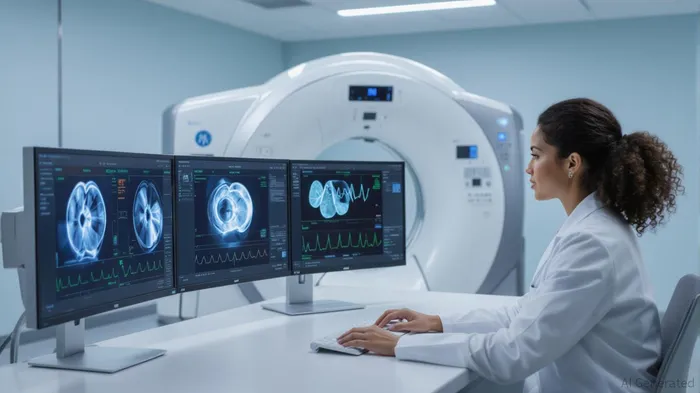
The global radiology workforce is in crisis. From the UK's 30% shortfall in clinical radiologists to the U.S. projecting a 37,800–124,000 physician shortage by 2034, the demand for imaging services is outpacing supply at an alarming rate. Imaging utilization is expected to grow 26.9% by 2055, while radiologist numbers will expand by just 25.7%. This gap—compounded by aging populations, chronic disease surges, and workforce burnout—has created a $20.2 billion radiology market ripe for disruption. Enter artificial intelligence (AI).
GE HealthCare, a leader in medical imaging, is positioning itself as a critical player in this transformation. Its recent AI-driven innovations—particularly in X-ray and CT technologies—align with the urgent need to automate workflows, reduce diagnostic delays, and scale access to care. With 60% of U.S. radiology departments already adopting AI tools, the company's strategic investments and partnerships are not just timely—they're essential to navigating a labor-constrained healthcare landscape.
GE HealthCare's AI-First Strategy: A Closer Look
GE HealthCare's collaboration with NVIDIANVDA--, announced in 2025, underscores its commitment to AI-driven imaging. By integrating NVIDIA's AI capabilities into its diagnostic systems, the company is enhancing image clarity, automating triage, and accelerating report generation. For example, its Revolution™ Vibe CT system leverages AI to enable one-beat cardiac imaging, reducing exam times and minimizing the need for repeat scans. Such advancements directly address the strain on radiologists, who spend 40% of their time on non-diagnostic tasks like report writing.
The company's AI Innovation Lab, launched in 2025, further cements its role as a pioneer. This lab is expected to develop tools for real-time image analysis, predictive analytics, and personalized imaging protocols—capabilities that could redefine diagnostic precision. Notably, GE's Flyrcado™ (flurpiridaz F 18) injection, launched in the U.S. in early 2025, pairs AI with radiopharmaceuticals to improve cardiac imaging accuracy, a market segment projected to grow at 15% annually through 2030.
Financials and Market Position: A Resilient Growth Story
GE HealthCare's Q1 2025 financials highlight its strong position in the AI-enabled imaging sector. The company reported $2.14 billion in Imaging segment revenue, up 4% year-over-year, with a 9.3% EBIT margin—a 130-basis-point improvement. Its Advanced Visualization Solutions (AVS) segment, which includes AI-powered tools, saw a 21.1% EBIT margin, reflecting robust profitability in high-margin digital offerings.
The company's book-to-bill ratio of 1.09 and 10% organic order growth signal strong demand for its AI-driven products. Strategic acquisitions, like Nihon Medi-Physics (NMP), are expanding its radiopharmaceutical pipeline, while partnerships with NVIDIA and cloud-based PACSPACS-- systems are future-proofing its infrastructure.
Market Tailwinds: AI in Radiology is a $4.54 Billion Opportunity by 2029
The AI-driven radiology market is expanding at a 22.4% CAGR, driven by the need to offset staffing shortages. GEGE-- HealthCare's teleradiology solutions, integrated with AI for 24/7 diagnostic coverage, are particularly compelling in rural and underserved regions. For instance, its Falcon MD DICOM viewer enables secure, high-quality image interpretation from mobile devices, a critical tool in areas with radiologist shortages.
The company's focus on AI-powered workflow automation—such as prioritizing critical exams and detecting normal findings—aligns with the industry's push to reduce burnout. A 2024 FDA-cleared AI tool for fracture triage, for example, cut X-ray report turnaround times by 83%, a metric that could become a standard in AI adoption.
Risks and Challenges
Despite its strengths, GE HealthCareGEHC-- faces headwinds. Regulatory scrutiny of AI tools, particularly around algorithmic bias and post-market surveillance, could delay product launches. Competition from startups and tech giants (e.g., Siemens Healthineers, Philips) is intensifying, and GE's reliance on U.S. markets (which account for 55% of its Imaging segment revenue) exposes it to policy shifts like Medicare reimbursement cuts.
Moreover, the AI medical imaging sector is capital-intensive. GE's Q1 2025 cash flow from operations dipped to $250 million, partly due to increased R&D and capital expenditures. While the company's $1 billion share repurchase program signals confidence, investors must weigh near-term liquidity pressures against long-term growth potential.
Investment Thesis: A Buy for the Long-Term
GE HealthCare's AI-driven innovations are not just solving a staffing crisis—they're redefining the economics of radiology. With the AI in Medical Imaging Market projected to reach $4.54 billion by 2029, GE's first-mover advantage in integrating AI with hardware and radiopharmaceuticals positions it to capture a disproportionate share of growth.
For investors, the key metrics to watch are:
1. AI segment revenue growth: GE's AVS and Imaging segments are outperforming its broader business.
2. Regulatory milestones: FDA clearances for new AI tools will validate their clinical utility.
3. Global adoption rates: Teleradiology and mobile imaging solutions could unlock growth in emerging markets.
While short-term volatility is possible, GE HealthCare's strategic alignment with a $20.2 billion radiology market and a 25.7% CAGR in AI adoption makes it a compelling long-term play. For those seeking exposure to the AI healthcare revolution, this is a stock worth watching.





Comentarios
Aún no hay comentarios