
U.S. GDP Growth and Its Implications for Equity and Bond Markets: A Shift in Monetary Policy and Asset Allocation Strategies
The U.S. economy has delivered a striking performance in the third quarter of 2025, with real GDP expanding at an annualized rate of 4.3%, far exceeding economists' expectations of 3.3%
according to the initial estimate. This surge, driven by robust consumer spending, a rebound in exports, and increased government outlays, underscores a resilient but uneven recovery. Consumer spending alone accelerated to 3.5%, while exports
surged by 8.8%-a dramatic reversal from the -1.8% contraction in the prior quarter. Such data has reignited debates about the Federal Reserve's policy path and its implications for global financial markets.
The Fed's Tightrope: Growth, Inflation, and Policy Dilemmas
The Federal Reserve now faces a classic conundrum: balancing the need to support a strong economy against the persistence of inflation above its 2% target.
The PCE price index, the Fed's preferred inflation gauge, rose 2.9% year-over-year in August 2025. This "stickiness" in inflation, despite three rate cuts earlier in the year, has led the Fed to project only one additional 25-basis-point cut in 2026
according to the outlook.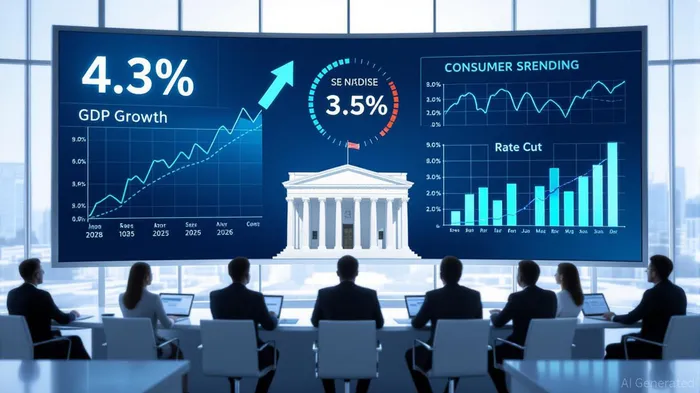 St. Louis Fed President Alberto Musalem has highlighted the risks of a potential slowdown, noting that weaker consumer spending and housing market data could undermine growth
according to his remarks.
Market expectations, however, remain at odds with the Fed's cautious stance. Futures contracts suggest investors anticipate two more rate cuts in 2025 and two in 2026, which would bring the federal funds rate to 3% by year-end 2026
according to market analysis. The dollar index has already weakened in response to these expectations, as the anticipated rate differential with the Bank of Japan and the European Central Bank eroded its appeal
according to analysis. The uncertainty is compounded by the upcoming appointment of a new Fed Chair in May 2026, which could introduce volatility in policy communication and execution
according to the outlook.
Market Reactions: Equities, Bonds, and the K-Shaped Recovery
The equity and bond markets have responded to this evolving landscape with a mix of optimism and caution. In Q3 2025, the S&P 500
surged by 8%, fueled by strong corporate earnings, a 25-basis-point rate cut in September, and surging demand for artificial intelligence (AI) technologies. Bond markets also benefited, with the Bloomberg Aggregate Bond Index rising 2% and the 10-year Treasury yield
falling to 4.2% from a peak of 4.5% in July. This "risk-on" environment reflects a belief that the Fed's accommodative stance will continue to support asset prices.
Yet, the economic recovery remains uneven. The U.S. is increasingly characterized by a K-shaped growth pattern, where AI-driven sectors thrive while others, such as housing and manufacturing, face headwinds. Schwab analysts caution that circular financing and capital expenditure sustainability in tech-heavy industries could pose long-term risks
according to their analysis. Meanwhile, emerging markets have outperformed developed peers, with the MSCI Emerging Markets index delivering double-digit returns, driven by progress in U.S.-China trade talks and the Fed's rate cuts
according to commentary. However, political uncertainties in Brazil and India, coupled with U.S. trade tariffs, have created pockets of vulnerability
according to market insights.
Asset Allocation Strategies: Diversification and Prudence
Given these dynamics, investors are recalibrating their strategies. The focus is shifting from concentrated bets in tech and narrative-driven sectors to a more diversified approach. Riverbridge Capital, for instance, recommends increasing exposure to sectors with strong cash flows and lower sensitivity to interest rates, such as utilities and consumer staples
according to their guidance. Similarly, Schwab highlights the importance of hedging against inflation through real assets like commodities and real estate
according to their outlook.
In fixed income, the search for yield has intensified, with investors gravitating toward high-yield corporate bonds and emerging market debt. The Bloomberg Municipal Bond Index's 3% gain in Q3 2025 reflects growing interest in tax-advantaged securities
according to market analysis. However, analysts warn that the Fed's tightening bias in 2026 could pressure bond prices, particularly for long-duration assets
according to the outlook.
Conclusion: Navigating Uncertainty with Agility
The U.S. GDP data for Q3 2025 signals a pivotal moment in the economic cycle. While the Fed's policy path remains constrained by inflation, the market's pricing of further rate cuts suggests a belief in a soft landing. For investors, the challenge lies in balancing growth opportunities with the risks of a potential policy misstep. A diversified, agile portfolio-combining equities in resilient sectors, defensive fixed income, and real assets-offers the best defense against the uncertainties ahead. As the Fed's next moves unfold, adaptability will be the hallmark of successful asset allocation.







Comentarios
Aún no hay comentarios