
GDOG's Underperformance and the Future of Meme-Coin ETFs: A Hierarchy of Institutional Adoption in a Fragmented Market
The GDOG Debut: A Case Study in Meme-Coin Hesitation
GDOG's muted reception contrasts sharply with the success of BitcoinBTC-- and EthereumETH-- ETFs, which have attracted over $179.5 billion in assets under management by mid-2025. While BlackRock's IBIT alone commands 48.5% of the Bitcoin ETF market with $50 billion in AUM according to data, GDOG's first-day volume pales in comparison to even niche altcoin ETFs. For context, the Rex-Osprey Dogecoin ETF, launched in September 2025, achieved $17 million in opening-day volume under different regulatory parameters. This disparity underscores a critical hierarchy: institutional investors prioritize assets with proven utility and regulatory certainty, leaving meme coins like DOGEDOGE-- in a precarious middle ground.
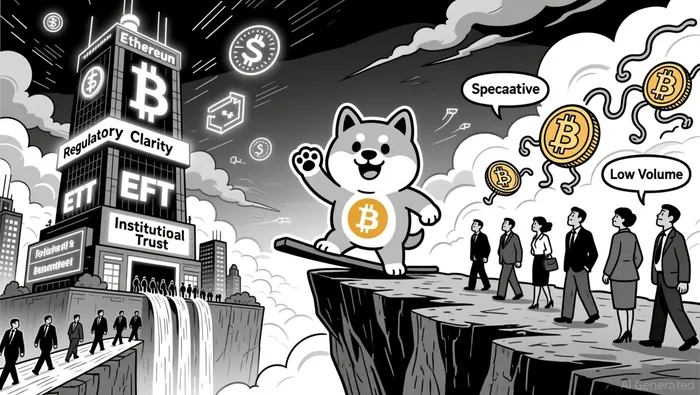
The root of GDOG's struggles lies in DOGE's identity. Despite its cultural cachet and 10th-largest market cap, Dogecoin lacks intrinsic value or staking capabilities that drive institutional interest in Bitcoin and Ethereum. Moreover, competing ETFs like BWOW and TXXD have fragmented institutional capital, diluting GDOG's appeal. Even the broader market context-Q3 2025's crypto downturn-exacerbated caution, with investors favoring Bitcoin's stability over DOGE's volatility.
The Hierarchy of Institutional Adoption: Regulatory Clarity Trumps Meme Momentum
Institutional investors in 2025 are guided by a clear hierarchy of factors: regulatory frameworks, liquidity, and asset utility. The approval of spot Bitcoin ETFs in 2024, coupled with the U.S. SEC's removal of enforcement barriers and the Trump administration's Strategic Bitcoin Reserve, created a regulatory tailwind that legitimized crypto as an asset class. By contrast, meme-coin ETFs lack this clarity. While the SEC's recent approval of in-kind creation/redemption mechanisms for altcoins like DOGE and XRPXRP-- is a step forward, the absence of a unified framework for meme coins leaves investors exposed to regulatory arbitrage and uncertainty.
Liquidity further compounds the issue. Bitcoin ETFs benefit from a $179.5 billion AUM and a "liquidity flywheel" driven by institutional-grade custody solutions and stablecoin infrastructure according to analysis. Meme-coin ETFs, however, operate in a fragmented market where trading volumes are volatile and often speculative. For example, GDOG's second-day inflows plummeted to $381,650-a 73% drop-highlighting the fragility of demand according to reports. This volatility is exacerbated by the lack of real-world utility in meme coins, which rely on social sentiment rather than tangible use cases.
Meme-Coin ETFs: A Niche with Long-Term Potential?
Despite these challenges, meme-coin ETFs are not without appeal. Institutional investors are increasingly viewing them as tools for portfolio diversification and structured trading, particularly as cross-asset correlations between DOGE and BTCBTC-- rise. For instance, CleanCore Solutions' accumulation of 710 million DOGE tokens-a move that historically correlates with 12% price spikes-demonstrates how corporate treasuries can stabilize meme-coin valuations. Additionally, innovations like yield-enhanced ETFs are beginning to align institutional strategies with meme-coin dynamics.
However, the path to mainstream adoption is steep. Regulatory hurdles remain significant: while Bloomberg estimates a 75–90% approval chance for SolanaSOL-- and XRP ETFs, meme-coin funds face a much lower probability due to their speculative nature according to analysis. This regulatory asymmetry is compounded by market fragmentation. In Europe, the Markets in Crypto-Assets (MiCA) regulation aims to unify standards, but its implementation is still nascent. Meanwhile, U.S. investors must navigate a patchwork of state-level policies, further complicating capital allocation.
Implications for the Future of Meme-Coin ETFs
GDOG's underperformance serves as a bellwether for the broader meme-coin ETF market. If institutional demand for DOGE remains tepid, it could deter the launch of additional single-token funds, leading to a consolidation of the crypto ETF pipeline. Conversely, if projects like Maxi Doge or BONKBONK-- develop utility-driven use cases-such as DeFi integration or tokenized real-world assets (RWAs)-they may transition from speculative assets to institutional-grade investments according to analysis.
The key takeaway is that meme-coin ETFs will succeed only if they address three core barriers: regulatory ambiguity, volatility, and utility gaps. For now, the hierarchy of institutional adoption remains tilted toward Bitcoin and Ethereum, with meme coins occupying a niche role. Yet, as the crypto market evolves, the interplay between regulatory clarity, technological innovation, and community-driven utility could redefine this hierarchy-transforming meme-coin ETFs from speculative curiosities into strategic diversifiers.





Comentarios
Aún no hay comentarios