
GBTC's Declining Relevance in the Post-ETF Era
The Grayscale Bitcoin Trust ETFGBTC-- (GBTC) once stood as the dominant vehicle for institutional and retail investors seeking exposure to BitcoinBTC--. However, the approval of new Bitcoin ETFs in late 2024 and their subsequent performance in 2025 has exposed GBTC's vulnerabilities, particularly its fee structure and its inability to retain capital in a rapidly evolving market. As investors increasingly prioritize cost efficiency and flexibility, GBTC's market share has eroded, raising questions about its long-term relevance in the post-ETF era.
Fee Sensitivity: A Tipping Point for Capital Migration
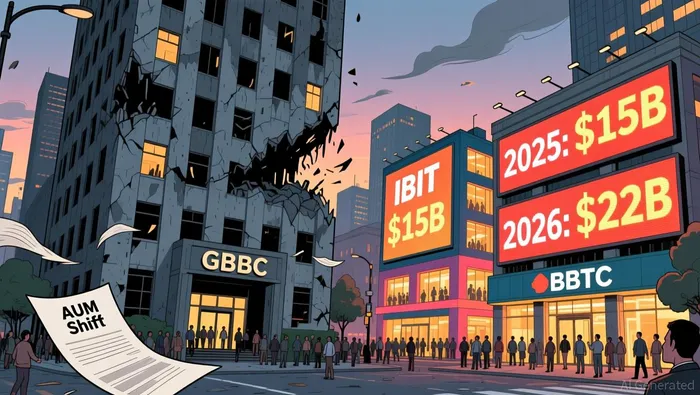
GBTC's 1.52% expense ratio has become a critical liability in a landscape where competitors like the iShares Bitcoin Trust ETFIBIT-- (IBIT) and the Grayscale Bitcoin Mini Trust ETFBTC-- (BTC) charge as little as 0.15% to 0.22%. This stark disparity has driven a mass exodus of capital. According to a report by , IBITIBIT-- alone attracted $25.1 billion in net inflows in 2025, while GBTCGBTC-- lost $3.7 billion in the same period. The cost differential is not merely a matter of cents on the dollar; it compounds over time, eroding returns for investors who could otherwise allocate savings to lower-cost alternatives.
The December 2025 outflows further underscore this trend. GBTC recorded $515 million in net outflows on a single day in early January 2026, adding to nearly $4 billion in redemptions since its conversion to an ETF. By contrast, rival ETFs such as Fidelity's FBTC and IBIT saw inflows of $372 million and $25.1 billion, respectively. Analysts attribute this shift to the growing fee consciousness of both retail and institutional investors, who now view GBTC's high costs as unjustifiable in a market saturated with cheaper options.
Investor Behavior: Tax Efficiency and Strategic Arbitrage
Beyond fees, investor behavior has accelerated GBTC's decline. Capital gains taxes have incentivized investors to offload long-held GBTC shares, which carry embedded gains due to years of holding Bitcoin at a discount to its net asset value (NAV). As noted by , this "tax drag" has prompted many to liquidate GBTC positions and reallocate to newer ETFs with more favorable tax profiles.
Additionally, the emergence of pairs trading strategies has further weakened GBTC's position. Traders have exploited price discrepancies between GBTC (trading at a discount) and premium-listed ETFs by selling the latter while buying GBTC, effectively profiting from arbitrage opportunities. This activity has amplified outflows from GBTC, compounding its challenges in retaining assets.
Market Dynamics: Concentration and Competition
While the broader Bitcoin ETF category saw $34.1 billion in inflows in 2025, this growth was highly concentrated. IBIT's dominance-accounting for over 73% of total inflows- highlights the market's preference for low-cost, transparent structures. GBTC's $15.2 billion in assets under management (AUM) as of November 2025, though still substantial, pales in comparison to the explosive growth of its competitors.
The December 2025 outflows also reflect broader market volatility. Despite a $673 million industry-wide exodus in late December, Bitcoin ETFs rebounded in early January 2026, illustrating the sector's sensitivity to macroeconomic signals and investor sentiment. However, this volatility has not been kind to GBTC, which lacks the pricing flexibility of newer funds to attract capital during periods of uncertainty.
Conclusion: A Leadership Role Under Threat
GBTC's historical advantages-its first-mover status and operational track record-remain assets. Yet, observes, its high fees and declining AUM have made it increasingly vulnerable to competition. While it may retain a leadership position for the foreseeable future, the structural headwinds it faces suggest a long-term decline in relevance. For investors, the lesson is clear: in the post-ETF era, fee sensitivity and strategic adaptability will define success in the Bitcoin market.







Comentarios
Aún no hay comentarios