
GATX Corporation: Navigating the Crossroads of Asset-Heavy Operations and a Decarbonizing Economy
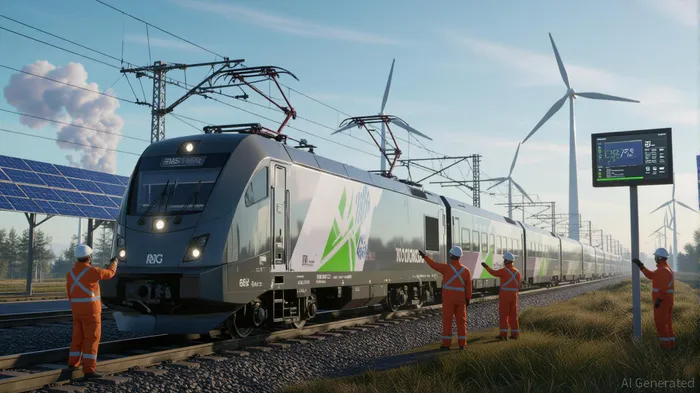
GATX Corporation’s asset-heavy business model, built on railcar leasing, aerospace engine leasing, and tank containers, has long thrived on high utilization rates and strategic fleet management. In Q2 2025, the company reported a 99.2% utilization rate for North American railcars and a 24.5% earnings boost in its aerospace segment [3]. These metrics underscore its operational resilience. However, as the global economy pivots toward decarbonization, GATXGATX-- faces a critical question: Can its capital-intensive model adapt to a future where carbon efficiency is non-negotiable?
The Strengths of an Asset-Heavy Model
GATX’s reliance on durable, long-lived assets has historically provided stable cash flows. Its railcar fleet, for instance, supports the transport of over 600 commodities, including raw materials and fuels, while rail transportation itself is three to four times more fuel-efficient than trucking [1]. The company’s strategic asset sales and reinvestments—such as $227 million in fleet expansion—further demonstrate its agility in managing a dynamic market [3]. Additionally, partnerships like the acquisition of Wells Fargo’s rail assets with Brookfield InfrastructureBIPC-- signal a commitment to scaling operations [5].
The Decarbonization Dilemma
The challenge lies in aligning these strengths with a low-carbon economy. While GATX highlights rail’s inherent efficiency and participates in programs like Responsible Care® and EcoVadis Gold Certification [4], it lacks specific emission reduction targets for 2025–2030. This absence is striking given that railcar operations indirectly support carbon-intensive industries, such as fossil fuel transport. The company’s 2025 sustainability report notes efforts to reduce energy use and waste but stops short of quantifiable goals [2].
Moreover, GATX’s asset-heavy structure could become a liability if regulators impose stricter emissions standards or if demand shifts toward renewable energy infrastructure. For example, the company’s $87.4 million investment in sustainable railcar technologies—a 35% fleet upgrade by 2024—shows progress, but such initiatives require sustained capital allocation [2]. Without clear decarbonization roadmaps, investors may question whether GATX is prepared for a future where stranded assets and regulatory penalties loom large.
Strategic Risks and Opportunities
The transition to a low-carbon economy is capital-intensive, particularly for infrastructure-heavy sectors. While rail remains a low-emission alternative to trucking, the broader logistics industry faces pressure to adopt zero-emission technologies, such as hydrogen-powered trains or electrified rail networks. GATX’s current focus on incremental improvements—like GPS tracking to reduce downtime—addresses operational efficiency but does not tackle systemic decarbonization [2].
A would clarify its historical performance and whether its “non-significant” emissions narrative holds under scrutiny [2]. Investors should also monitor how the company responds to growing customer demand for low-emission solutions, which has already risen 18.6% year-over-year [2].
Conclusion: A Model in Transition
GATX’s current success is rooted in its ability to maximize asset utilization and diversify its portfolio. However, the lack of concrete decarbonization targets and the inherent risks of an asset-heavy model in a climate-conscious era present a double-edged sword. While its railcar leasing business aligns with broader sustainability goals, the company must evolve beyond vague commitments to secure long-term relevance. For investors, the key will be to balance GATX’s short-term financial strength with its capacity to innovate in a decarbonizing world.
Source:
[1] Sustainability | GATX CorporationGATX-- [https://www.gatx.com/sustainability/]
[2] Our Environment | GATX Corporation [https://www.gatx.com/sustainability/environment/]
[3] GATX's Strategic Resilience in a Shifting Industrial Landscape [https://www.ainvest.com/news/gatx-strategic-resilience-shifting-industrial-landscape-2507/]
[4] GATX Rail Europe achieves EcoVadis Gold Certification [https://www.linkedin.com/posts/gatx-rail-europe_sustainability-ecovadisgold-greentransport-activity-7285939851730849792-35at]
[5] GATX Corporation and BrookfieldBN-- Infrastructure to Acquire ... [https://www.businesswire.com/news/home/20250529722487/en/GATX-Corporation-and-Brookfield-Infrastructure-to-Acquire-Wells-Fargos-Rail-Assets]







Comentarios
Aún no hay comentarios