
Gatik's Strategic Expansion in Canadian Freight: A Catalyst for Autonomous Trucking Adoption
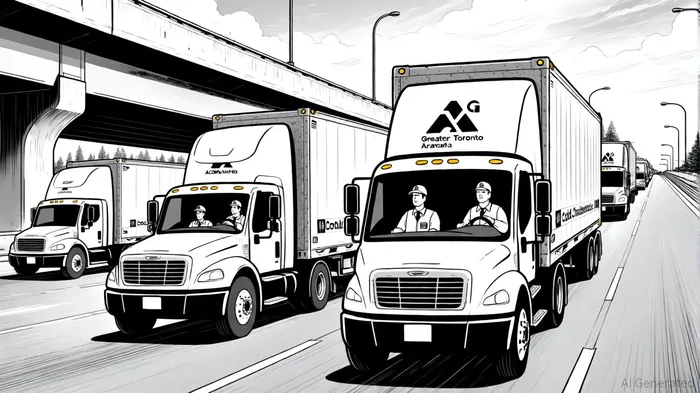
The autonomous trucking sector is on the cusp of a transformative leap, and Gatik's recent partnership with Loblaw in Canada represents a pivotal moment. By securing regulatory approvals under Ontario's Automated Commercial Motor Vehicle (ACMV) Pilot Program and scaling its AI-powered logistics network, Gatik is not just testing technology—it's building a blueprint for commercial viability in a highly regulated market. For investors, this raises a critical question: Can early-stage autonomous logistics players like Gatik overcome regulatory and operational hurdles to deliver scalable returns?
A Commercial Breakthrough in the GTA
Gatik's collaboration with Loblaw, , is the largest planned deployment of autonomous trucks in North America. By the end of 2026, , initially with safety drivers before transitioning to fully driverless operations[1]. This partnership is more than a technical milestone—it's a commercial validation. Loblaw's strategic investment in Gatik underscores confidence in the company's ability to reduce logistics costs, enhance supply chain reliability, and meet sustainability goals[2].
The GTA deployment leverages Gatik's proprietary AI Driver™, which has already demonstrated real-world performance in high-frequency, short-haul routes[3]. By focusing on regional logistics—where routes are predictable and demand is consistent—Gatik is mitigating the risks associated with long-haul autonomy. This approach aligns with the broader industry trend of “hub-and-spoke” models, where autonomous vehicles handle last-mile or regional deliveries while human drivers manage longer distances[4].
Regulatory Tailwinds and Market Dynamics
Ontario's , launched in August 2025, is a game-changer. It allows Gatik's medium-duty autonomous trucks to operate on all surface streets and highways, provided they meet safety and liability requirements[1]. This regulatory clarity is rare in the autonomous vehicle space, where fragmented laws often stifle innovation. While other provinces like British Columbia and Alberta lack explicit frameworks, Ontario's leadership creates a testbed for scalable deployment[5].
The Canadian autonomous trucking market is projected to grow at a 23.1% CAGR, . This growth is driven by persistent driver shortages, rising fuel costs, and advancements in AI, , and 5G connectivity[6]. . By 2027, the company aims to mass-produce its autonomous trucks, .
Competitive Landscape and Financial Resilience
Gatik faces competition from players like PlusAI, TuSimple, and Einride, but its focus on regional logistics gives it a distinct edge. PlusAI, for instance, has achieved 98% Autonomous Miles Percentage (AMP) and 76% Remote Assistance-Free Trips (RAFT) in 2025[8], yet its U.S.-centric strategy lacks the regulatory tailwinds Gatik enjoys in Canada. TuSimple, meanwhile, , highlighting the financial risks of long-haul autonomy[9]. , though modest, reflects a more sustainable path by prioritizing profitability over aggressive expansion.
Risks and Rewards
Investors must weigh regulatory fragmentation and public safety concerns against Gatik's strategic advantages. While Ontario's ACMV program is a breakthrough, inconsistent provincial laws could delay nationwide adoption. Additionally, the transition to driverless operations requires further regulatory approvals, as safety drivers are still mandated under current rules[1].
However, the long-term rewards are compelling. , according to McKinsey[10], . , Gatik is positioned to dominate regional logistics in North America.
Conclusion
Gatik's partnership with Loblaw is a masterclass in leveraging regulatory momentum and commercial partnerships to scale autonomous technology. For investors, the key takeaway is clear: Early-stage players that focus on high-frequency, low-risk routes in regulated markets are better positioned to deliver returns than those chasing long-haul gambles. , Gatik's ability to navigate regulatory hurdles and optimize its AI-driven logistics network could make it a standout in the autonomous trucking revolution.







Comentarios
Aún no hay comentarios